
Online classes give you flexibility: study from home, at night or around a job. But that flexibility is also the main challenge. Without a classroom, a fixed schedule and classmates around you, it is easy to fall behind, and online students often say that staying motivated is harder than the material itself. This guide shows how to set up your week, stay engaged and get help, whether you take one online course or a full online degree.
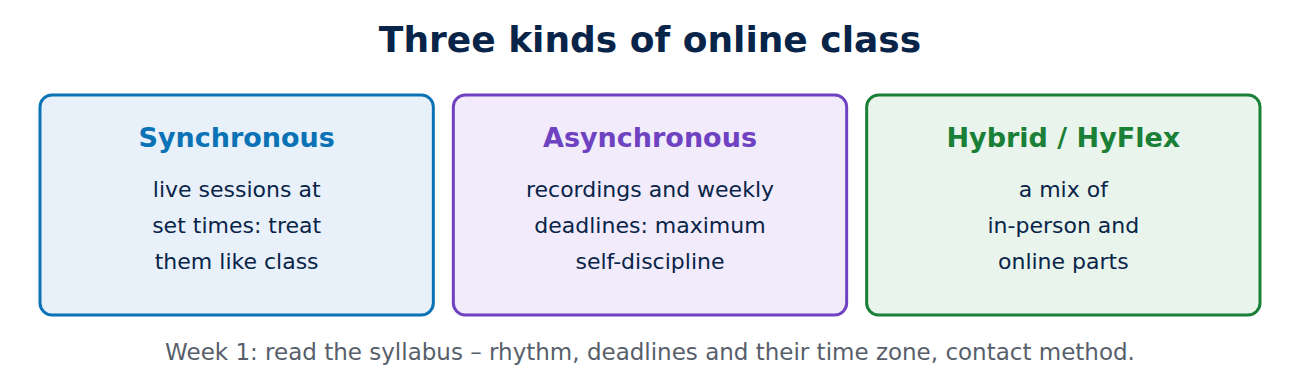
Know which kind of online class you are in
- Synchronous: live sessions at set times on Zoom, Teams or similar. Treat them like real class: on time, camera on if expected, notes ready.
- Asynchronous: recorded lectures, readings and weekly deadlines, no live meetings. Maximum flexibility, maximum need for self-discipline.
- Hybrid or HyFlex: a mix of in-person and online parts.
In the first week, read the syllabus closely: weekly rhythm, deadlines (and their time zone!), how participation is graded, exam rules and the instructor’s preferred contact method.
1. Build a weekly schedule
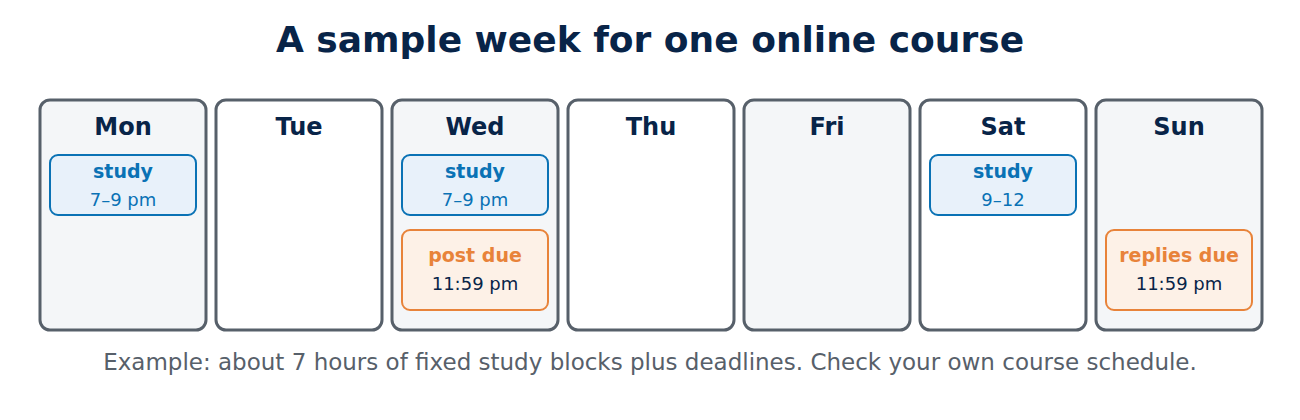
A common rule of thumb is about three hours of work per credit hour each week: one hour of class time plus two hours outside class. For a three-credit online course, where the online lectures replace class time, that is roughly nine hours per week. Block most of these hours in your calendar like appointments, for example Monday and Wednesday evenings plus Saturday morning. Put every deadline into your calendar with a reminder two days before. Many online courses have the same weekly rhythm (for example discussion post by Wednesday, replies by Sunday); build your schedule around it.
2. Create a study space
Choose a place you use for studying only, with a reliable internet connection, a headset and as few distractions as possible. If home is noisy, use the campus or public library. Close social media and put your phone out of reach during study blocks; focus modes or website blockers help.
3. Engage actively
- Watch lectures actively: take notes (for example with the Cornell method), pause to summarize, and avoid watching everything at 2x the night before the quiz.
- Participate in discussions with real substance; see how to write a discussion post.
- Test yourself after each module with practice questions or flashcards.
- Do the readings before the lecture when possible; it makes the lecture much easier to follow.
4. Communicate with your instructor
Online instructors cannot see confused faces. Introduce yourself in the first week, attend virtual office hours at least once, and ask early when something is unclear. Write clear, polite messages with the course name in the subject line; see how to email a professor. If you face a problem such as illness, work changes or technology failure, tell the instructor before the deadline, not after.
5. Connect with classmates
Isolation is a real risk in online learning. Join or start a study group on the course forum, Discord or WhatsApp, and meet on video before exams. Classmates help with motivation, explain things differently and make group projects easier; see group project tips.
6. Use the support services
Online students usually have access to the same services as campus students: online tutoring, the writing center, library databases and research help through chat, tech support, counseling and disability services. Find the links in the first week, so you know where to go when you need them.
7. Handle online exams
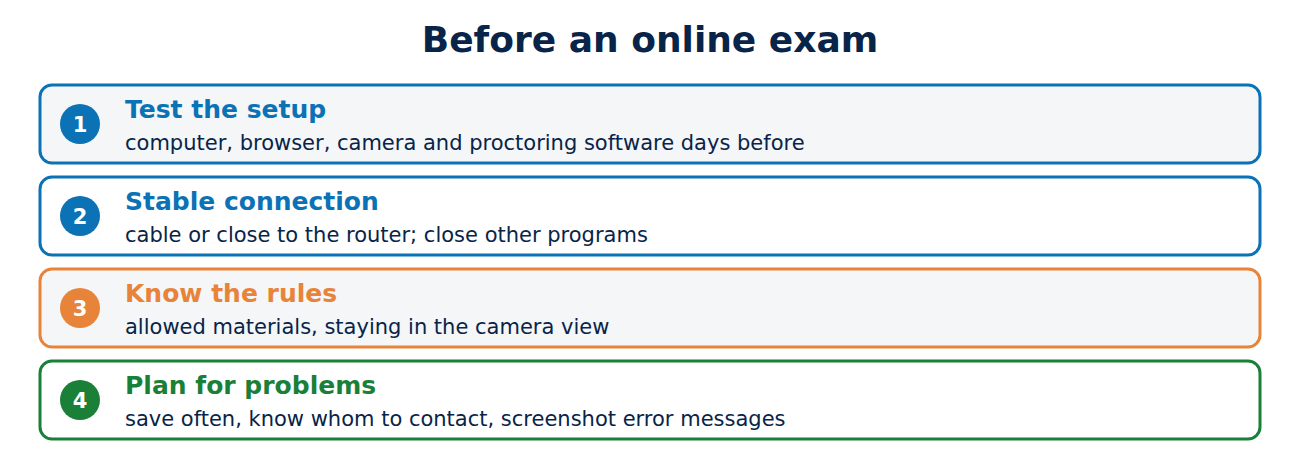
- Test your computer, browser, camera and proctoring software (for example Respondus LockDown Browser or Proctorio) before the exam day.
- Use a wired connection or sit close to the router, and close other programs.
- Know the rules: what materials are allowed, whether you can leave the camera view.
- Save answers regularly and know whom to contact if the connection drops; take a screenshot of error messages as proof.
8. Stay motivated
- Set a small weekly goal and reward yourself when you reach it.
- Track progress visibly, for example with a checklist per module.
- Use the Pomodoro technique on low-motivation days: just start one 25-minute block.
- Remember your reason: the job, the degree, the skills. Write it on a sticky note on your screen.
Struggling with getting started? How to stop procrastinating. Considering a full online program? Check whether the university is accredited and read are online degrees worth it?
Conclusion
Online classes reward structure. Know the course format and deadlines, block fixed study hours, set up a distraction-free study space, engage actively with lectures and discussions, and stay in contact with instructors and classmates. Use the online support services, prepare your tech before exams, and keep motivation up with small goals and visible progress.
Sources and further reading
- Studying 101: study smarter, not harder (UNC Learning Center)
- Online Learning Consortium

















Recent Comments