
A rhetorical analysis essay does not ask whether you agree with a speech, an article or an ad. It asks how the author tries to persuade: which strategies they use, why, and how well those strategies work for the intended audience. It is a core assignment in first-year composition and AP English Language. This guide explains the rhetorical situation, ethos, pathos and logos, and a step-by-step method from reading the text to writing the essay.
Analysis, not summary or opinion
Three things a rhetorical analysis is not:
- a summary of what the text says;
- your opinion on the topic (“I agree that school uniforms are good”);
- a list of devices without explanation (“the author uses a metaphor”).
Instead, you make claims like: “By opening with her own experience as a nurse, the author builds credibility with skeptical parents before presenting statistics.”
Step 1: map the rhetorical situation
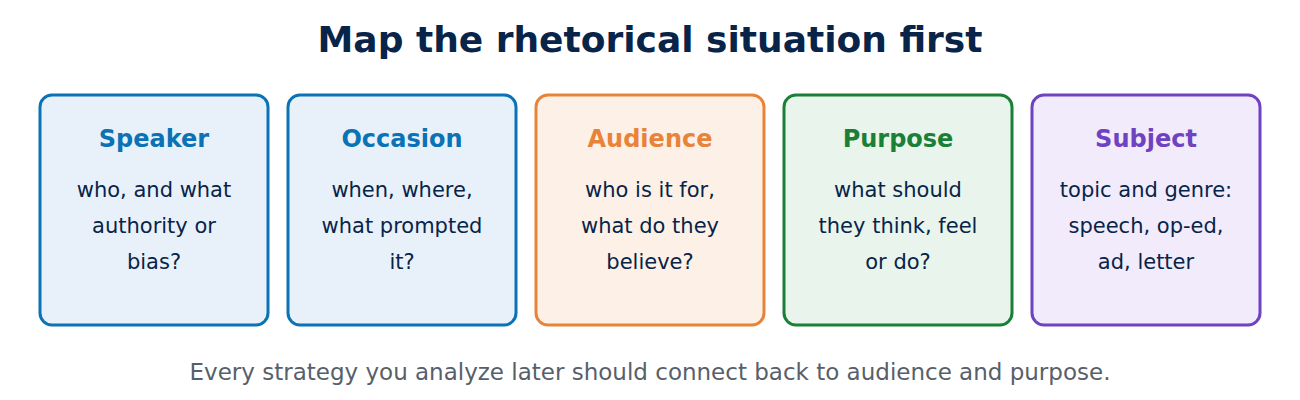
Before looking at strategies, answer these questions (often remembered as SOAPS or similar acronyms):
- Speaker: who is the author, and what gives them authority or bias?
- Occasion and context: when and where was it written, and what event prompted it?
- Audience: who is it for? What do they already believe?
- Purpose: what does the author want the audience to think, feel or do?
- Subject and genre: what is it about, and in what form (speech, op-ed, ad, letter)?
Every strategy you analyze later should connect back to audience and purpose.
Step 2: identify the appeals
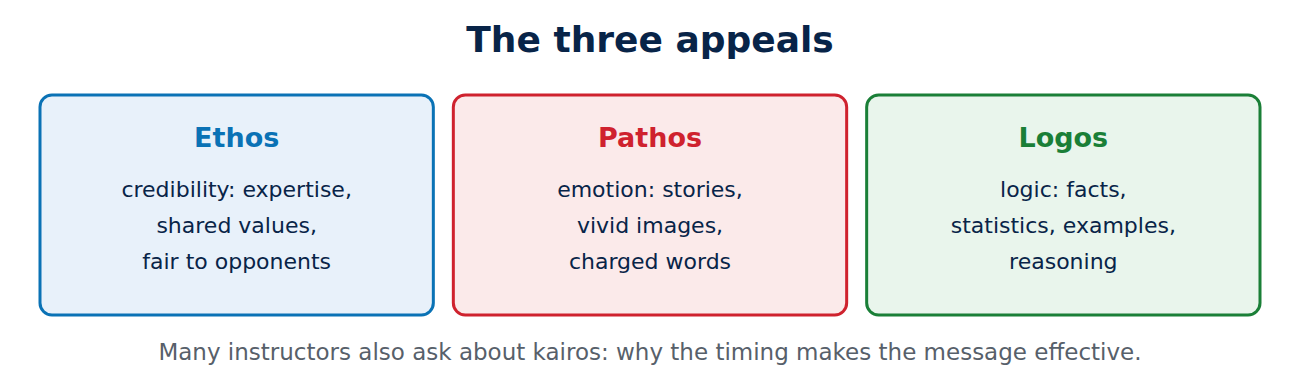
- Ethos (credibility): expertise, experience, shared values, fair treatment of opponents, a trustworthy tone.
- Pathos (emotion): stories, vivid images, emotionally charged words, appeals to hope, fear, pride or anger.
- Logos (logic): statistics, facts, examples, cause and effect reasoning, comparisons, the structure of the argument.
Many instructors also look at kairos: why the timing makes the message effective.
Step 3: look at style and structure
Beyond the appeals, notice choices such as:
- Diction: formal or casual words, technical terms, loaded words (“scheme” instead of “plan”).
- Syntax: short punchy sentences, long lists, questions, repetition and parallel structure (“We shall fight on the beaches, we shall fight on the landing grounds…”).
- Figurative language: metaphors, analogies, allusions to history, religion or popular culture.
- Organization: what comes first and last, where the counterargument appears, how the ending calls to action.
- Visuals in ads or infographics: color, placement, faces, fonts.
Step 4: write an analytical thesis
A strong thesis names the author, the purpose, the main strategies and their effect on the audience: “In his 1963 ‘Letter from Birmingham Jail’, Martin Luther King Jr. answers clergy who called his protests ‘unwise and untimely’ by establishing shared religious authority, contrasting their patience with the daily injustice Black Americans face, and logically dismantling the idea of waiting, to persuade moderate readers that direct action is necessary.”
Step 5: organize the body
- By strategy: one paragraph each for ethos, pathos and logos. Simple, but can become a checklist.
- Chronologically: follow the text from beginning to end, showing how strategies build on each other. Often more insightful, especially for speeches.
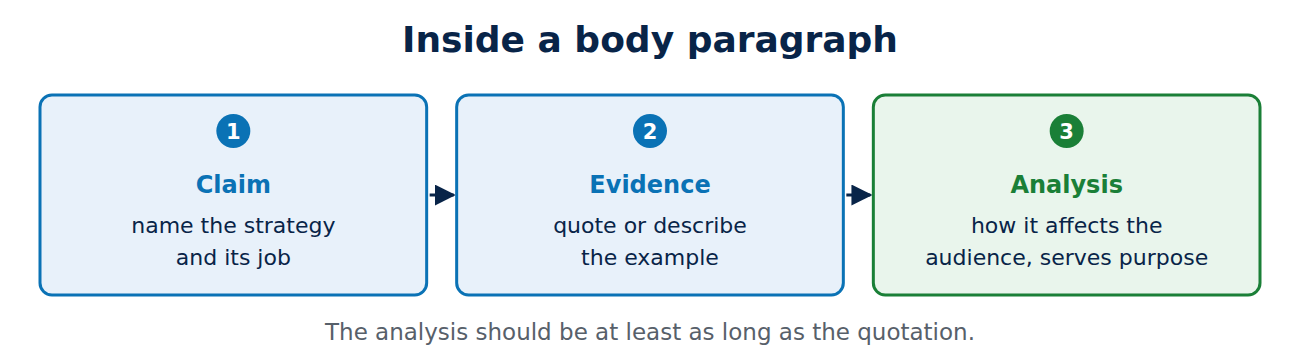
In each paragraph: state the strategy (claim), quote or describe the example (evidence), and explain how it affects the audience and serves the purpose (analysis). The analysis should be at least as long as the quote.
Useful verbs for analysis
Replace “uses” and “says” with precise verbs: establishes, emphasizes, contrasts, evokes, appeals to, undermines, concedes, reinforces, juxtaposes, invites, challenges, frames.
Introduction and conclusion
Introduce the text, the author and the context in two or three sentences, then give your thesis. In the conclusion, explain the overall effect and, if you can, why the strategies were or were not effective for that audience, or what the text shows about persuasion in its time. Do not just repeat your paragraphs.
Common mistakes
- Arguing for or against the author’s position.
- Naming devices without explaining their effect.
- Ignoring the audience: a strategy is only effective for someone.
- Quoting long passages without analysis.
- Writing in the first person (“I think the author…”) when the assignment expects an academic voice.
Related guides: how to write an argumentative essay, how to write a literary analysis essay and how to write a summary.
Conclusion
Map the speaker, occasion, audience and purpose; identify ethos, pathos and logos plus style and structure; write a thesis that links the strategies to their effect on the audience; and organize by strategy or chronologically. Each body paragraph needs claim, evidence and analysis, with precise verbs and no personal opinion on the topic.
Sources and further reading
- The rhetorical situation (Purdue Online Writing Lab)
- Argument (UNC Writing Center)
- Letter from Birmingham Jail (University of Pennsylvania African Studies Center)



















Recent Comments