
In online and hybrid courses, discussion boards often replace classroom participation, and they can count for a significant part of your grade. Yet many posts are rushed, generic or simply restate the reading. A thoughtful post takes little extra time, earns better grades and turns the discussion into something you actually learn from.
This guide shows how to write a strong initial discussion post, how to reply to classmates in a meaningful way, and how to manage discussion deadlines in online classes.
What instructors look for
Most discussion rubrics reward the same things:
- Answering the prompt fully, including every part of a multi-part question.
- Using course materials: readings, lectures and sometimes outside sources, with citations.
- Critical thinking: analysis, examples and your own position, not just summary.
- Engagement: substantive replies that move the discussion forward.
- Clear writing and meeting the deadlines and length requirements.
How to write the initial post
- Read the prompt and the rubric carefully. Note the word count, number of sources and deadline.
- Do the reading first. Take quick notes on the points that relate to the prompt.
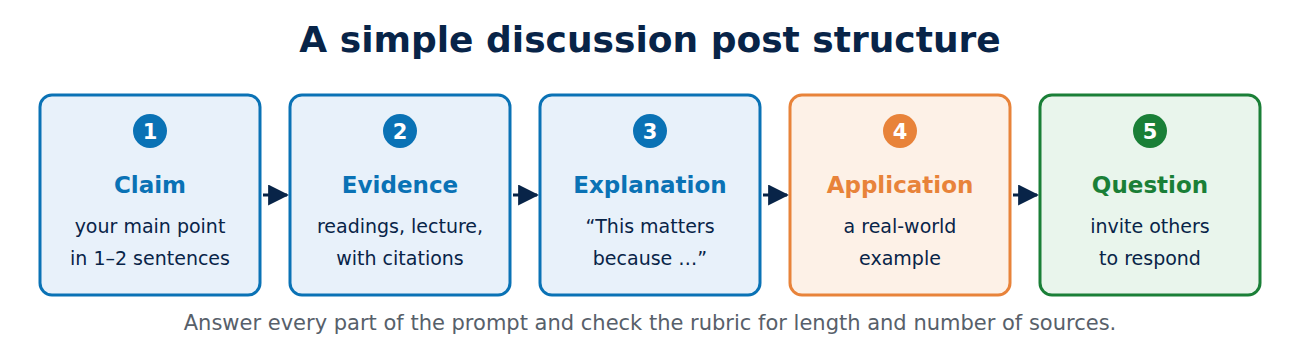
- Start with your main point: one or two sentences that answer the question directly.
- Support it: two or three reasons or examples, with evidence from the readings and citations.
- Add your own angle: a real-world example, a connection to another reading, a personal or professional experience that relates.
- End with a question that invites others to respond.
- Proofread before posting; many platforms do not allow edits after replies.
A simple post structure
- Claim: “I think the most important factor in X is Y.”
- Evidence: “Smith (2024) found that… In the lecture, we saw that…”
- Explanation: “This matters because…”
- Application: “In my own workplace, …”
- Question: “Do you think this would also apply to…?”
Typical length: 200–300 words for an initial post, unless the instructor says otherwise.
How to reply to classmates
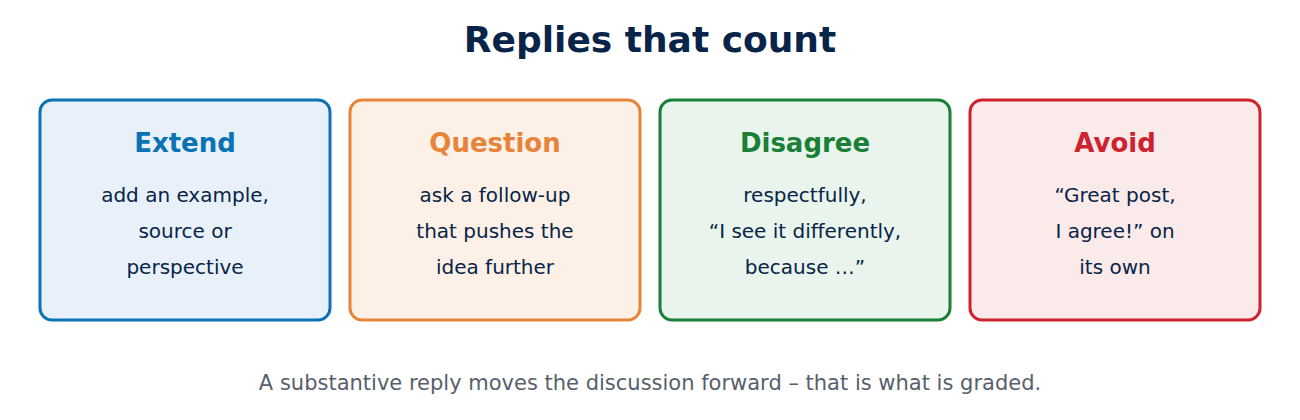
“Great post, I agree!” earns no points. Substantive replies do one or more of these:
- Extend: add an example, source or perspective that builds on their point.
- Question: ask a follow-up that pushes the idea further.
- Respectfully disagree: “I see it differently, because…”, with evidence.
- Connect: link their idea to a reading or to another classmate’s post.
Address the person by name, refer to a specific point in their post, and aim for 75–150 words per reply.
Netiquette
- Be respectful, especially when you disagree; criticize ideas, not people.
- Write in full sentences, without text-message abbreviations or all caps.
- Assume good intentions; tone is easy to misread in writing.
- Do not share classmates’ posts outside the course.
Citing in discussion posts
Even short posts need citations when you use someone else’s ideas or words. Use the course’s required style, usually APA or MLA, with an in-text citation and a short reference list at the end. See our APA guide and how to avoid plagiarism.
Managing discussion deadlines
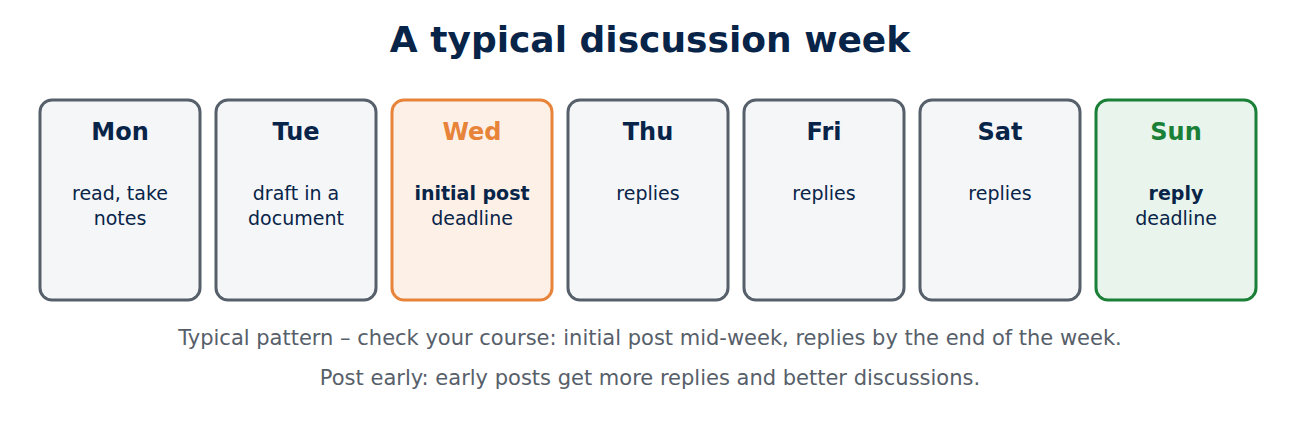
- Most online courses set an initial post deadline mid-week and reply deadlines at the end of the week. Put both in your calendar.
- Post early: early posts get more replies and more meaningful discussions.
- Draft in a document first, so a browser crash does not erase your work.
- Block fixed times each week, as for an in-person class; see time management tools and strategies.
Considering an online program? See are online degrees worth it.
Frequently asked questions
How long should a discussion post be?
Usually 200 to 300 words for the initial post and 75 to 150 words for each reply, unless your instructor sets other limits. Quality matters more than length: answer every part of the prompt and support your point with the readings.
Can I use “I” in a discussion post?
Yes. Discussion posts are less formal than essays, and sharing your own view or experience is often expected. Keep the tone academic and support opinions with evidence.
How many sources should I cite?
Follow the rubric. Many instructors expect at least one course reading in the initial post; outside sources should be credible and cited in the course style.
Conclusion
A strong discussion post answers the prompt directly, supports your point with course readings and citations, adds your own example and ends with a question. Replies should extend, question, respectfully challenge or connect ideas, with specific references to your classmate’s post. Read the rubric, post early, draft offline, and treat the discussion board as a real conversation.
Sources and further reading
- Academic Writing (Purdue Online Writing Lab)
- Tips and Tools (The Writing Center, University of North Carolina at Chapel Hill)



















Recent Comments