
Writing to a professor can feel more stressful than it should. How formal should you be? What do you put in the subject line? Is it rude to follow up? A clear, polite e-mail gets a faster answer and leaves a good impression, which matters later when you need an extension, a recommendation letter or a research position.
This guide gives you a simple structure, templates for the most common situations, and the mistakes to avoid.
Before you write: check first
- Read the syllabus and the course website. Many questions about deadlines, formats and grading are answered there, and professors notice when you have not looked.
- Ask a classmate or the teaching assistant for simple organizational questions.
- Consider office hours for questions that need a conversation, such as feedback on a draft or a difficult topic.
- Use your university e-mail account, not a personal one. It is more professional, and messages from outside addresses may land in spam.
The structure of a good e-mail
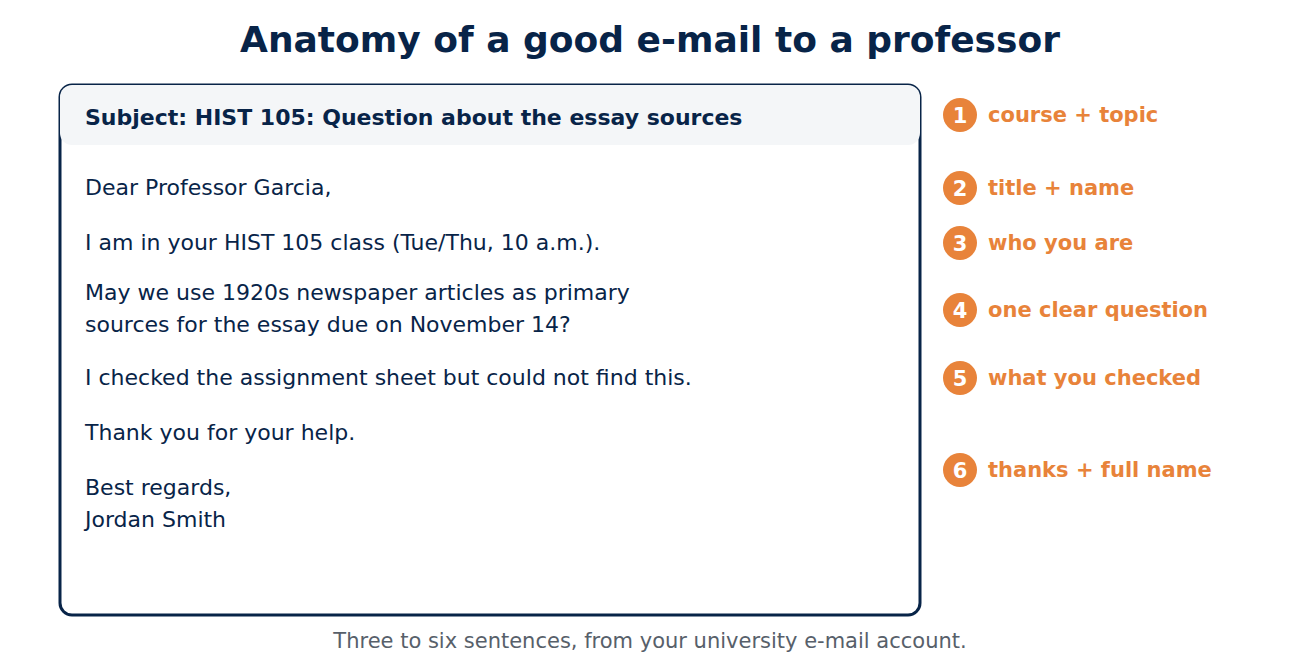
- A clear subject line with the course and the topic: “BIO 210: Question about lab report 3”.
- A polite greeting with the correct title: “Dear Professor Lee,” or “Dear Dr. Lee,”. If you are not sure, “Professor” is a safe choice in the US. Avoid “Hey” and first names unless they asked you to use them.
- Who you are: your name, the course and the section or meeting time, because professors teach many students.
- Your question or request, briefly and specifically, with any context needed.
- What you have already done, for example “I checked the syllabus and the course page”.
- A polite closing: “Thank you for your time,” followed by “Best regards,” and your full name.
Keep it short: three to six sentences are enough for most e-mails.
Template: asking a question about an assignment
Subject: HIST 105: Question about the essay sources
Dear Professor Garcia,
I am in your HIST 105 class (Tuesday/Thursday, 10 a.m.). For the essay due on November 14, may we use newspaper articles from the 1920s as primary sources, or should all sources come from the library databases? I checked the assignment sheet but could not find this.
Thank you for your help.
Best regards,
Jordan Smith
Template: asking for an extension
Subject: PSY 201: Request for an extension on the research report
Dear Dr. Patel,
I am in your PSY 201 class (section 3). I have been ill since Monday and have a doctor’s note. Would it be possible to submit the research report, due on Friday, by next Wednesday instead? I have finished the literature review and the method section and can send them now if that helps.
Thank you for considering my request.
Best regards,
Alex Chen
Ask as early as possible, before the deadline, give a short honest reason and propose a specific new date. You do not need to share private medical details.
Template: missing a class
Subject: ECON 101: Absence on November 3
Dear Professor Brown,
I will miss class on Tuesday, November 3, because of a family emergency. I will get the notes from a classmate and review the slides. Is there anything else I should do to catch up, such as an in-class exercise?
Best regards,
Sam Taylor
Template: asking for a recommendation letter
Ask at least three to four weeks before the deadline, ideally in person or in office hours first, then follow up by e-mail with everything the professor needs: the program or job, the deadline, how to submit the letter, your CV or resume, and a few points about your work in their class. Make it easy to say yes, and accept a no gracefully.
Following up
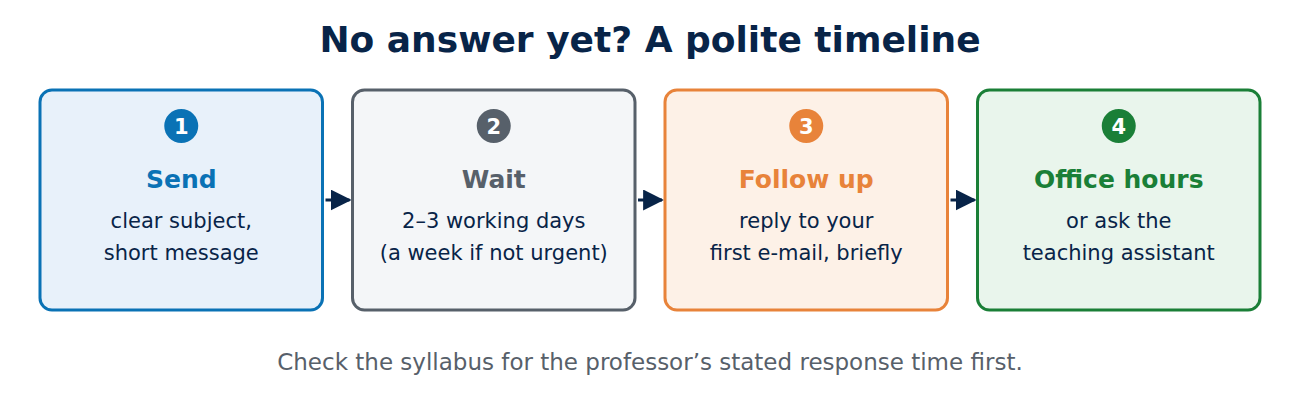
Professors receive many e-mails. If you get no answer after about two to three working days (or one week for non-urgent questions), send a short, polite follow-up by replying to your first message: “I wanted to follow up on my e-mail below about…”. Avoid e-mailing late at night and expecting an answer by morning, and check the syllabus for the professor’s stated response time.
Mistakes to avoid
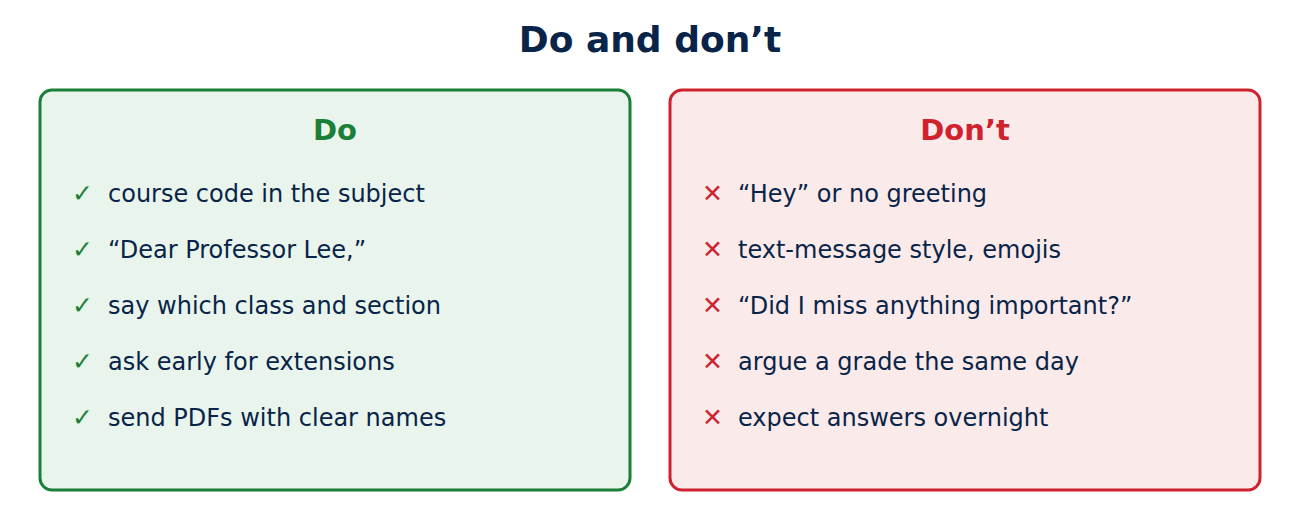
- No subject line or a vague one like “Question”.
- Text-message style: abbreviations, emojis, all lowercase.
- Demanding tone: “I need my grade changed” instead of “Could you help me understand my grade?”.
- Asking what you missed as “Did I miss anything important?” (to a professor, everything in class is important). Ask what you should review instead.
- Arguing about grades by e-mail right after they come out. Wait a day, reread the feedback, then ask for a meeting.
- Attachments without explanation, or files in unusual formats. Send PDFs and name them clearly.
Thank-you e-mails
A short thank-you after a professor helped you, wrote a recommendation or gave extra feedback is always appreciated, and it helps you build a relationship that can matter for internships and graduate school. Tell them later how it worked out, too.
Conclusion
A good e-mail to a professor has a clear subject line with the course, a polite greeting with the right title, a short introduction, a specific question or request, and a friendly closing with your full name. Check the syllabus first, ask early for extensions, keep the tone respectful, and follow up politely after a few days if you do not hear back.
Sources and further reading
- Effective E-mail Communication (The Writing Center, University of North Carolina at Chapel Hill)







Recent Comments