
Your heart races, your hands are sweaty, and the answer you knew perfectly last night is suddenly gone. Test anxiety is common among high school and college students, and it can lower grades even when you have studied well. The good news: it responds well to simple, research-based strategies, before and during the exam. This guide explains what test anxiety is, what helps, and when to get support.
What test anxiety is
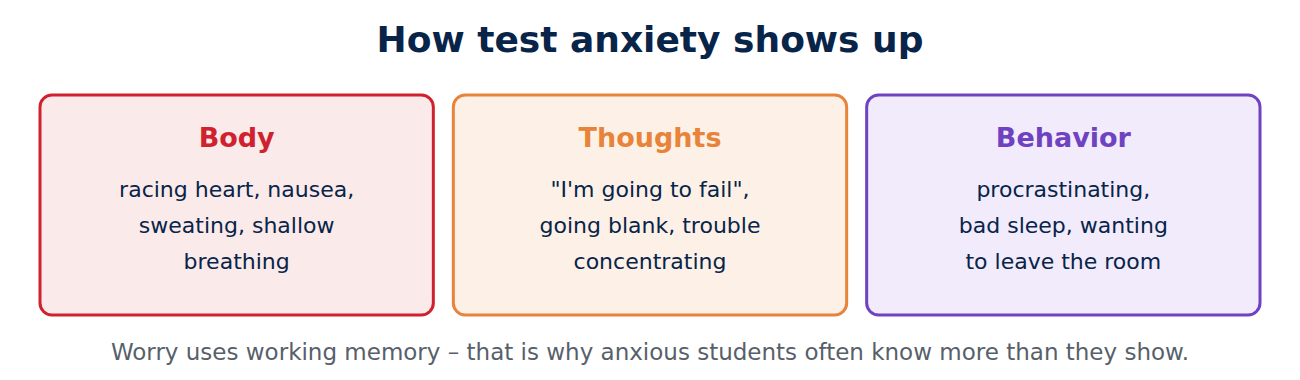
Some nervousness before an exam is normal and even useful: it keeps you alert. Test anxiety is when the stress becomes so strong that it interferes with your performance. It shows up in three ways:
- Body: racing heart, shallow breathing, nausea, headache, sweating, trembling.
- Thoughts: “I’m going to fail”, “everyone else knows this”, going blank, trouble concentrating.
- Behavior: procrastinating, avoiding studying, sleeping badly, wanting to leave the exam room.
Worry takes up working memory, the mental space you need to solve problems. That is why anxious students often know more than their grades show.
Before the exam: prepare to feel confident
- Prepare early and actively. Solid preparation is the strongest protection against anxiety. Practice tests under exam conditions make the real exam feel familiar. See how to prepare for final exams.
- Practice retrieval. Studies suggest that practicing recall makes memories more resistant to stress, so self-testing helps twice.
- Plan the logistics: know the room, time and what to bring, so there are no surprises.
- Sleep, eat, move: sleep deprivation and too much caffeine amplify anxiety. A walk or workout the day before lowers tension.
- Write your worries down. In experiments by Ramirez and Beilock (2011), students who spent ten minutes writing about their exam worries right before a test performed better than those who did not.
Reframe the nerves
Instead of trying to calm down completely, tell yourself the racing heart means your body is getting ready: “I’m excited”, not “I’m scared”. Research on “anxiety reappraisal” suggests this can improve performance. Also challenge catastrophic thoughts: “If this exam goes badly, what will actually happen? One grade, which I can make up.”
During the exam: calm your body, focus your mind
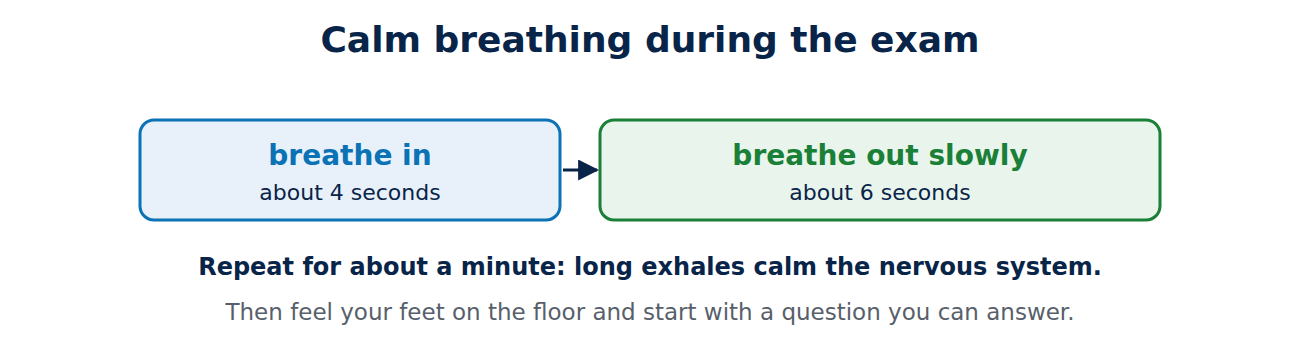
- Breathe slowly: breathe in for about four seconds and out for about six, for a minute. Long exhales calm the nervous system.
- Ground yourself: feel your feet on the floor, notice five things you can see. It brings attention back to the room.
- Read the whole exam first and start with a question you can answer. Early success builds confidence.
- If you go blank, skip the question, write down anything related (a formula, a keyword, a diagram), and come back later. Memories often return once you relax.
- Ignore others: people handing in early are not necessarily doing better.
- Use positive self-talk: “I’ve prepared for this. One question at a time.”
After the exam
Do something relaxing and avoid long post-exam comparisons of answers. When you get the results, review what went well and what to change in your preparation, without judging yourself.
Accommodations and support
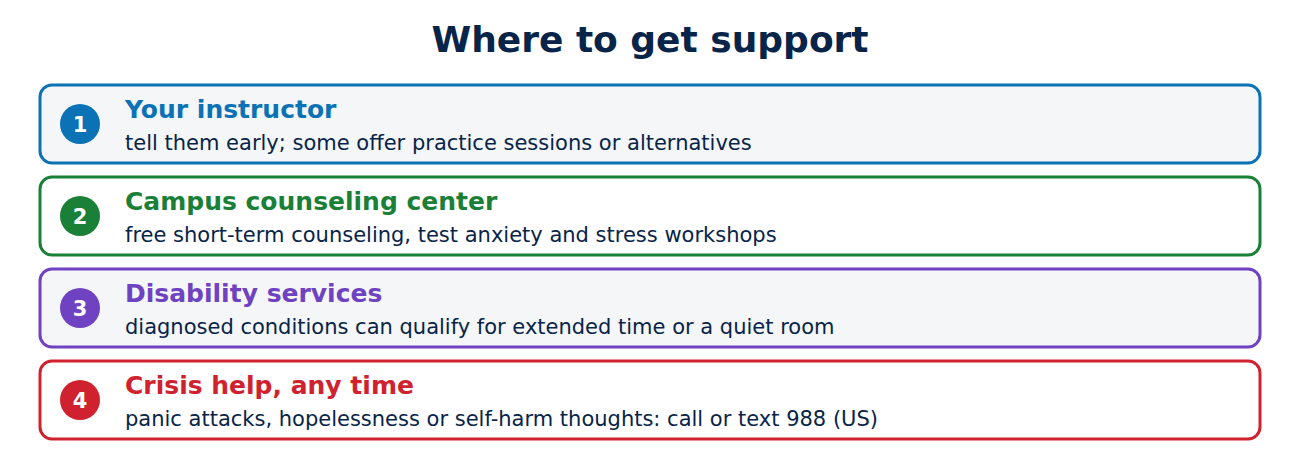
- Talk to your instructor early if anxiety affects your exams; some offer alternatives or practice sessions.
- Counseling center: most colleges offer free short-term counseling and workshops on test anxiety and stress. Cognitive behavioral therapy (CBT) techniques are particularly effective.
- Disability services: if you have a diagnosed anxiety disorder, ADHD or another condition, you may qualify for accommodations such as extended time or a quieter room. Register early in the semester; documentation can take time.
- Get help right away if anxiety comes with panic attacks, constant worry beyond exams, or thoughts of self-harm. In the US, you can call or text 988 (Suicide & Crisis Lifeline) at any time.
More on stress in college: how to deal with stress in college. Presentations make you nervous too? How to give a presentation.
Conclusion
Test anxiety is common and treatable. Prepare early with practice tests, sleep and move, write down your worries before the exam and reframe nerves as energy. During the exam, breathe slowly, start with an easy question and skip what blocks you. If anxiety is severe or persistent, your counseling center and disability services can help.
Sources and further reading
- Ramirez and Beilock (2011): Writing about testing worries boosts exam performance in the classroom (Science)
- Smith et al. (2016): Retrieval practice protects memory against acute stress (Science)
- Test anxiety (UNC Learning Center)
- 988 Suicide & Crisis Lifeline
















Recent Comments