
Most students study the way they were shown at school: reread the notes, highlight the important parts, and hope it sticks. Research in cognitive psychology shows that these are among the least effective methods. The good news is that the techniques that work best are not harder or more time-consuming; they are just different.
This guide brings together six evidence-based study techniques, explains why they work, and shows how to combine them into a weekly routine. Each technique links to a detailed guide.
What the research says
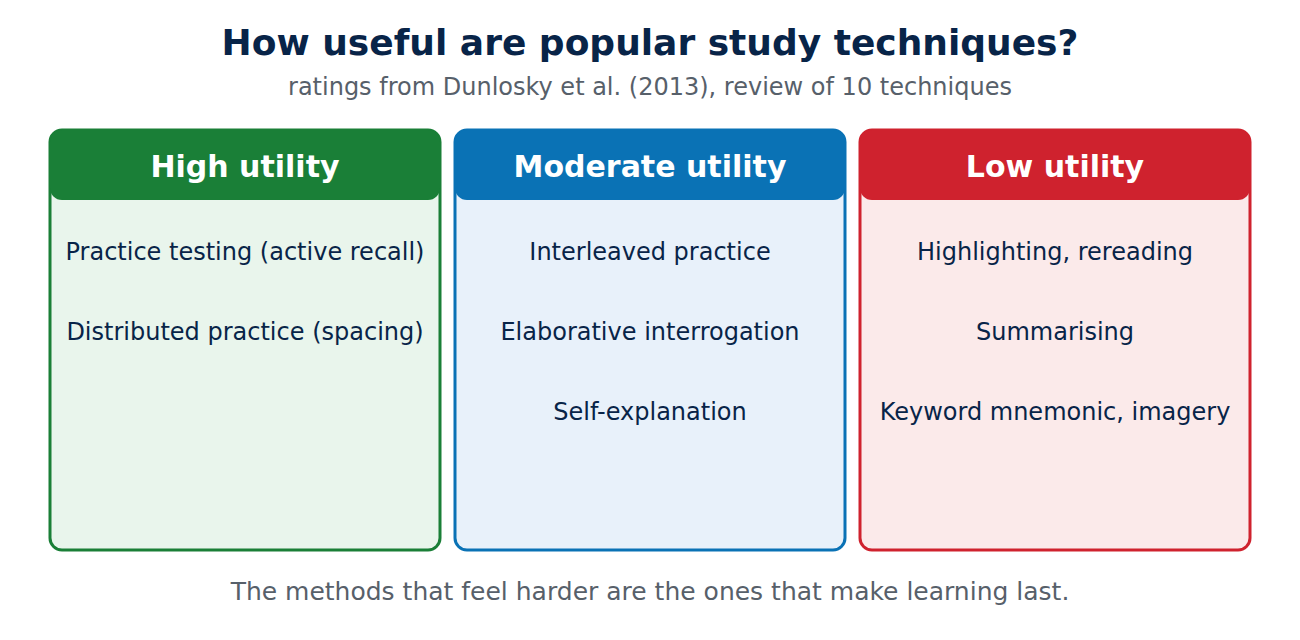
In 2013, a team of psychologists led by John Dunlosky reviewed hundreds of studies on ten popular learning techniques and rated how useful each one is for students. Their review, published by the Association for Psychological Science, reached a clear result:
- High utility: practice testing (active recall) and distributed practice (spaced repetition).
- Moderate utility: interleaved practice, elaborative interrogation (asking “why?”) and self-explanation.
- Low utility: highlighting, rereading, summarising, the keyword mnemonic and imagery for text learning.
Rereading and highlighting are not useless, but they create a feeling of familiarity without building strong memories. The techniques below make your brain work harder, and that effort is what makes learning last.
1. Active recall: test yourself
Instead of reading your notes again, close them and try to remember: answer questions, write down everything you know about a topic, or work through flashcards and past exam papers. Each time you retrieve information, the memory becomes stronger. Read the full guide: Why Active Recall Beats Rereading for Long-Term Mastery.
2. Spaced repetition: spread it out
Cramming the night before can get you through an exam, but most of it is gone a week later. Reviewing the same material several times with growing gaps (after one day, three days, a week, two weeks) leads to much better long-term memory with the same total study time. Flashcard apps such as Anki plan the intervals for you. Details: The Power of Spaced Repetition.
3. Interleaving: mix topics and problem types
When you practise maths, it is tempting to do twenty problems of the same type in a row. Interleaving means mixing different types: a derivative, then an integral, then a word problem. It feels harder and slower, but it trains the skill exams actually test: recognising which method a problem needs. Interleaving works especially well in maths, physics and other subjects with many similar-looking problem types.
4. Elaboration: ask why and how
For every new fact, ask yourself why it is true and how it connects to what you already know. Why does a higher interest rate slow inflation? How does this enzyme relate to the one from last week? Connecting ideas builds a network of knowledge that is easier to recall and apply.
5. The Feynman technique: explain it simply
Explain a topic in plain words, as if to someone who has never heard of it. Wherever you get stuck or need jargon, you have found a gap to fix. This combines active recall with self-explanation. Step-by-step guide: The Feynman Technique: Learn Anything by Explaining It Simply.
6. Focused blocks: the Pomodoro technique
The best techniques do not help if you are distracted every two minutes. Working in fixed blocks of about 25 minutes with short breaks makes it easier to start and to stay focused, and it gives your day a clear structure. Guide: The Pomodoro Technique for Studying.
Putting it together: a weekly routine
- After each lecture (same day): spend 10 minutes writing down the main points from memory, then check your notes and fill the gaps. Turn key facts into flashcards.
- Every day: one or two Pomodoro blocks of flashcard review with spaced repetition.
- Every week: for each course, explain the week’s main concept with the Feynman technique, and solve a mixed set of practice problems from this and earlier weeks.
- Before exams: do past papers under exam conditions instead of rereading. Every mistake shows you what to revise.
Also look after the basics: sleep consolidates what you learned during the day, and regular exercise and breaks help concentration. A planner helps you keep the routine, see AI study planners and our list of the best apps for university students.
Why the better methods feel worse
Effective techniques often feel less pleasant than rereading. Testing yourself shows you what you do not know, and interleaved problems are slower at first. Psychologists call this “desirable difficulty”: the extra effort is a sign that you are learning, not that the method fails. Trust the results on your next test, not the feeling during the study session.
Conclusion
To study effectively, test yourself instead of rereading, spread your reviews over time, mix problem types, ask why, explain topics in simple words, and work in focused blocks. These methods do not need more time than the old habits, but they lead to much better results in exams and long after.
Sources and further reading
- Improving Students’ Learning With Effective Learning Techniques (Dunlosky et al., 2013, Association for Psychological Science)
- Spaced repetition (Wikipedia)
- Testing effect (Wikipedia)















Recent Comments