
For graduate school applications, the personal statement or statement of purpose is often the only place where the admissions committee hears your voice. Grades and test scores show what you have done; the statement shows why you want this degree, what you will bring to the program and where you are going. A focused, specific statement can lift a good application into the “admit” pile.
This guide explains the difference between a personal statement and a statement of purpose, offers a proven structure, and gives tips on tailoring, tone and editing.
Personal statement vs statement of purpose
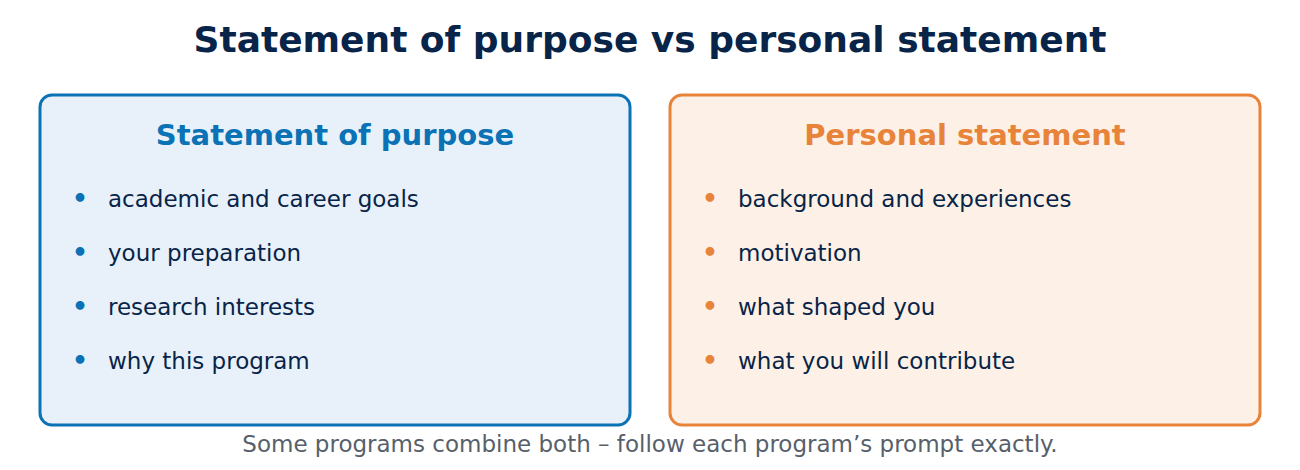
- Statement of purpose: focuses on your academic and professional goals, your preparation (courses, research, work) and why this program fits. Common for research master’s and PhD programs.
- Personal statement: often more personal, about your background, experiences and motivation, and sometimes how you would contribute to the community. Common for professional programs, law and medical school, and some scholarships.
Many programs use the terms loosely. Read each prompt carefully and answer exactly what it asks.
What admissions committees look for
- A clear sense of what you want to study and why.
- Evidence that you are prepared: research, coursework, work experience, skills.
- A good fit with the program: faculty, labs, resources, specializations.
- Maturity, motivation and the ability to write clearly.
A proven structure
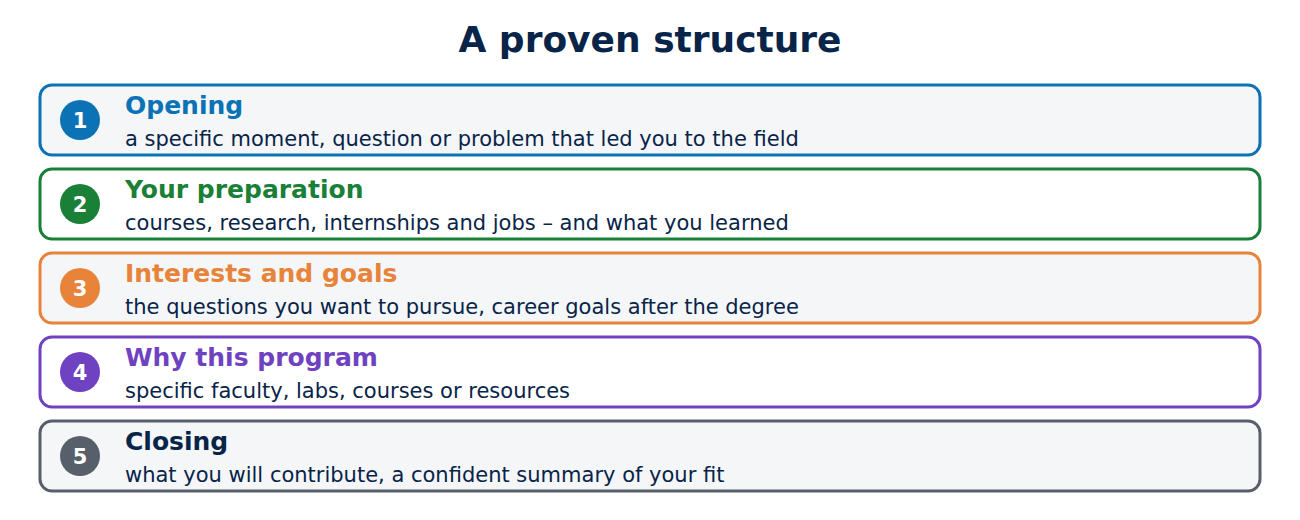
- Opening: a specific moment, question or problem that led you to the field, or a direct statement of your research interest. Avoid “Ever since I was a child…”
- Your preparation: the courses, research projects, internships or jobs that built your skills. Show what you did and learned, with concrete details.
- Your interests and goals: the questions or areas you want to pursue, and your career goals after the degree.
- Why this program: specific faculty, labs, courses, clinical placements or resources, and how they connect to your interests.
- Closing: what you will contribute and a confident summary of your fit.
Show, do not tell
“I am passionate about neuroscience” tells little. “In Dr. Rivera’s lab, I spent eight months analyzing sleep EEG data from 40 participants, and the unexpected pattern we found in older adults is the question I want to pursue” shows passion, experience and direction at once. The same principle applies to scholarship essays; see how to write a scholarship essay.
Tailor every statement
- Research each program: faculty profiles, recent publications, lab websites and the curriculum.
- Name one to three faculty members whose work fits your interests, and explain the connection briefly.
- Adapt the “why this program” section completely for each application; the rest can share a core.
- Double-check program names; a statement that names the wrong university is an instant red flag.
Addressing weaknesses
If your application has a weak spot, such as a low semester GPA or a gap, address it briefly and factually if the program allows, ideally in an optional statement: what happened, what changed and evidence of your current ability. Do not make excuses or let it dominate the statement.
Length, tone and format
- Follow the limit exactly, typically 500–1,000 words or one to two pages.
- Professional but personal; first person is expected.
- Clear structure with one main idea per paragraph.
- Standard font, consistent formatting, no typos.
Editing and feedback
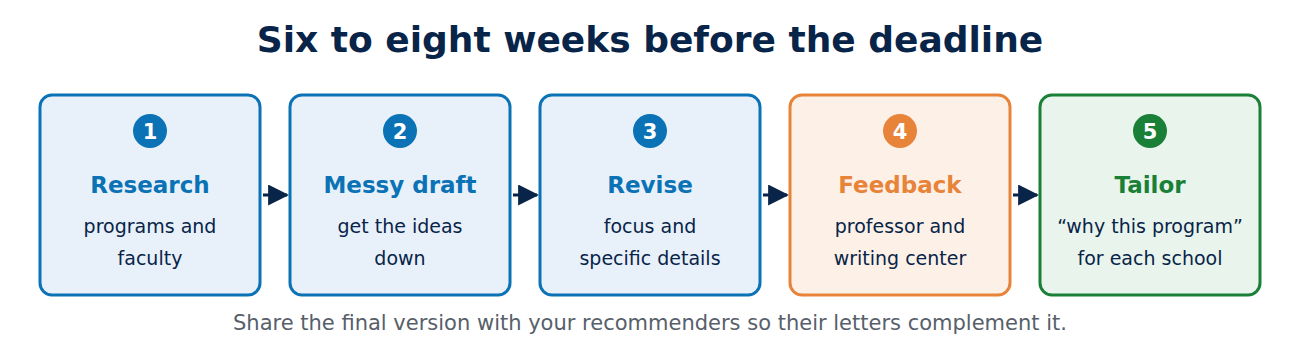
- Start at least six to eight weeks before the deadline.
- Write a messy first draft, then revise for focus and specific details.
- Ask a professor in your field and your campus writing center for feedback.
- Read it aloud and proofread on paper.
- Share your statement with your recommenders so their letters complement it; see how to ask for a letter of recommendation.
Use AI tools only as your program allows; committees value an authentic voice, and many applications ask you to confirm the statement is your own work.
Frequently asked questions
How long should a graduate school personal statement be?
Typically 500 to 1,000 words or one to two pages. Always follow each program’s limit exactly.
Should I mention professors by name?
Yes, if their research genuinely fits your interests. Name one to three faculty members and explain the connection briefly.
Can I reuse my statement for several programs?
You can reuse a core, but rewrite the opening and the “why this program” section for every application.
Conclusion
A strong graduate school statement explains what you want to study, shows your preparation with specific examples, sets out your goals and explains why this particular program fits. Answer the prompt exactly, tailor the program section for every application, address weaknesses briefly, stay within the length and get feedback from professors and the writing center. For your research ideas, see also how to write a research proposal.
Sources and further reading
- Writing the Personal Statement (Purdue Online Writing Lab)
- Application Essays (The Writing Center, University of North Carolina at Chapel Hill)

















Recent Comments