
A literary analysis essay makes an argument about a novel, short story, poem or play: not what happens, but what it means and how the author creates that meaning. It is the standard essay in English and literature classes, from high school to graduate seminars. This guide shows how to read actively, find an arguable thesis, use quotations well and structure the essay, with the conventions instructors expect.
What your essay should do
Your reader has read the text. They do not need a plot summary; they want an interpretation they had not fully seen before, supported by evidence from the text. A good literary analysis answers a “how” or “why” question: How does Fitzgerald use the green light in The Great Gatsby? Why does Shakespeare give Lady Macbeth her sleepwalking scene in prose?
Step 1: read actively
Read the text at least twice, the second time with a pen or notes app. Mark:
- Patterns and repetition: images, colors, words or situations that recur.
- Surprises and tensions: a character acting against type, a change in tone, an ending that does not resolve.
- Literary elements: point of view, narrator reliability, setting, symbolism, structure, imagery, figurative language, meter and rhyme in poetry.
- Your questions: “Why is the narrator so vague here?” Questions are the seeds of a thesis.
Step 2: develop an arguable thesis
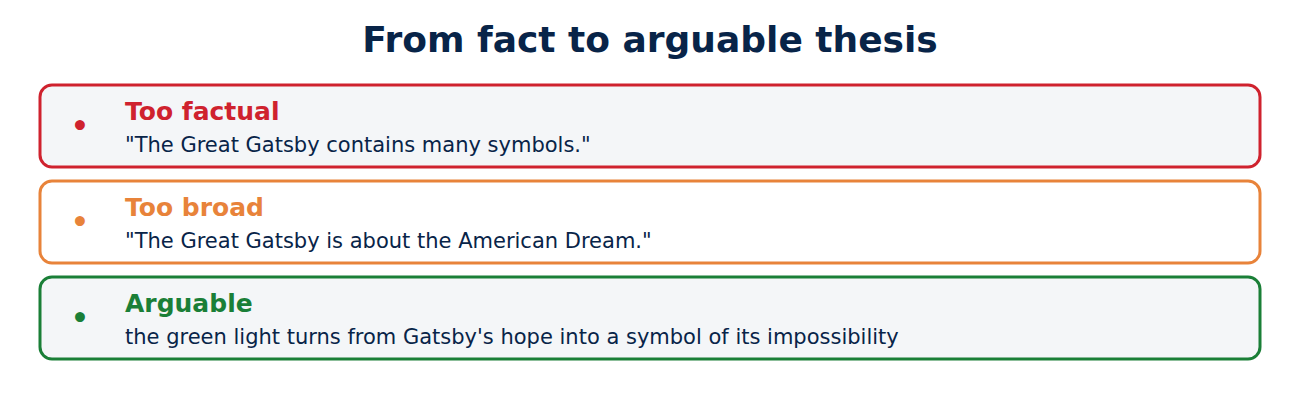
A literary thesis is a claim that someone could disagree with and that needs evidence from the text:
- Too factual: “The Great Gatsby contains many symbols.”
- Too broad: “The Great Gatsby is about the American Dream.”
- Arguable: “Fitzgerald turns the green light from a symbol of Gatsby’s hope into a symbol of its impossibility, suggesting that the American Dream depends on a future that never arrives.”
Your thesis may change while you write. That is normal; revise it at the end so it matches what your essay actually argues.
Step 3: gather and analyze evidence
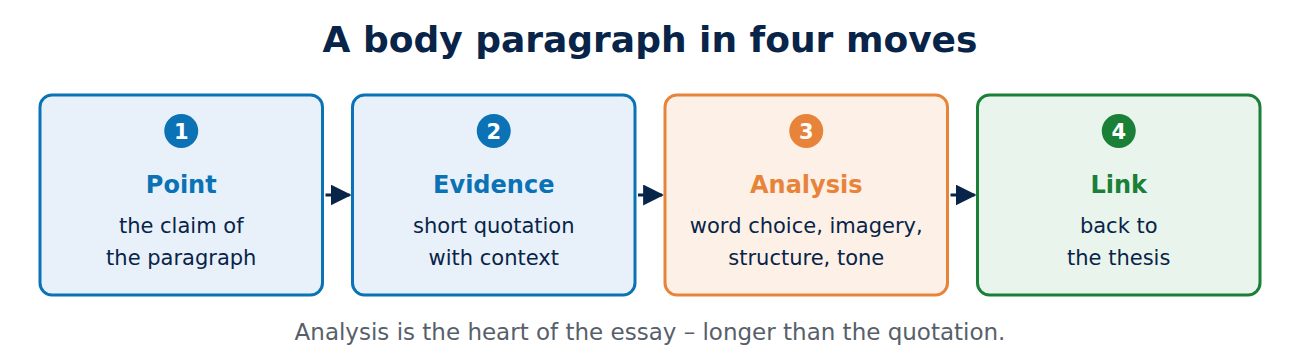
Collect short quotations and specific details that support your claim. For each one, ask: what does this word, image or choice do? How does it support my thesis? The analysis is the heart of the essay, and it should be longer than the quotation. A common pattern:
- Point: the claim of the paragraph.
- Evidence: a quotation or detail, introduced with context.
- Analysis: close reading of word choice, imagery, structure or tone.
- Link: how it supports the thesis.
Step 4: structure the essay
- Introduction: a hook connected to the text, the author and title, the necessary context and your thesis.
- Body paragraphs: each develops one part of your argument. Organize by idea, not by plot order, unless the development over time is your point.
- Counter-reading (optional): acknowledge another interpretation and show why yours explains more.
- Conclusion: show why your reading matters: what it reveals about the work, its time or a broader theme.
Conventions instructors expect
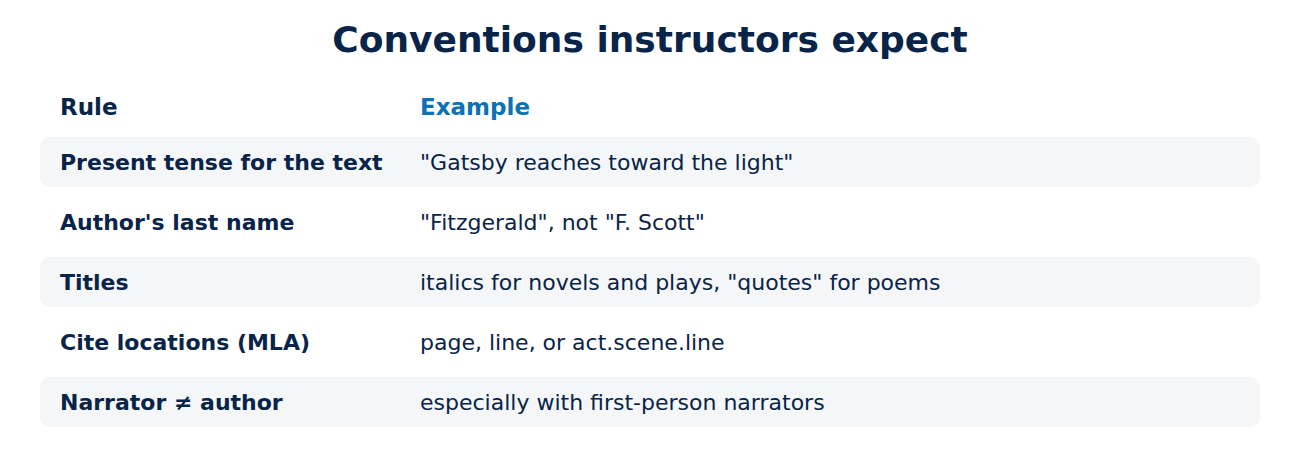
- Present tense for events in the text: “Gatsby reaches toward the light”, not “reached”.
- Author’s last name after the first mention: “Fitzgerald”, not “F. Scott” or “Scott”.
- Titles: italics for novels and plays, quotation marks for short stories and poems.
- Integrate quotations into your sentences, and cite page numbers, lines for poems, or act, scene and line for plays, usually in MLA style; see the MLA citation guide.
- Do not confuse author and narrator, especially with first-person narrators.
- Use literary terms precisely, but only when they add meaning.
Using secondary sources
Some assignments ask you to use literary criticism. Find scholarly articles through your library (MLA International Bibliography or JSTOR), and use critics to support, extend or argue against, never to replace your own reading. Cite them carefully; see how to avoid plagiarism.
Common mistakes
- Retelling the plot instead of analyzing.
- “Quote dumping”: quotations with no explanation.
- Claiming what the author “intended” without textual evidence; focus on what the text does.
- Generalizations about “society” or “humans” that the text does not support.
Related: how to write a rhetorical analysis essay and how to write a strong paragraph.
Conclusion
Read twice and mark patterns, tensions and questions; turn a “how” or “why” question into an arguable thesis; and support each body paragraph with short quotations and close analysis that is longer than the quote. Write in the present tense, organize by idea, follow MLA conventions and show in the conclusion why your reading matters.
Sources and further reading
- Writing about literature (Purdue Online Writing Lab)
- Literature (fiction) (UNC Writing Center)
- Poetry explications (UNC Writing Center)



















Recent Comments