
A part-time job in college pays for rent, food and books, reduces student loans and builds experience for your resume. The challenge is finding one that fits around classes and does not hurt your grades. This guide covers where to find student jobs, on-campus versus off-campus work, Federal Work-Study, how many hours make sense, and how to apply successfully even without experience.
On-campus or off-campus?
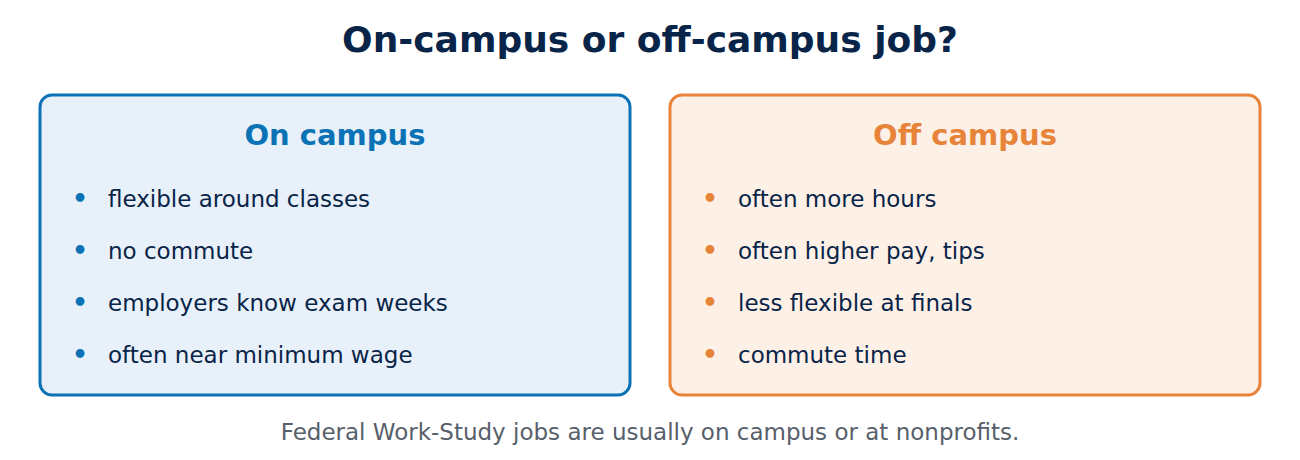
- On-campus jobs (library, dining hall, rec center, admissions, labs, IT help desk, tutoring center): flexible around class schedules, no commute, employers who understand exam weeks, and sometimes quiet time to study during shifts. Pay is often close to the local minimum wage.
- Off-campus jobs (retail, restaurants, cafés, offices, childcare, delivery): often more hours and higher pay, sometimes tips, but less flexibility around exams and breaks.
- Remote and freelance work (tutoring online, writing, design, social media, data entry): flexible, but watch for scams; see how to make money as a student.
Federal Work-Study
If you are a US student with financial need, your financial aid offer may include Federal Work-Study (FWS): a part-time job, usually on campus or at a nonprofit, where the government pays part of your wage. You earn at least the minimum wage and are paid directly, like in any other job. To be considered, you must file the FAFSA and indicate interest in work-study. Having work-study in your offer does not guarantee a job: you still need to apply for positions, so start early in the semester.
How many hours should you work?
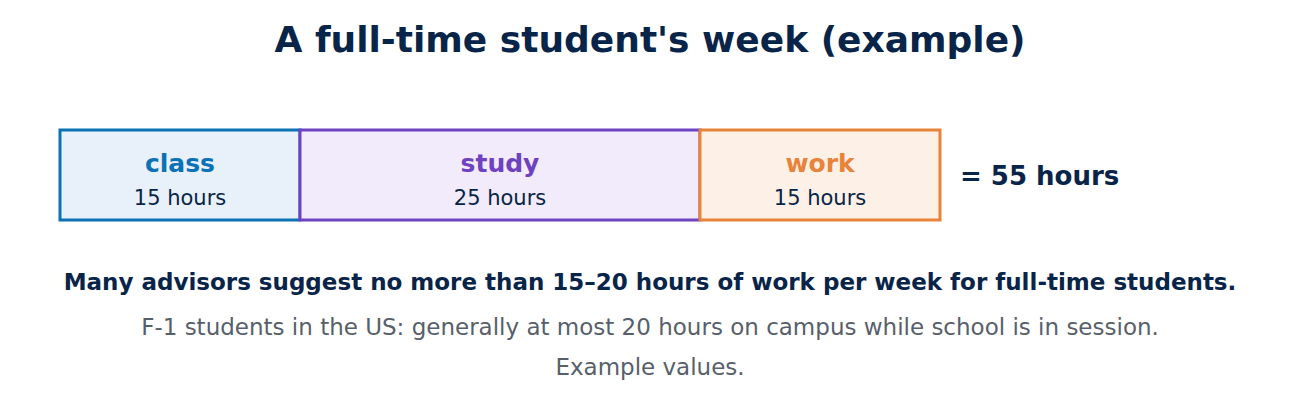
Many advisors suggest no more than 15–20 hours per week for full-time students; above that, studies have linked work to lower grades and higher dropout risk. Some research suggests moderate work of about 10–15 hours, especially on campus, is fine or even helpful for time management. Count your weekly hours honestly: about 15 hours in class plus 20–30 hours of study leaves limited room. International students in the US on an F-1 visa are generally limited to 20 hours per week of on-campus work during the semester; check with your international student office before taking any job.
Where to find jobs
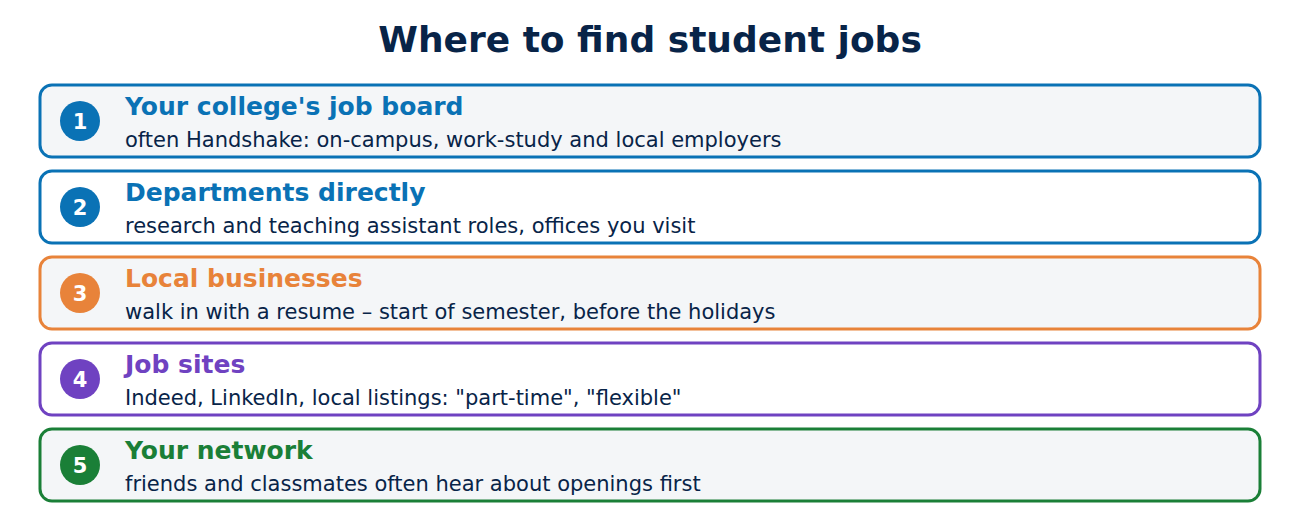
- Your college’s job board (often Handshake or the career center website): on-campus jobs, work-study positions and student-friendly local employers.
- Departments directly: ask professors about research or teaching assistant roles, and offices you visit often.
- Local businesses: walk in with a short resume, especially at the start of the semester and before the holiday season.
- Job sites: Indeed, LinkedIn and local listings; filter for “part-time” and “flexible schedule”.
- Your network: friends, roommates and classmates often know about openings before they are posted.
Apply even without experience
- A one-page resume with education, skills, volunteering, school projects and any babysitting or family-business work counts. See how to write a resume with no experience.
- List your availability clearly, by day and time, and when it changes (finals, breaks).
- Show reliability: employers of student workers care most that you show up on time and communicate.
- Prepare for the interview: common questions include “Why do you want this job?” and “How will you balance work and classes?”; see common interview questions for students.
- Follow up with a short thank-you email: how to write a thank-you email after an interview.
Choose jobs that build your future
When you can choose, look for jobs related to your major or career goals: a lab assistant for science majors, a campus newspaper or communications office for media students, a tutoring center for future teachers. Even unrelated jobs build transferable skills such as customer service, teamwork and responsibility; describe them with results on your resume.
Balance work and school
- Give your employer your class and exam schedule at the start of each semester.
- Ask for fewer shifts during midterms and finals well in advance.
- Keep one or two evenings free of both work and study.
- If grades slip, reduce hours before it is too late; your degree is the long-term investment.
Know your rights and taxes
You are entitled to at least the federal, state or local minimum wage (whichever is highest), and to pay stubs showing deductions. You will fill out a W-4 form for tax withholding; students with low income often get most withheld tax back by filing a tax return. Keep your W-2 forms for that.
Conclusion
On-campus jobs offer flexibility and understanding employers; off-campus jobs often pay more. Check your financial aid offer for Federal Work-Study, keep work to about 15–20 hours per week, and search your college’s job board, departments and local businesses early in the semester. A simple resume, clear availability and reliability get you hired.
Sources and further reading
- Federal Work-Study jobs (Federal Student Aid, US Department of Education)
- Working in the United States as an F-1 student (Study in the States, DHS)
- Minimum wage (US Department of Labor)



















Recent Comments