
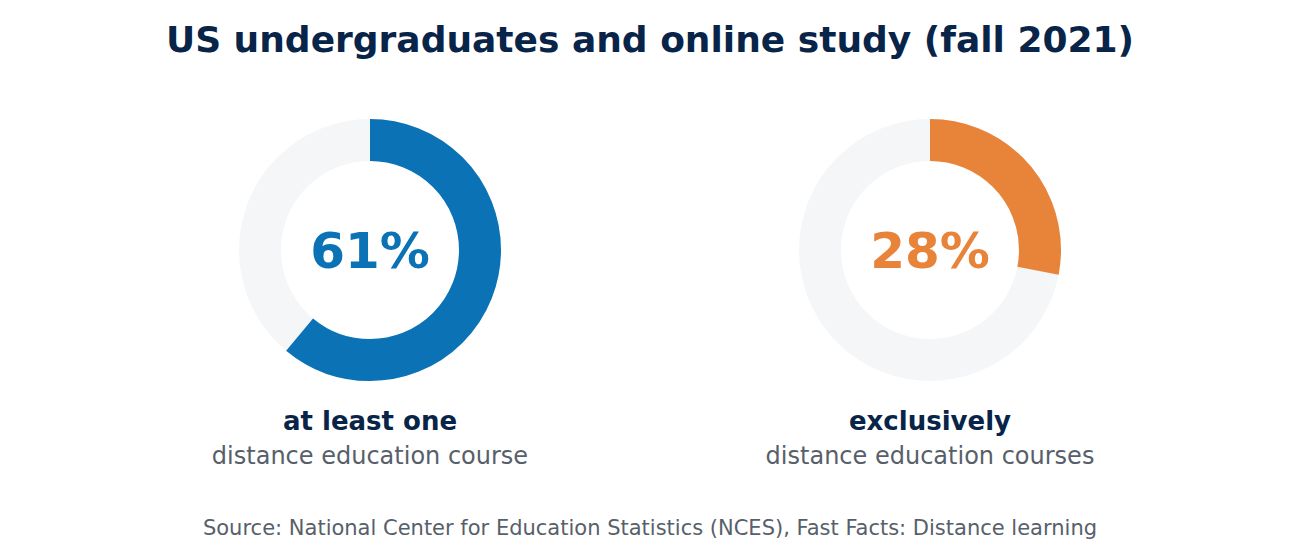
Online degrees used to have a reputation problem. Today, they are part of normal higher education: in the US, according to the National Center for Education Statistics, 61 percent of undergraduates took at least one distance education course in fall 2021, and 28 percent studied exclusively online. Major public and private universities now offer complete bachelor’s and master’s programs online.
So are online degrees worth it? For many students, yes, but only if the program is properly accredited, fits how you learn, and costs what it is worth. This guide explains how employers see online degrees, what they really cost, who they suit, and how to tell a good program from a bad one.
Are online degrees respected by employers?
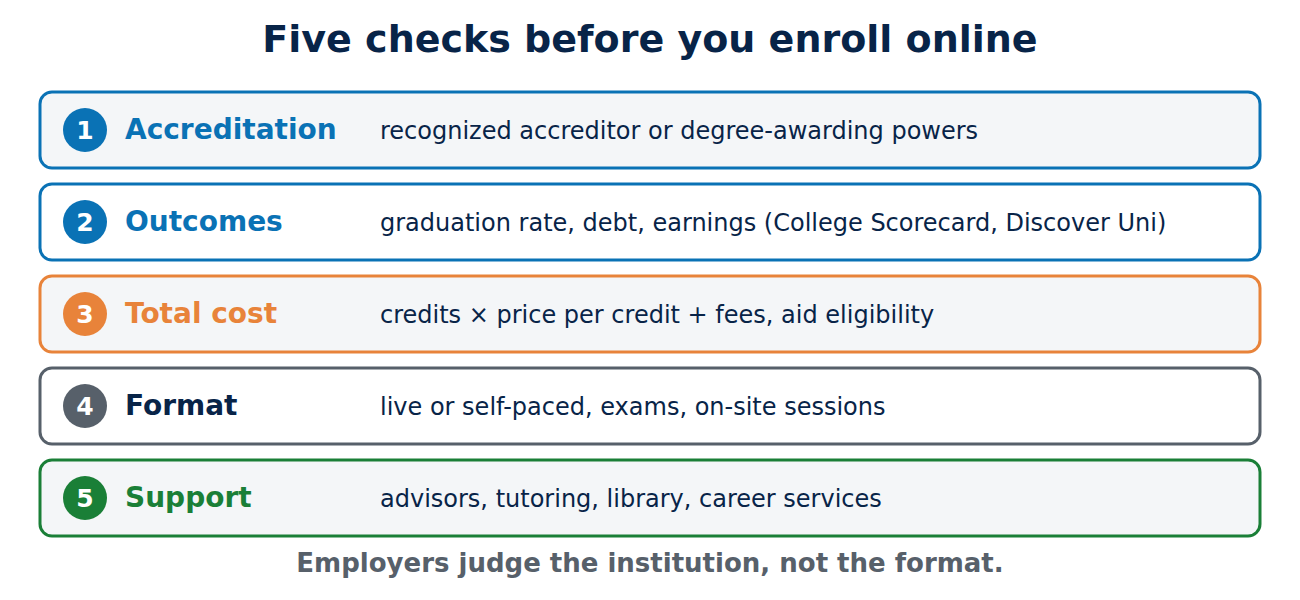
What employers care about is the institution and its accreditation, not the format. A degree from an accredited university is a degree from that university, and at most institutions the diploma and transcript do not say “online” at all. A bachelor’s from a well-known state university’s online program carries the same weight as one earned on its campus.
Problems arise with two kinds of providers:
- Unaccredited “universities” and diploma mills that sell degrees with little or no study. Their degrees are worthless and can damage your credibility. Learn how to spot them in our guide on how to check if an online university is accredited.
- Programs with weak outcomes: accredited, but with low completion rates, high debt and poor job results. These are legal, but often not worth the money.
What an online degree really costs
Online study is not automatically cheaper. Many universities charge the same tuition per credit online as on campus, and some add technology or distance-learning fees. The savings usually come from elsewhere:
- No relocation, rent or campus housing.
- No commuting, which saves both money and hours every week.
- Keeping your job: for many adult students, the biggest benefit is continuing to earn while studying part-time.
Compare the total cost of the degree (credits × price per credit + fees), not just the price per course. In the US, accredited online programs are usually eligible for federal student aid; check this before you enroll.
Who online degrees suit best
- Working adults who want to change career or move up without quitting their job.
- Parents and caregivers who need flexible hours.
- Students in rural areas or abroad, without a good university nearby.
- Self-motivated learners who can plan their week and work alone.
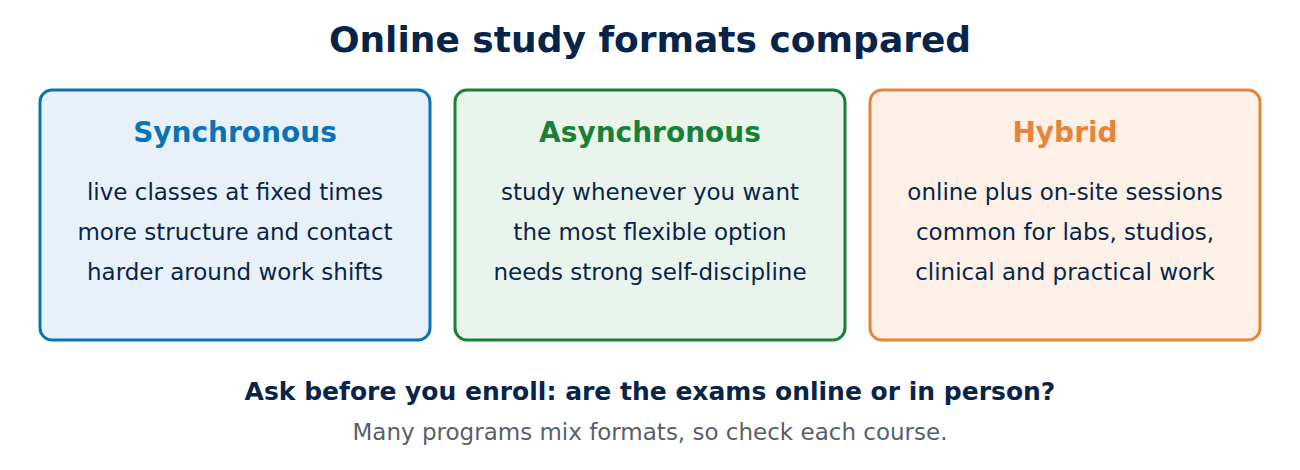
Online study is harder if you need a fixed daily structure to stay motivated, learn best through discussion in a room, or want the full campus experience. Fields with intensive lab, studio or clinical work also have limits online; many such programs are hybrid, with required on-site sessions.
Pros and cons at a glance
- Pros: flexibility in time and place, no relocation, often part-time options, the same degree as on campus at accredited universities, and practice with digital tools you will use at work.
- Cons: requires strong self-discipline, fewer spontaneous contacts with classmates and professors, a networking effort you have to make actively, and a risk of choosing a weak or predatory program if you do not check carefully.
How to check if an online program is good
- Accreditation: the institution must be accredited by a recognized body (in the US) or have degree-awarding powers (in the UK). Professional fields such as nursing, teaching or engineering may need additional program accreditation.
- Outcomes: look up graduation rates, typical debt and earnings. In the US, the Department of Education’s College Scorecard shows these figures; in the UK, Discover Uni shows student satisfaction and graduate outcomes.
- Format: are classes live at fixed times (synchronous) or available whenever you want (asynchronous)? Are there exams in person?
- Support: online students need advisors, tutoring, library access and career services just as much as campus students. Ask what is available.
- Transfer of credits: check how many of your previous credits count, and whether credits from this program would transfer elsewhere.
- Talk to graduates: find alumni on LinkedIn and ask about workload, teaching quality and jobs afterwards.
Be wary of aggressive sales calls, “limited-time” discounts and promises of a degree in a few months.
How to succeed in an online program
- Schedule study time like a class: fixed blocks in your calendar every week.
- Create a study space and turn off notifications during sessions.
- Participate actively in forums and live sessions; it builds the network that online students otherwise miss.
- Use proven study methods such as active recall and spaced repetition; see our guide on how to study effectively.
- Contact instructors early when you fall behind, not in the last week.
Where to start
Our country guides list established online options: online universities in the United States, in the United Kingdom and in Canada. Before you apply, verify each school’s accreditation and outcomes yourself, as described above.
Conclusion
An online degree is worth it when it comes from an accredited institution with good outcomes, costs what you can afford in total, and fits your life and learning style. Employers judge the university, not the format. Check accreditation, graduation rates and support before you enroll, plan your study time like a job, and an online degree can be one of the most flexible ways to move your career forward.
Sources and further reading
- Distance learning (Fast Facts) (National Center for Education Statistics)
- College Scorecard (US Department of Education)
- Discover Uni (UK)

















Recent Comments