
Finals week compresses a whole semester into a few days: several cumulative exams, papers due, little sleep and a lot of stress. Students who do well rarely study more hours in total; they start earlier, plan better and use study methods that actually stick. This guide gives you a step-by-step plan from three weeks out to the morning of the exam.
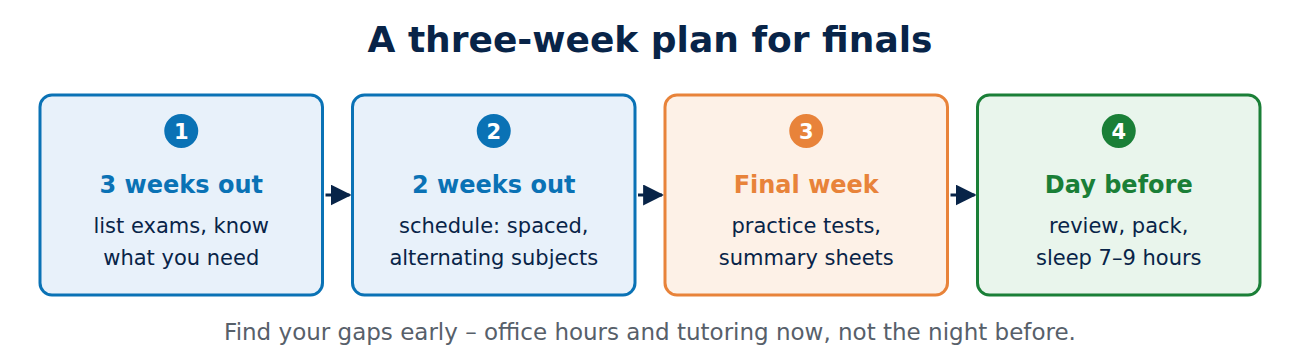
Three weeks before: get the overview
- List every exam and deadline with date, time, room, format (multiple choice, essay, problems, open book) and weight in your grade.
- Calculate what you need: your syllabus or learning platform shows your current grade. Knowing that you need a 70 % on the final to keep a B helps you divide your time sensibly; see how to calculate your GPA.
- Collect materials: lecture slides, notes, past quizzes, practice exams and the study guide. Ask the instructor what the final covers and how it is weighted between old and new material.
- Find the gaps: topics you missed or never understood. These need the most time and maybe office hours or tutoring now, not the night before.
Two weeks before: make a study schedule
Divide your available hours across subjects according to difficulty, weight and exam date. Plan 45–90 minute blocks with breaks, and alternate subjects rather than spending a whole day on one. Schedule reviews of each subject several times, not only once; spacing makes the material last. Leave buffer time for the unexpected. A step-by-step template is in how to make a revision timetable.
Use study methods that work
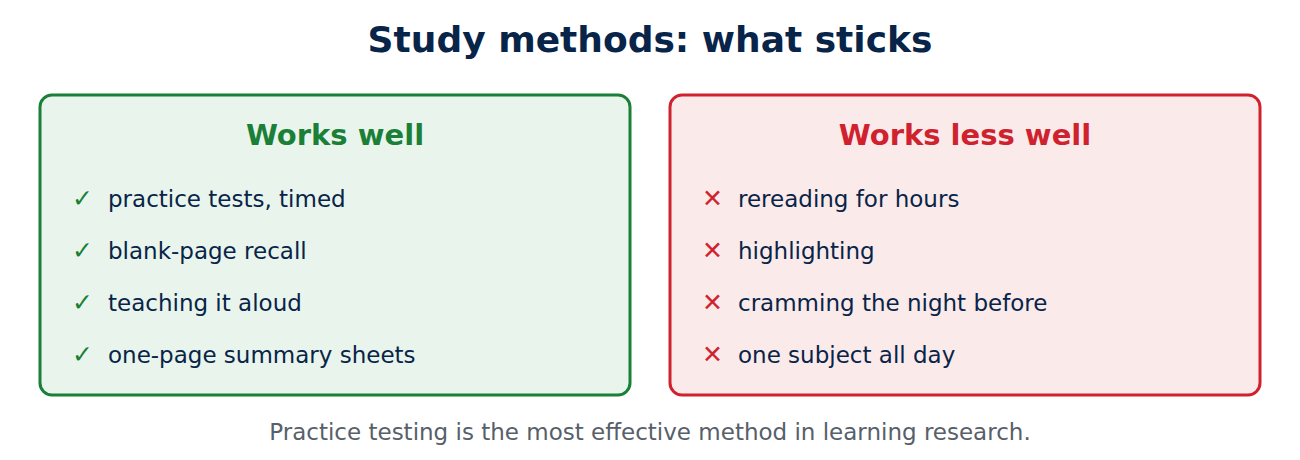
- Practice testing: do past exams and practice problems under timed conditions; quiz yourself with flashcards. This is the most effective method in learning research.
- Blank-page recall: write everything you remember about a topic, then check your notes and fill the gaps.
- Teach it: explain a concept to a friend or out loud, in simple words.
- Make a summary sheet per course (one or two pages) with key formulas, definitions and diagrams. Creating it is study; reviewing it the day before is efficient.
- Mix problem types in math and science, so you learn to recognize which method fits.
Avoid spending hours rereading and highlighting: it feels good but builds little recall. More techniques: how to memorize faster and how to study for a math exam.
Exam-specific strategies
- Multiple choice: learn to distinguish similar concepts; practice with questions, not just definitions.
- Essay exams: predict likely questions from the study guide and lecture themes, outline answers with a thesis and key evidence, and practice writing one under time pressure.
- Problem-based exams: work problems without looking at the solution first; keep an error log of mistakes.
- Open-book exams: they are often harder. Organize your notes with tabs and an index; you will not have time to learn during the exam.
Take care of the basics
- Sleep 7–9 hours, especially the night before an exam. Sleep consolidates memory; all-nighters lower performance. See sleep tips for students.
- Eat regular meals and drink water; keep caffeine moderate and avoid it late in the day.
- Move: a 20-minute walk improves mood and concentration.
- Limit distractions: put your phone in another room during study blocks or use focus modes.
- Take breaks and keep one small fun thing per day.
The day before and the morning of
- Review your summary sheet and the topics you find hardest. Do not try to learn new material late at night.
- Pack everything: student ID, pens, a permitted calculator with fresh batteries, water, a watch if phones are not allowed.
- Check the room and time again, and plan to arrive 10–15 minutes early.
- Eat a proper breakfast.
- Avoid last-minute panic conversations outside the exam room; they raise anxiety.
During the exam
- Read the instructions and scan the whole exam first.
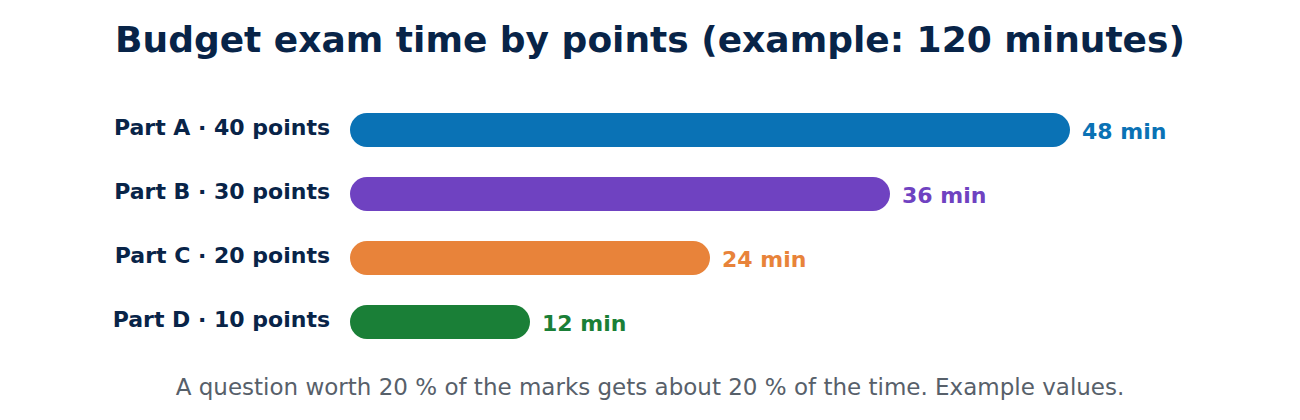
- Budget your time by points: a question worth 20 % of the marks gets about 20 % of the time.
- Start with what you know to build confidence; mark hard questions and return later.
- Show your work for partial credit.
- Use the last minutes to check answers and that nothing is left blank (if there is no penalty for guessing).
If nerves are a big problem, see how to deal with test anxiety.
Conclusion
Start three weeks out: list exams, know what you need, find your gaps and make a schedule with spaced, alternating sessions. Study with practice tests, recall and summary sheets instead of rereading, sleep properly, and go into each exam with a time plan. Finals become much more manageable when the work is spread over weeks instead of nights.
Sources and further reading
- Preparing for finals (UNC Learning Center)
- Dunlosky et al. (2013): Improving students’ learning with effective learning techniques (Psychological Science in the Public Interest)
- About sleep (Centers for Disease Control and Prevention)


















Recent Comments