
Why did the Roman Empire fall? What happens to students’ grades when they sleep less? How does social media affect political polarization? A cause and effect essay answers questions like these: it explains why something happened, what results it led to, or both. It is a common assignment in composition, history, economics and the sciences, and the same logic appears in lab reports and research papers. This guide explains the three structures, how to build a convincing causal chain and how to avoid the classic logic traps.
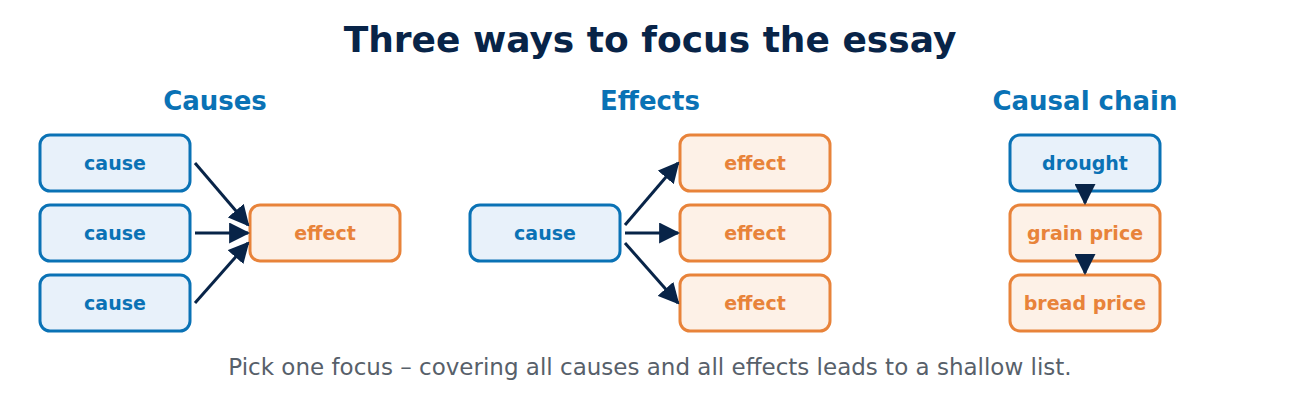
Three ways to focus the essay
- Causes: several causes lead to one effect. “Why do so many first-year students drop out?”
- Effects: one cause has several effects. “What are the effects of remote work on cities?”
- Causal chain: one event leads to the next, like dominoes. “A drought raises grain prices, which raises bread prices, which leads to protests.”
Pick one focus. Trying to cover all causes and all effects of a big event leads to a shallow list.
Step 1: choose a manageable topic
Good topics are specific and have evidence available. “The effects of technology” is too broad; “How smartphone use in class affects note-taking” can be handled in a few pages with real studies. Check your library databases early to see whether research exists.
Step 2: research the connections
The hardest part of a cause and effect essay is proving that one thing actually caused another. Look for:
- Experiments where researchers changed one factor and measured the result: the strongest evidence of causation.
- Studies that control for other factors, or several studies that point the same way.
- Expert analysis from historians, economists or scientists explaining the mechanism: how the cause produces the effect.
- Data over time, showing the effect followed the cause.
Step 3: write a causal thesis
Your thesis states the cause(s) or effect(s) and, ideally, which matters most. For example: “Rising tuition, inadequate academic advising and the need to work full time are the main reasons first-year students leave college, and of these, financial pressure has the strongest impact.” See how to write a strong thesis statement.
Step 4: organize the body
- Block by cause or effect: one body paragraph per cause or effect, each with evidence and explanation.
- Order of importance: usually from least to most important, so your strongest point comes last; or chronologically for a causal chain.
- Explain the mechanism: do not just say A causes B; say how. “Less sleep reduces memory consolidation, so students remember less of what they studied.”
- Use transition words that show causation: because, therefore, as a result, consequently, this led to, due to.
Each paragraph can follow claim, evidence, explanation, as in argumentative essays.
Avoid the classic logic traps
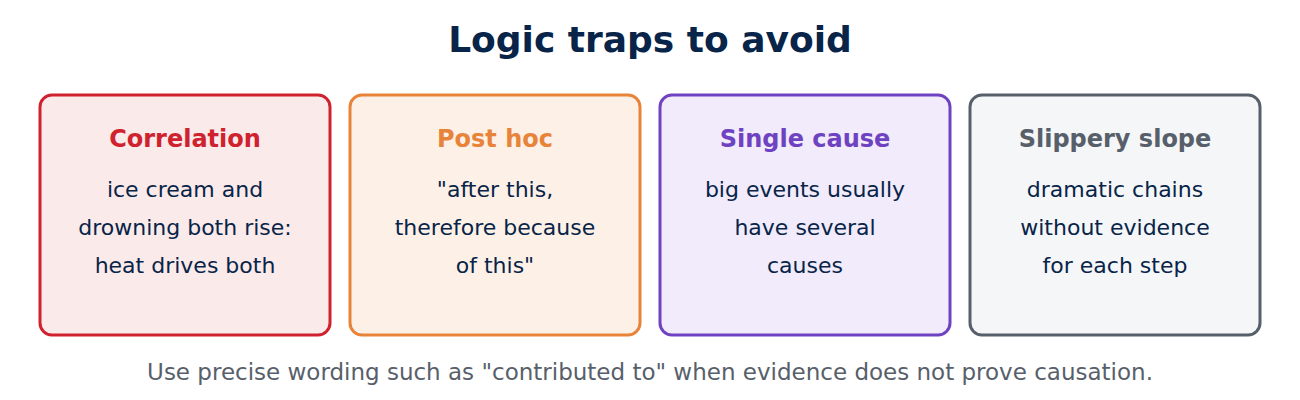
- Correlation is not causation. Ice cream sales and drowning both rise in summer, but one does not cause the other; hot weather drives both. Ask whether a third factor could explain the link.
- Post hoc fallacy: “after this, therefore because of this.” Something happening first does not prove it caused what came next.
- Single-cause thinking: big events usually have several causes. Acknowledge them, even if you focus on one.
- Slippery slope: claiming a chain of increasingly dramatic effects without evidence for each step.
- Overstating: use precise language, such as “contributed to” or “is strongly associated with”, when evidence does not show direct causation.
The introduction and conclusion
Open with the effect or phenomenon readers recognize, give brief background, and end with your thesis; see how to write an essay introduction. In the conclusion, restate the main causes or effects, explain why understanding them matters, and, if fitting, suggest what could change the outcome.
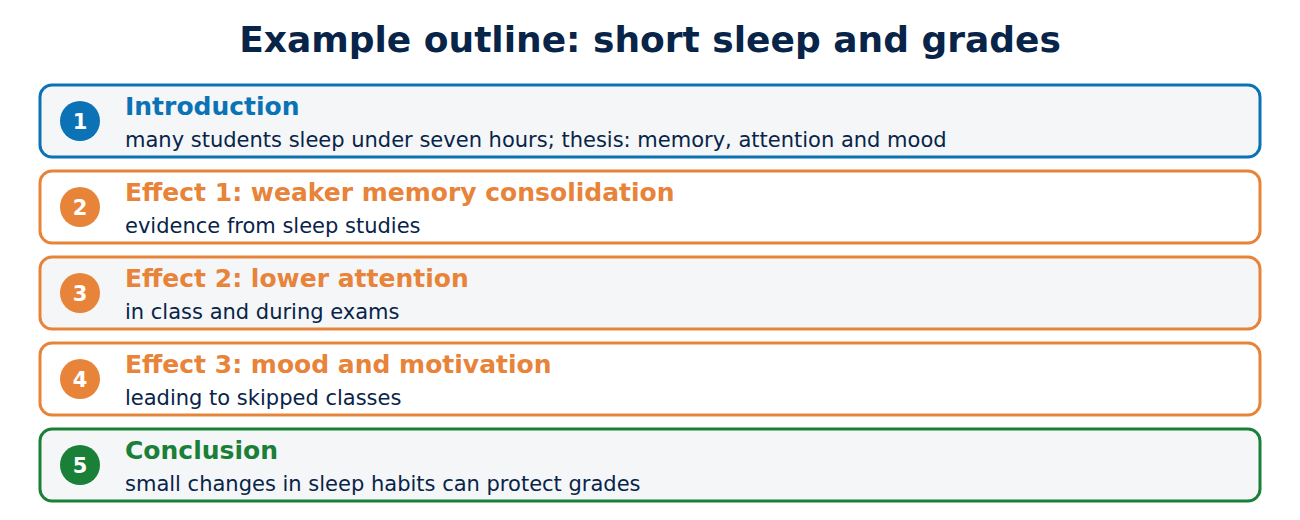
A quick example outline
- Introduction: many students report sleeping less than seven hours on school nights; thesis: short sleep lowers grades through memory, attention and mood.
- Effect 1: weaker memory consolidation (evidence from sleep studies).
- Effect 2: lower attention in class and during exams.
- Effect 3: mood and motivation, leading to skipped classes.
- Conclusion: small changes in sleep habits can protect grades; see sleep tips for students.
Conclusion
Choose one focus (causes, effects or a chain), research evidence that shows real causation, write a thesis that names the main causes or effects, and organize the body by importance or time. Explain the mechanism behind each link, use precise language, and avoid confusing correlation with causation.
Sources and further reading
- Logical fallacies (Purdue Online Writing Lab)
- Fallacies (UNC Writing Center)
- Transitions (UNC Writing Center)



















Recent Comments