
Online degrees have become a normal part of higher education: many respected universities now offer bachelor’s and master’s programmes that you can complete entirely from home. At the same time, the internet is full of “universities” that sell worthless degrees. Before you pay any fees, check one thing above all: is the institution properly accredited or officially recognised?
This guide explains what accreditation means, how to check it in the US, the UK and other countries in a few minutes, and which warning signs reveal a diploma mill.
What accreditation means
Accreditation is an external quality review. An independent body checks whether a university meets standards for teaching, staff, finances and student support, and it reviews the institution again at regular intervals. In most countries, an online degree from an accredited university is legally the same as a degree earned on campus, and the certificate usually does not even mention that you studied online.
Accreditation matters for practical reasons:
- Employers and other universities may not accept a degree from an unaccredited institution, for example when you apply for a master’s or a doctorate.
- Financial aid: in the US, federal student aid is only available at institutions accredited by an agency recognised by the Department of Education.
- Licensed professions such as nursing, teaching, psychology, law and engineering often require a degree from an accredited programme.
- Credits and visas: transferring credits or using your degree for a work visa abroad usually depends on recognition.
How to check accreditation in the US
In the United States, accreditation is carried out by private agencies, but only some of them are recognised by the US Department of Education or by the Council for Higher Education Accreditation (CHEA). To check a university:
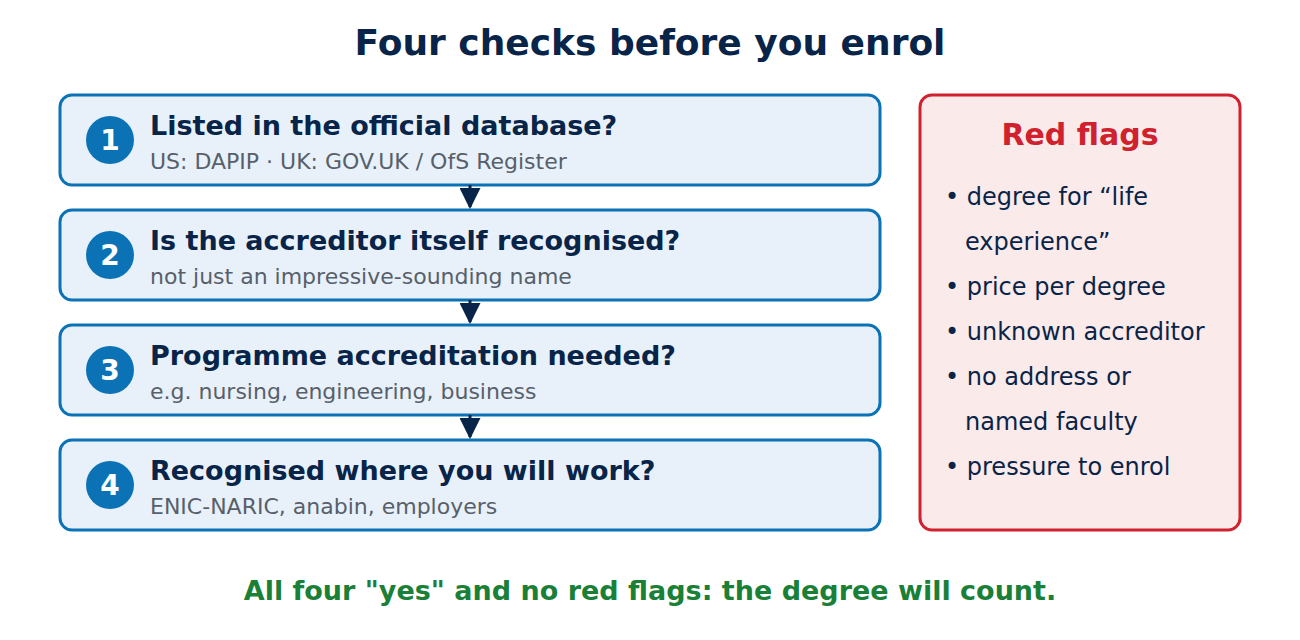
- Search for it in the Database of Accredited Postsecondary Institutions and Programs (DAPIP) of the US Department of Education. It shows the institution’s accreditor and status.
- Check that the accreditor itself is recognised. Fake universities often name an impressive-sounding “accreditation agency” that does not appear in the official lists. These are called accreditation mills.
- For your field, check programme accreditation too, for example ABET for engineering, AACSB for business schools, or nursing accreditors for nursing degrees.
- Use the Federal School Code search: institutions that can receive federal student aid are listed there.
The US Department of Education explains the system on its page about college accreditation. For examples of established online programmes, see our overview of online universities in the United States.
How to check in the UK
In the UK, only institutions with legal degree-awarding powers (“recognised bodies”) can award degrees, and some colleges teach courses that lead to a degree from a recognised body (“listed bodies”). The UK government publishes both lists:
- Use the GOV.UK service Check if your university or college can award a degree.
- For providers in England, check the Office for Students Register.
- To verify a degree certificate or check a suspicious institution, use HEDD (Higher Education Degree Datacheck), the official degree verification service, which also lists known bogus universities.
See also our guide to online universities in the United Kingdom.
Other countries and degrees from abroad
- Canada: education is regulated by the provinces. The Canadian Information Centre for International Credentials (CICIC) lists recognised institutions in each province.
- Australia: all higher education providers must be registered with the national regulator TEQSA, which publishes a national register.
- Europe and worldwide: the ENIC-NARIC networks provide national information centres that tell you whether a foreign degree is recognised in your country. In Germany, for example, the anabin database shows how foreign institutions and degrees are rated.
If you want to use an online degree from one country to work in another, check recognition in the country where you plan to work, not only in the country of the university.
Warning signs of a diploma mill
- Degrees for “life experience” or after only a few weeks, with little or no coursework.
- Payment per degree instead of per course or per semester, often with discounts for ordering several degrees.
- Accreditors that you cannot find in official lists, or claims of “international accreditation” without details.
- No physical address, no named faculty with checkable qualifications, or only a PO box.
- Pressure to enrol now, with “limited time” offers and sales calls.
- A name very similar to a famous university. Check the exact name and website address.
Five questions to ask before you enrol
- Which body accredits or recognises the institution, and is that body listed by the government?
- Does my programme need additional professional accreditation for my career?
- Will my degree be recognised in the country where I want to work?
- Can I transfer credits to other universities?
- What do graduates do afterwards? Ask for employment data and talk to alumni on LinkedIn.
Conclusion
A good online degree can be just as valuable as one from campus, but only if the university is properly accredited or recognised. Check the institution in the official database of your country (DAPIP in the US, GOV.UK and the OfS Register in the UK), verify that the accreditor is recognised, and watch out for the warning signs of diploma mills. Ten minutes of checking can save you years and thousands in fees.
Sources and further reading
- College Accreditation (US Department of Education)
- Database of Accredited Postsecondary Institutions and Programs (US Department of Education)
- Check if your university or college can award a degree (GOV.UK)
- Higher Education Degree Datacheck (HEDD)
- Diploma mill (Wikipedia)
















Recent Comments