
A personal narrative essay tells a true story from your life and shows what it meant to you. It is one of the most common assignments in first-year writing courses, and the same skills power college application essays and scholarship essays. Unlike an argumentative essay, you do not need sources or a formal thesis. You need a focused story, vivid details and honest reflection. This guide walks you through choosing a story, structuring it, writing scenes and avoiding the mistakes that make narratives flat.
What makes a good personal narrative
- It is focused. One moment, one day or one short period, not your whole childhood.
- It has a change. You realize, decide, lose or learn something, and the reader feels the difference between before and after.
- It shows instead of tells. Scenes, sensory details and dialogue let the reader experience the moment.
- It reflects. You explain why the story matters to you now, without preaching.
Step 1: choose the right story
The best topics are often small. “The summer I worked at my uncle’s diner” beats “my life philosophy”. Brainstorm moments when:
- you failed at something or changed your mind;
- you saw a person, place or tradition differently;
- you made a difficult decision or took responsibility;
- an ordinary object or routine came to mean something.
Then ask: can I tell this in a few scenes, and does it lead to an insight I can put into one sentence? If yes, you have your story. Avoid topics you are not ready to write about honestly; a narrative essay is graded writing, not therapy, and you decide how much you share.
Step 2: find your insight
Before drafting, write one sentence that says what the story means: “Losing the election taught me that I like organizing people more than leading them.” This is your controlling idea. It does not have to appear word for word in the essay, but every scene should point toward it.
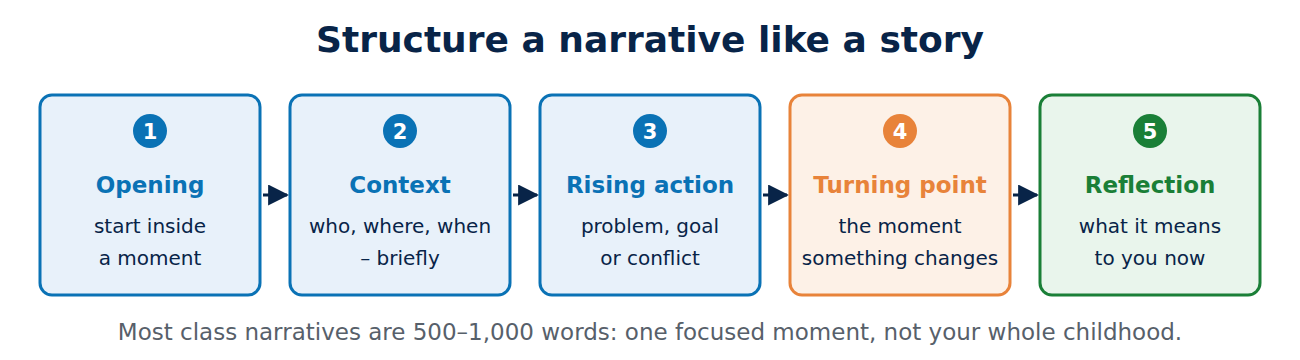
Step 3: structure it like a story
- Opening: start in the middle of a moment, with an image, an action or a line of dialogue. See how to write a hook.
- Context: a few sentences on who, where and when, just enough for the reader to follow.
- Rising action: the events that build tension: a problem, a goal, a conflict.
- Turning point: the moment where something changes.
- Reflection and ending: what you understood, and how it affects you now. End with an image or a thought that echoes the opening.
Most narrative essays for class are 500–1,000 words; check your assignment.
Step 4: write scenes, not summaries
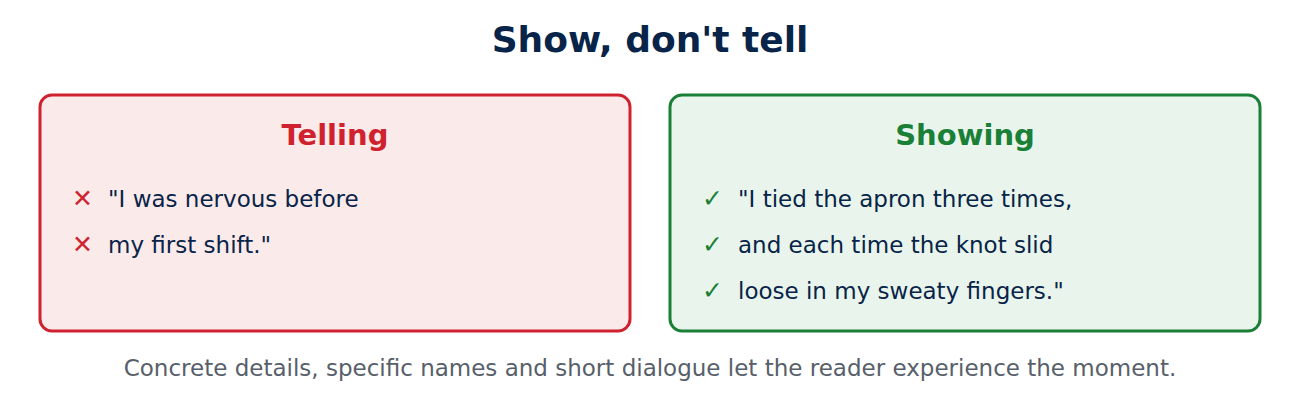
Compare two versions:
- Telling: “I was nervous before my first shift.”
- Showing: “I tied the apron three times, and each time the knot slid loose in my sweaty fingers.”
Use concrete details from all five senses, specific names (not “a car” but “my mom’s dented Corolla”), and short pieces of dialogue that reveal character. Write in the first person and keep the tense consistent; past tense is the default, present tense can create immediacy.
Step 5: reflect without moralizing
The reflection is what turns an anecdote into an essay. Connect the experience to who you are now, but stay specific. “Since then, I volunteer to run the group chat for every project” is stronger than “this taught me that teamwork is important.” Place most of the reflection near the end, with small moments of insight along the way.
Common mistakes
- Too much ground: covering years in a few paragraphs leaves no room for scenes.
- A cliché ending: “and I learned that you should never give up.” Show the specific lesson.
- All summary, no scene, or the reverse: lovely scenes with no reflection.
- Starting with background: begin in the action and add context afterward.
- Overwriting: stacking adjectives. One precise detail beats three general ones.
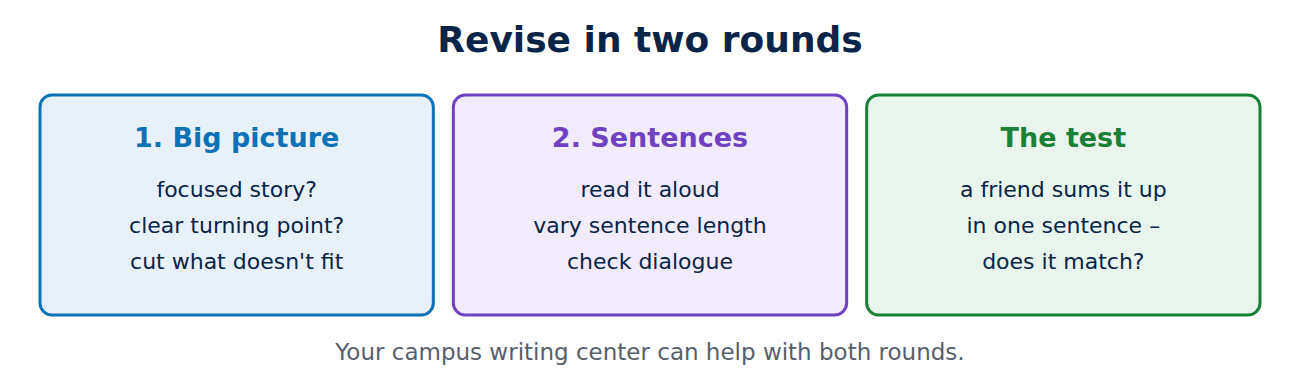
Revise in two rounds
- Big picture: Is the story focused? Does the turning point stand out? Does every scene support the insight? Cut anything that does not.
- Sentences: read it aloud, vary sentence length, replace vague words, check dialogue punctuation.
Ask a friend to tell you, in one sentence, what your essay is about. If it matches your controlling idea, the essay works. Your campus writing center can help too.
Writing about yourself for an application instead? See how to write an essay about yourself and how to write a scholarship essay. Need to finish strongly? How to write a conclusion.
Conclusion
Choose one focused, true moment with a change at its center, decide what it means in one sentence, and structure it like a story: opening scene, context, rising action, turning point, reflection. Show with specific details and dialogue, reflect honestly without moralizing, and revise for focus first and sentences second.
Sources and further reading
- Narrative essays (Purdue Online Writing Lab)
- Application essays (UNC Writing Center)
- Overview of creative nonfiction (The New York Times Learning Network)



















Recent Comments