
Most students take notes the same way: write down as much as possible during the lecture, then never look at the notes again until the night before the exam. The Cornell note-taking method changes that with a simple page layout that turns your notes into a self-test. It needs nothing but paper (or a note app) and works for lectures, readings and online classes.
This guide explains how to set up a Cornell page, what to do before, during and after class, and how to adapt the method for different subjects.
What is the Cornell method?
The Cornell note-taking system was developed by Walter Pauk, an education professor at Cornell University, and described in his book How to Study in College. Its key idea is that notes are not only a record of the lecture but a study tool: you divide each page into areas for notes, questions and a summary, and you use the questions later to test yourself.
How to set up a Cornell page
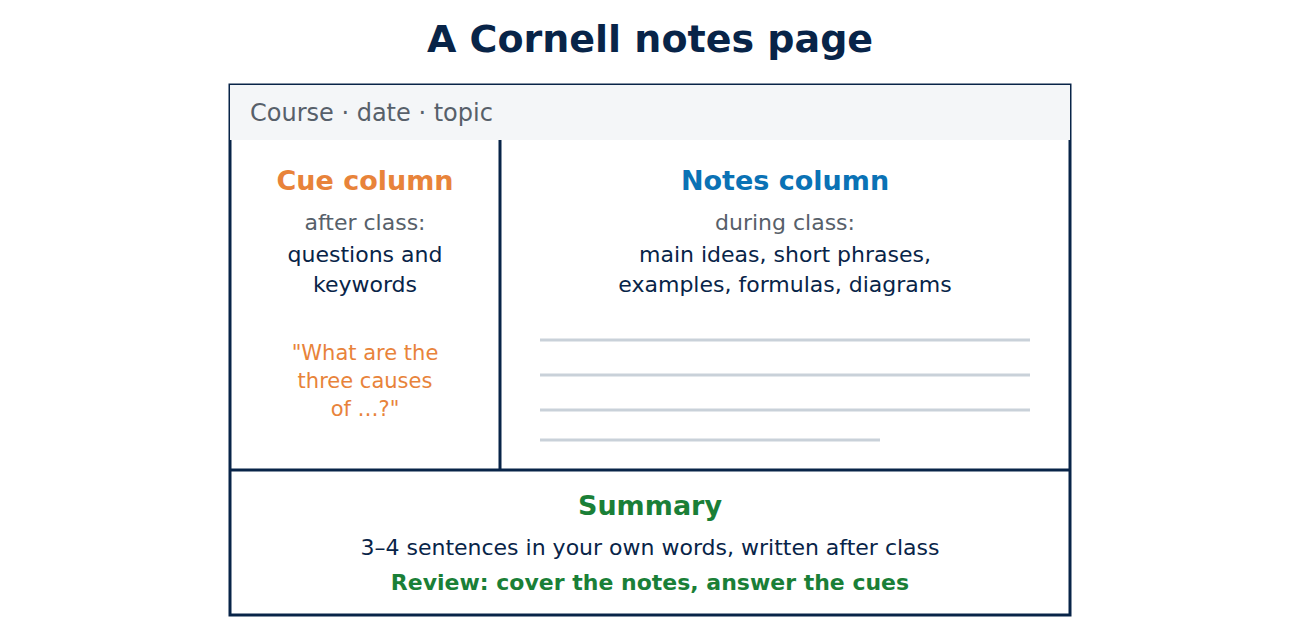
Divide a sheet of paper into three parts. A common layout:
- Notes column (right, about two thirds of the width): what you write during the lecture.
- Cue column (left, about one third): filled in after the lecture with questions and keywords.
- Summary (bottom, a few lines): three or four sentences in your own words.
Add the course, date and topic at the top. Many students print a template or create one in OneNote, Notion or GoodNotes.
During class: record
Write in the notes column only. Your goal is to capture the main ideas, not every word:
- Use short phrases, abbreviations and symbols instead of full sentences.
- Listen for signals such as “the key point is”, “there are three reasons” or anything the lecturer writes on the board or repeats.
- Leave space between topics so you can add explanations later.
- Copy examples, formulas and diagrams carefully: they are often what exam questions are built on.
After class: questions and summary
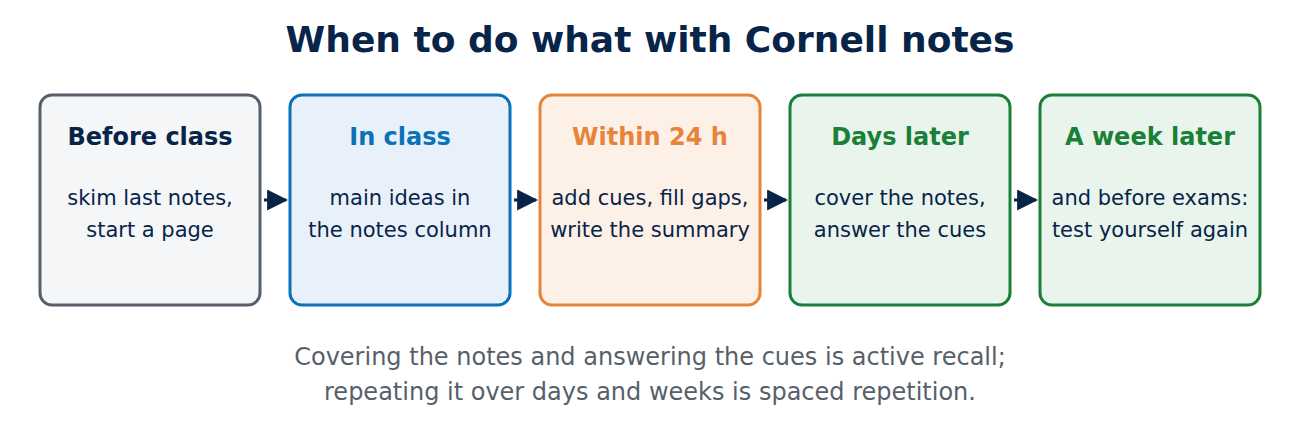
The real work happens within 24 hours of the lecture, while you still remember it:
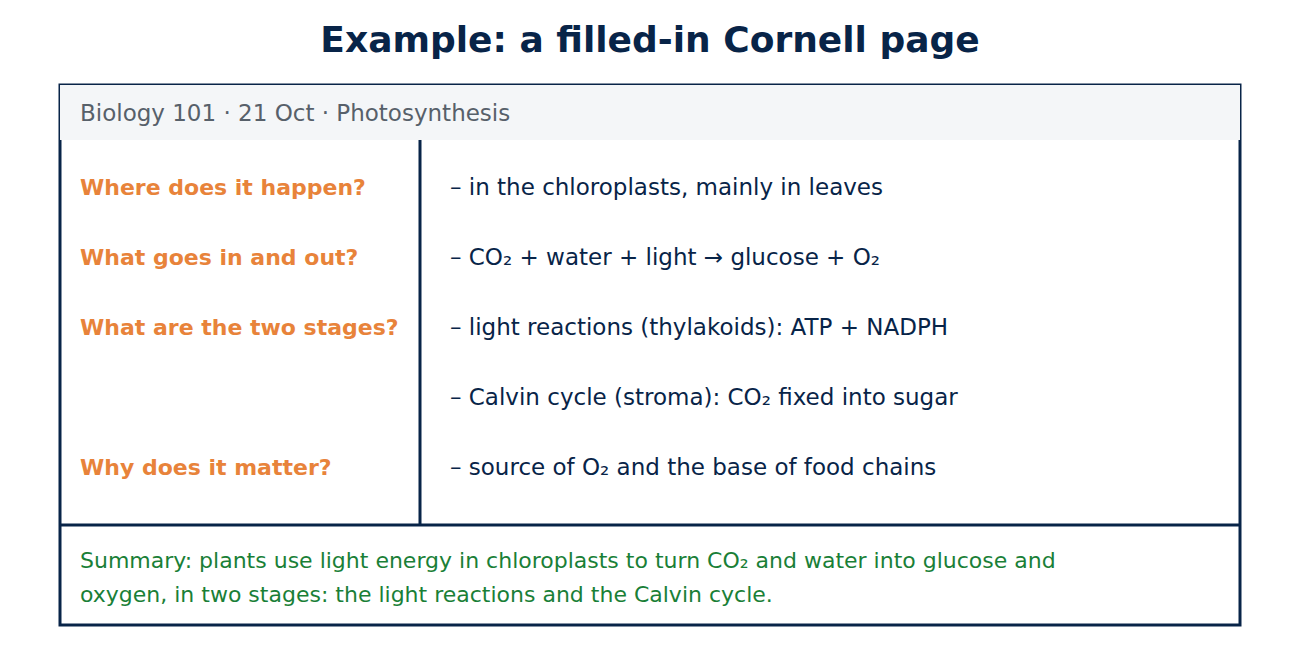
- Write questions in the cue column. For every main idea in the notes column, write a question it answers: “What are the three causes of …?”, “How does … work?”, “Why does … matter?”. Keywords work too.
- Fill gaps. Add missing details from the slides or the textbook, and mark anything you still do not understand to ask about.
- Write the summary at the bottom: the main message of the page in three or four sentences, in your own words.
Review: test yourself
This is the step that makes the method effective. Cover the notes column with a sheet of paper, read each question in the cue column and answer it out loud or on paper. Then uncover the notes and check. Questions you could not answer are the ones to review again.
This is active recall, one of the most effective study techniques. Review the same pages again after a few days and a week, and you are also using spaced repetition. Before an exam, your cue columns become a ready-made list of practice questions.
Adapting the method to your subjects
- Maths, physics, engineering: put worked examples in the notes column and write “Solve: …” problems in the cue column. Re-solve them without looking.
- History, law, social sciences: use the cue column for dates, names, cases and “why” questions; the summary can state the argument of the lecture.
- Biology and medicine: draw diagrams in the notes column and write “Label …” or “Explain the steps of …” as cues.
- Readings: the method works just as well for textbook chapters and articles. Write the source at the top so you can cite it later.
Paper or laptop?
Both work. A well-known 2014 study by Mueller and Oppenheimer found that students who wrote notes by hand did better on conceptual questions than those who typed, probably because typing tempts people to transcribe word for word. Later replications found smaller or no differences. What matters most is that you summarize in your own words instead of copying, whichever tool you use. If you type, turn off notifications and use a two-column table or template. A tablet with a pen combines both.
Common mistakes
- Skipping the cue column and summary. Without them, Cornell notes are just ordinary notes.
- Writing too much during class. If you cannot keep up, you are transcribing, not taking notes.
- Waiting until exam week to add questions. After a few days, you no longer remember what the notes meant.
- Rereading instead of testing. Covering the notes and answering the cues is what builds memory.
Conclusion
The Cornell method turns note-taking into studying: record the main ideas during class, add questions and a summary within a day, and test yourself by covering the notes. It takes about 10 extra minutes per lecture and saves hours before exams. Combine it with focused study blocks from the Pomodoro technique and the other methods in our guide on how to study effectively.
Sources and further reading
- The Cornell Note Taking System (Cornell University Learning Strategies Center)
- The Pen Is Mightier Than the Keyboard (Mueller and Oppenheimer, 2014, Psychological Science)

















Recent Comments