
Graduate schools, scholarships, internships and study abroad programs often ask for one to three letters of recommendation. A strong letter from someone who knows your work can make your application stand out. But many students ask too late, ask the wrong people or give their recommenders too little to work with.
This guide explains whom to ask, when and how to ask, what to give your recommenders, and how to follow up, with an example request e-mail.
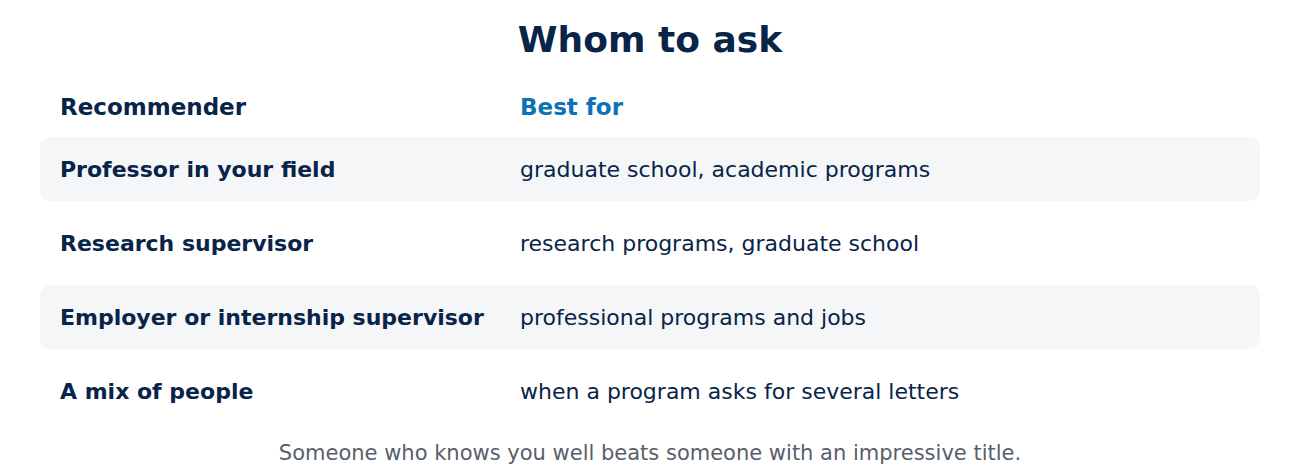
Whom to ask
- Someone who knows you well, not just someone with an impressive title. A detailed letter from a seminar instructor beats a generic one from a famous professor who barely knows your name.
- Professors whose classes you did well in, especially in your field, for graduate school and academic scholarships.
- Research supervisors for research programs and graduate school.
- Employers or internship supervisors for professional programs and jobs.
- A mix that covers different strengths, if the program asks for several letters.
Avoid family members and friends, and check the program’s rules on who may write.
When to ask
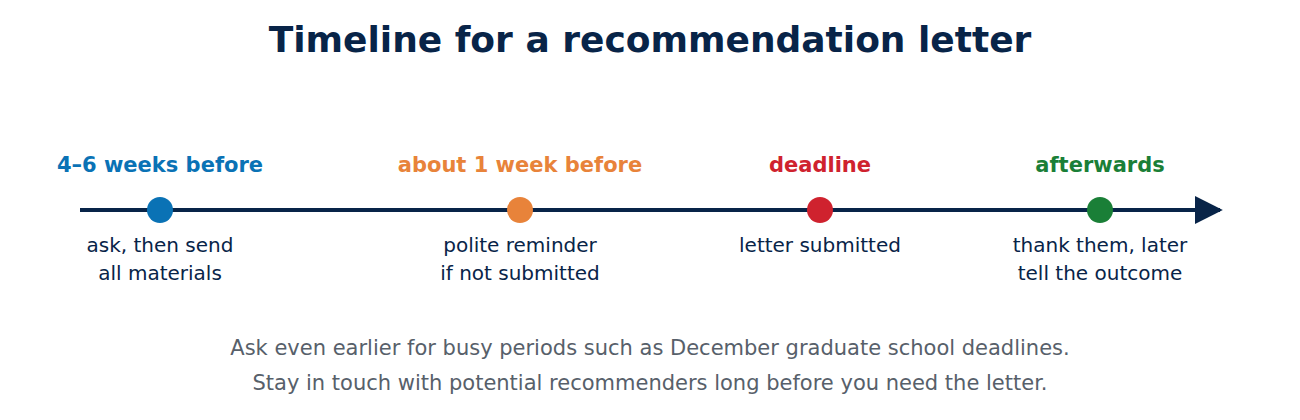
Ask at least four to six weeks before the deadline, and earlier for busy periods such as December graduate school deadlines. Recommenders write many letters, often on top of teaching and research. If you know you will need letters next year, stay in touch with potential recommenders now: go to office hours, take another class with them, ask about their research.
How to ask
- Ask in person or in office hours if possible, then follow up by e-mail with the details.
- Ask if they can write a strong letter: “Would you feel comfortable writing a strong letter of recommendation for me?” This gives them an easy way to decline if they cannot, which is better than a lukewarm letter.
- Explain why you are asking them specifically.
An example request e-mail
Subject: Recommendation letter request: MS in Public Health applications
Dear Professor Kim,
I was in your Epidemiology 301 seminar last spring and wrote my final paper on vaccination rates in rural counties. I am applying to master’s programs in public health this fall, and I would be grateful if you would consider writing a strong letter of recommendation for me. Your seminar is what convinced me to pursue this field.
The first deadline is December 1. If you are able to help, I will send my resume, statement of purpose, a list of programs and deadlines, and a short summary of my work in your class.
Thank you for considering my request.
Best regards,
Jordan Lee
More tips on tone and structure in how to email a professor.
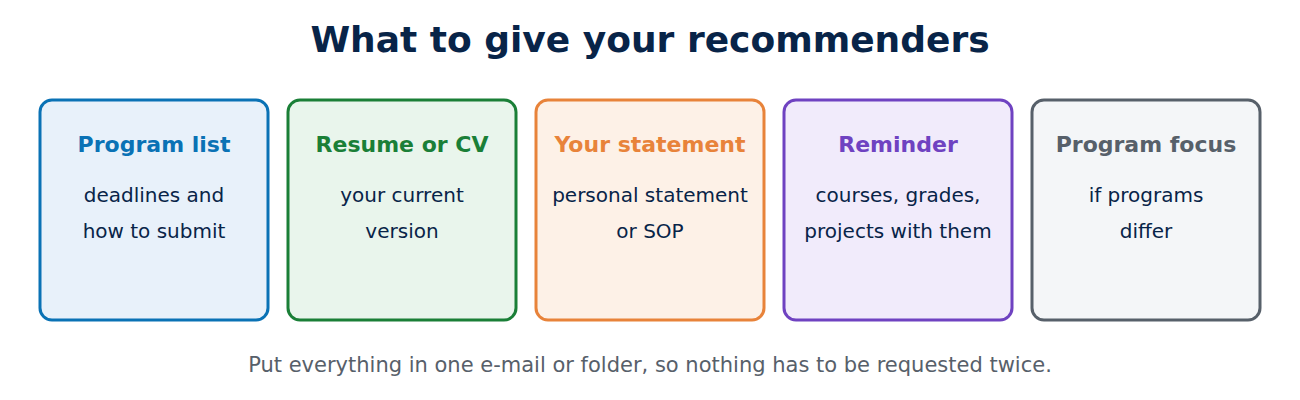
What to give your recommenders
Make their job easy with one organized package (a “brag sheet”):
- A list of programs, deadlines and how to submit (most are online portals that send the recommender a link).
- Your resume or CV.
- Your personal statement or statement of purpose; see how to write a personal statement for grad school.
- A short reminder of your work with them: courses, grades, papers or projects, things you did that they might mention.
- What each program emphasizes, if it differs.
Waive your right to see the letter
Application portals in the US ask whether you waive your right under FERPA to read the letter. Most advisors recommend waiving it: admissions committees tend to trust confidential letters more, and recommenders often prefer it.
Follow up and say thank you
- Send a polite reminder about a week before the deadline if the portal shows the letter is not yet submitted.
- Thank your recommenders after they submit, with a short e-mail or a handwritten card.
- Tell them the outcome later; recommenders like to hear where you got in.
Common mistakes
- Asking only a week or two before the deadline.
- Choosing someone who barely knows you because of their title.
- Sending incomplete information or changing the list of programs at the last minute.
- Asking a recommender to let you write the letter yourself; many programs consider that a breach of integrity.
- Forgetting to say thank you.
Conclusion
Ask for letters of recommendation from people who know your work well, at least four to six weeks before the deadline, preferably in person and with a clear follow-up e-mail. Ask whether they can write a strong letter, give them a complete package with deadlines, your resume, statement and reminders of your work, waive your right to see the letter, send a gentle reminder and thank them afterwards.
Sources and further reading
- Tips and Tools (The Writing Center, University of North Carolina at Chapel Hill)
- What is FERPA? (US Department of Education, Student Privacy Policy Office)












Recent Comments