
Few assignments cause as much frustration as group projects: one person does all the work, another disappears until the night before the deadline, and nobody knows who is responsible for what. Yet group work is a skill employers value highly, and with a little structure, most problems can be prevented before they start.
This guide gives you a practical plan for group projects: the first meeting, dividing the work, communication, dealing with slackers and conflicts, and finishing strong.
The first meeting: set the foundation
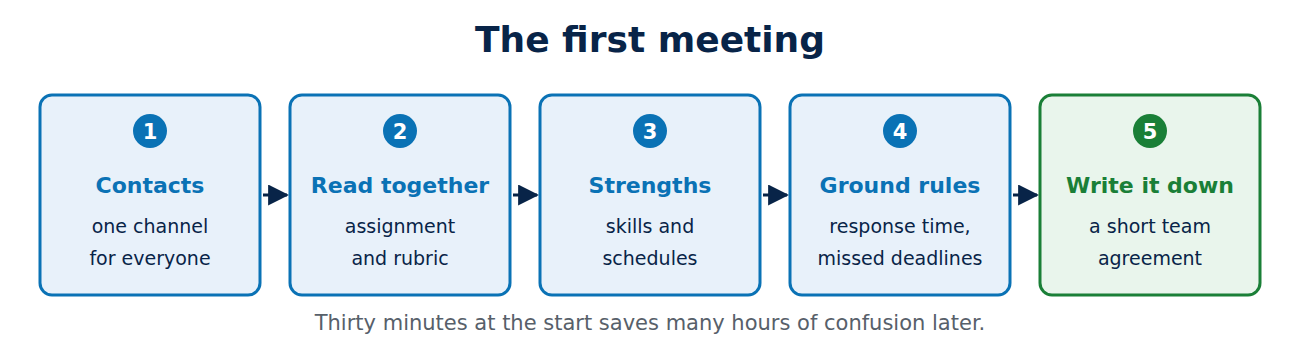
- Exchange contacts and agree on one communication channel (a group chat, Teams, Slack or Discord) and one shared folder (Google Drive, OneDrive).
- Read the assignment together and the grading rubric. Agree on what a great result looks like.
- Share strengths and schedules: who is good at research, writing, design, presenting, data? Who works weekends?
- Agree on ground rules: response time for messages, meeting attendance, what happens if someone misses a deadline.
- Write it down in a short team agreement, so everyone can refer back to it.
Divide the work clearly
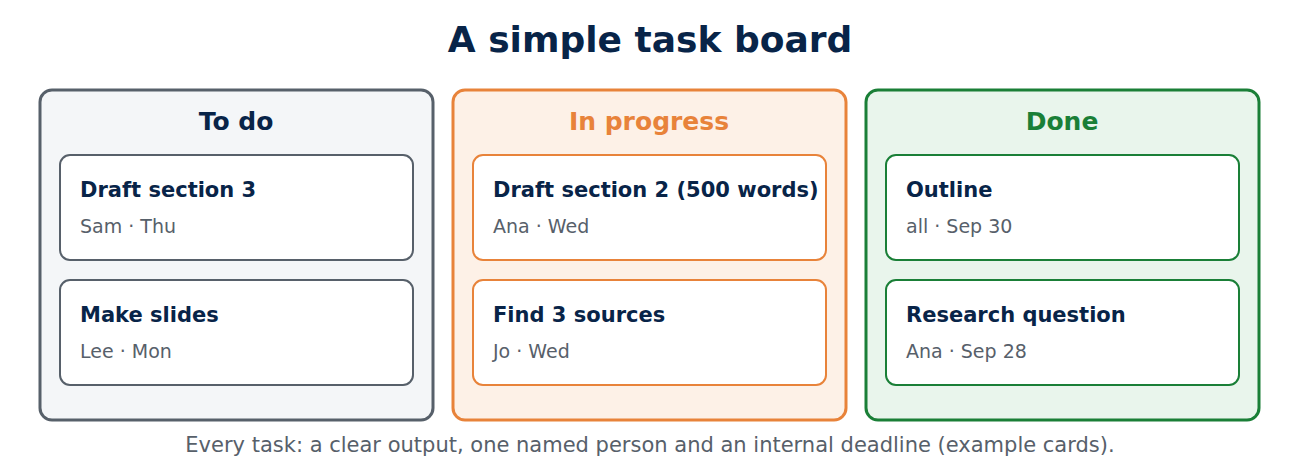
- Break the project into tasks with clear outputs: “draft section 2 (500 words) with three sources”, not “do research”.
- Assign every task to one named person, even if others help.
- Set internal deadlines several days before the real one, leaving time to combine and revise.
- Rotate roles if the project is long: coordinator, editor, timekeeper, presenter.
- Keep a simple task board: a shared document, spreadsheet or a free tool such as Trello, with columns To do, In progress, Done.
Communicate well
- Short regular check-ins (15 minutes, weekly) work better than long, rare meetings.
- Write down decisions after each meeting in the shared folder.
- Work in one shared document rather than e-mailing files back and forth; use comments and suggestions.
- Be clear and kind: “Can you share your draft by Thursday at 6 p.m.? I need it to start editing” works better than vague reminders.
When someone is not contributing
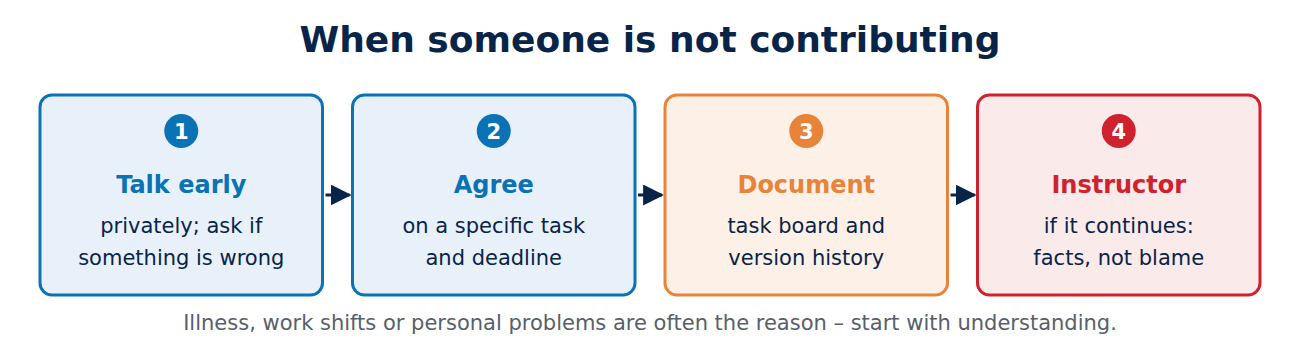
- Talk to them early and privately. Ask if something is wrong; illness, work shifts or personal problems are common reasons.
- Agree on a specific task and deadline together.
- Document contributions: the task board and document version history show who did what.
- Involve the instructor if the problem continues, with facts, not complaints. Many instructors use peer evaluations; be honest and fair in them.
Do not quietly do their part without saying anything: it hides the problem and often hurts you most.
Handling conflicts
- Focus on the task and the goal, not on personalities.
- Let everyone explain their view before deciding.
- Decide by a method agreed in advance: consensus, majority vote, or the coordinator decides after discussion.
- If a conflict escalates, ask the instructor or teaching assistant to mediate early. See how to email a professor.
Working in online and international teams
- Agree on time zones and use a scheduling poll for meetings.
- Prefer asynchronous updates in the shared document, with a short video call for key decisions.
- Be explicit; humor and indirect hints are easy to misunderstand across cultures and in writing.
Finishing strong
- Assign one editor to make the final document consistent in style, formatting and citations; see our APA guide.
- Check that every source is cited and nobody copied text; see how to avoid plagiarism.
- Rehearse presentations together at least once, with timing.
- Submit early, and keep a copy.
- Hold a short debrief: what worked, what would you change next time?
Frequently asked questions
What if one group member does nothing?
Talk to them early and privately, agree on a specific task and deadline, document contributions and involve the instructor if nothing changes. Do not silently do their part.
How do we split the grade fairly?
Many instructors use peer evaluations. Keep a task board and the document version history so contributions are visible, and fill in peer reviews honestly.
Which tools work best for group projects?
One shared folder (Google Drive or OneDrive), one chat channel, a shared document for writing and a simple task board such as a spreadsheet or Trello are enough for most projects.
Conclusion
Successful group projects start with a clear first meeting: one channel, one shared folder, ground rules and a written team agreement. Break the project into concrete tasks with one owner and internal deadlines, check in briefly every week, and document decisions and contributions. Address slackers and conflicts early and privately, involve the instructor if needed, and give the final product to one editor. Good habits also help with procrastination for the whole team.
Sources and further reading
- Group Writing (The Writing Center, University of North Carolina at Chapel Hill)
- Using Group Projects Effectively (Eberly Center, Carnegie Mellon University)
















Recent Comments