
You have read the chapter twice, the slides look familiar, and you feel ready. Then a friend asks a simple question about the topic and you cannot answer it. That gap between “it looks familiar” and “I understand it” is exactly what the Feynman technique closes. You learn a topic by explaining it in plain words, as if to someone who has never heard of it, and you find out at once where your understanding breaks down.
This guide explains the four steps, shows a worked example, and gives tips for using the technique in maths, science and essay subjects.
Who was Feynman?
Richard Feynman (1918–1988) was an American physicist who received the Nobel Prize in Physics in 1965 for his work on quantum electrodynamics. He was also famous as a teacher: his introductory lectures at Caltech, published as The Feynman Lectures on Physics, are still read today. Feynman insisted that if you cannot explain something simply, you do not really understand it, and he distrusted learning that was only about memorising names and formulas.
The “Feynman technique” is not a method he wrote down himself. It is a summary of his approach to learning, made popular by teachers and study guides.
The four steps
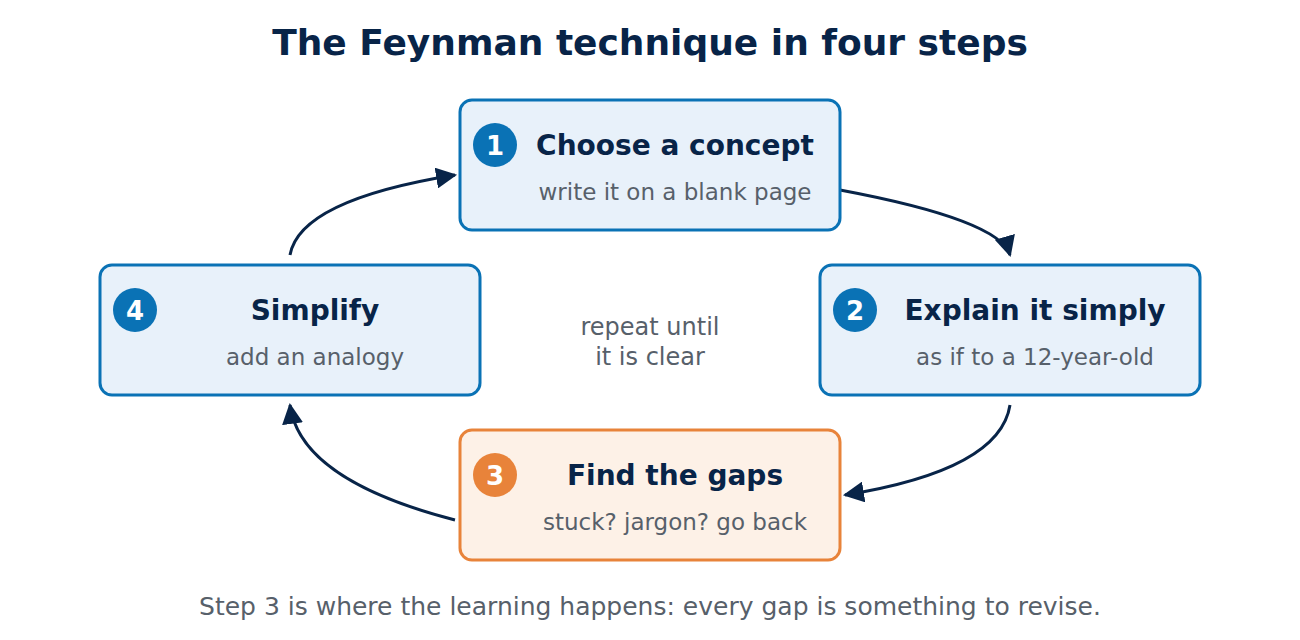
- Choose a concept. Write its name at the top of a blank page, for example “photosynthesis”, “supply and demand” or “the chain rule”.
- Explain it in simple words. Write (or say out loud) an explanation for a 12-year-old: short sentences, everyday words, an example. Do not copy from your notes.
- Find the gaps. Wherever you get stuck, use a technical term you cannot explain, or wave your hands (“it just works like that”), you have found a gap. Go back to the textbook or lecture for exactly that part.
- Simplify and use analogies. Rewrite the explanation until it is clear and short. Add an analogy or a picture that captures the idea.
A worked example
Suppose you are learning about interest rates in economics. Your first attempt might be: “When the central bank raises interest rates, inflation goes down because of monetary transmission.” This sounds right, but “monetary transmission” hides the actual mechanism. That is a gap.
After checking your notes, your simple version might be: “When the central bank raises its rate, banks charge more for loans. Borrowing becomes expensive, so people and companies buy fewer houses, cars and machines. With less spending, shops find it harder to raise prices, so prices rise more slowly.” Now every step is in your own words, and you could answer a follow-up question about any of them.
The same works in the sciences. If you can explain why a quadratic formula gives two solutions, or what a derivative tells you about a graph, without reading out the formula, you understand it.
Why it works
- It is a form of active recall. You produce the explanation from memory instead of rereading it, which strengthens memory far more. See why active recall beats rereading.
- It reveals the illusion of knowing. Familiar material feels understood. Explaining it shows honestly what is missing.
- It builds connections. Self-explanation, linking new facts to what you already know, is one of the learning strategies that research rates as moderately to highly effective.
Tips for different subjects
- Maths and physics: explain each step of a solution and why it is allowed, not only the result. Then solve a new problem without notes.
- Biology, chemistry, medicine: draw the process as a simple diagram and explain each arrow.
- History, law, social sciences: explain a case or event as a short story with cause and effect, then the key argument of each side.
- Languages: explain a grammar rule with two of your own example sentences.
Ways to practise
- Teach a friend or study group. Take turns explaining topics for five minutes each and ask each other “why?”.
- Record yourself. Explain a topic in a two-minute voice memo and listen to it: the gaps are easy to hear.
- Use the blank page before an exam. For every topic on the syllabus, write a short explanation from memory. The topics where you struggle are your revision plan.
- Combine it with flashcards. Turn each gap you find into a flashcard question and review it with spaced repetition.
Common mistakes
- Explaining with the book open. That is copying, not explaining. Close your notes first.
- Staying too vague. “Simple” does not mean wrong or incomplete. A good simple explanation is precise; it just uses everyday words.
- Skipping step 3. The value of the technique is finding gaps. Mark them clearly and fix them, or the exercise only makes you feel good.
Conclusion
The Feynman technique is simple: pick a concept, explain it in plain words, find where you get stuck, and fix exactly those parts. It turns vague familiarity into real understanding and shows you what to revise. Use it in focused Pomodoro blocks, and read How to Study Effectively: 6 Evidence-Based Techniques for the methods that work best alongside it.
Sources and further reading
- Richard Feynman (Wikipedia)
- Improving Students’ Learning With Effective Learning Techniques (Dunlosky et al., Association for Psychological Science)
















Recent Comments