
You sit down to study, check your phone “just for a second”, and an hour later the chapter is still unread. The Pomodoro technique is a simple way out of this loop: you work in short, fixed blocks with a timer and take a real break after each one. It costs nothing, needs no app, and works for reading, writing, problem sets and revision.
This guide explains how the technique works, how to adapt it to different kinds of study, and when longer blocks work better.
What is the Pomodoro technique?
The technique was developed by the Italian Francesco Cirillo in the late 1980s, when he was a university student. He used a kitchen timer shaped like a tomato (pomodoro in Italian) to make himself study for just ten focused minutes. The name stuck, and today one work block is called “a pomodoro”.
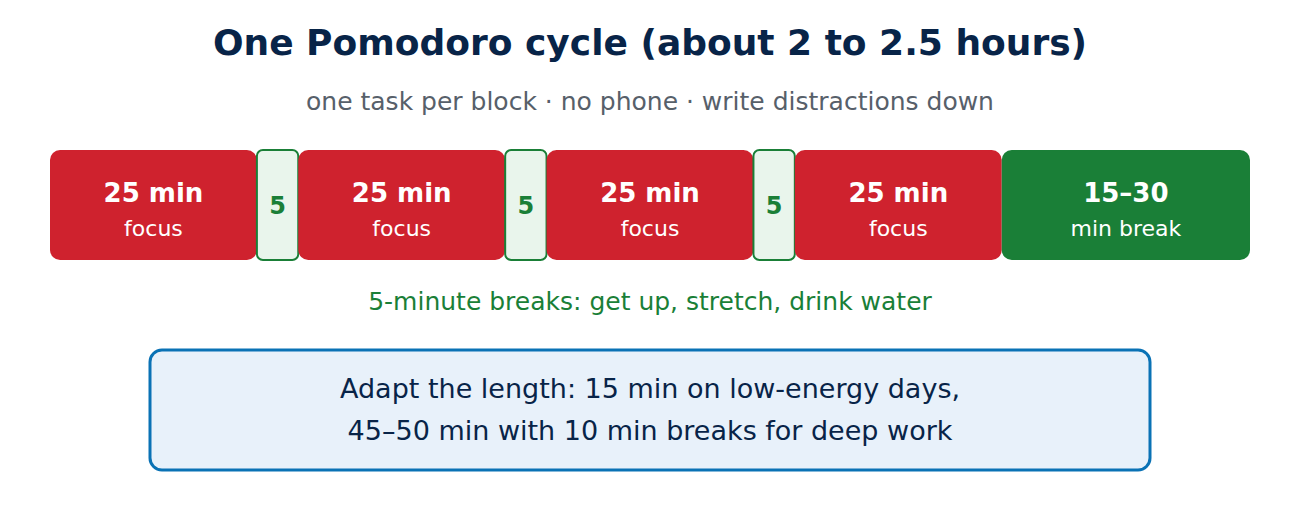
The classic method has five steps:
- Choose one task, for example “read section 3.2 and write a summary”.
- Set a timer for 25 minutes and work only on that task.
- When the timer rings, stop and make a mark on a piece of paper.
- Take a 5-minute break.
- After four pomodoros, take a longer break of 15 to 30 minutes.
Why it works
- Starting is easier. “Study for two hours” feels heavy; “study for 25 minutes” feels doable. Getting started is often the hardest part of procrastination.
- Distractions get a place. If you think of something else (a message, a shopping item), write it down and deal with it in the break. The timer protects the block.
- Breaks keep you fresh. Short, regular breaks help you keep concentration over a long day instead of fading after the first hour.
- You see your effort. Counting pomodoros shows how much real work a task takes, which makes planning the next week much more accurate.
How to use it for studying
Plan your pomodoros
At the start of the day, list your tasks and estimate how many pomodoros each needs. Tasks larger than five pomodoros should be split into smaller steps. Tasks smaller than one can be grouped, for example “answer e-mails and update the to-do list”.
Use the right task for each block
- Reading: one pomodoro per section, then write three key points from memory in the last minutes.
- Revision: use the blocks for active recall: test yourself with flashcards or past exam questions instead of rereading.
- Writing: one block for an outline, one per section of the draft, one for editing.
- Problem sets: work on one problem per block; if you are stuck at the end, write down where, and come back after the break.
Take real breaks
A break means getting up, drinking water, stretching or looking out of the window. Scrolling social media is not a break: it pulls your attention into new content and makes it harder to return. Leave the phone in another room or use a focus app.
Adapting the timer
25 minutes is a starting point, not a law. Adjust it to the task and to your concentration:
- 15 minutes for days with low energy or tasks you strongly avoid.
- 25 minutes for most reading, revision and admin.
- 45 to 50 minutes with a 10-minute break for deep work such as programming, essay writing or difficult proofs, where getting into the topic takes a while.
If you are in a flow when the timer rings, it is fine to finish the thought, but do take the break before the next block.
Tools: timer, app or paper
Any timer works: your phone’s clock, a kitchen timer, or a browser timer. Apps such as Forest grow a virtual tree while you stay away from your phone, and many task apps have a built-in focus timer. For more study tools see our list of the best apps for university students.
Studying with friends? Try a shared pomodoro: everyone works silently during the block and talks only in the breaks. It works in the library and on a video call.
When Pomodoro does not fit
- Lectures, labs and exams have their own rhythm; use the technique for self-study around them.
- Very creative or complex work can suffer from interruptions every 25 minutes. Use longer blocks or keep going if you are in a flow.
- If the timer causes stress, treat the count as a guide, not a test. The goal is focused work, not a high score.
Conclusion
The Pomodoro technique turns “I should study” into a clear, small step: one task, 25 minutes, then a real break. Combine the blocks with effective methods such as active recall and spaced repetition, adjust the length to your task, and you will get more done in fewer hours. For the full set of methods, read How to Study Effectively: 6 Evidence-Based Techniques.
Sources and further reading
- Pomodoro Technique (Wikipedia)
- How to Stay Focused When Studying From Home: 15 Strategies (Student Life Online)

















Recent Comments