
You planned to start the essay on Monday. Now it is Thursday night, the deadline is tomorrow, and you have cleaned your room, answered every message and watched three videos about productivity. Procrastination is one of the most common problems students face, and it is not simply laziness. It is usually a way of avoiding the unpleasant feelings a task brings: boredom, confusion, fear of doing badly.
This guide explains why we procrastinate and gives you practical, research-based strategies to get started and keep going.
Why we procrastinate
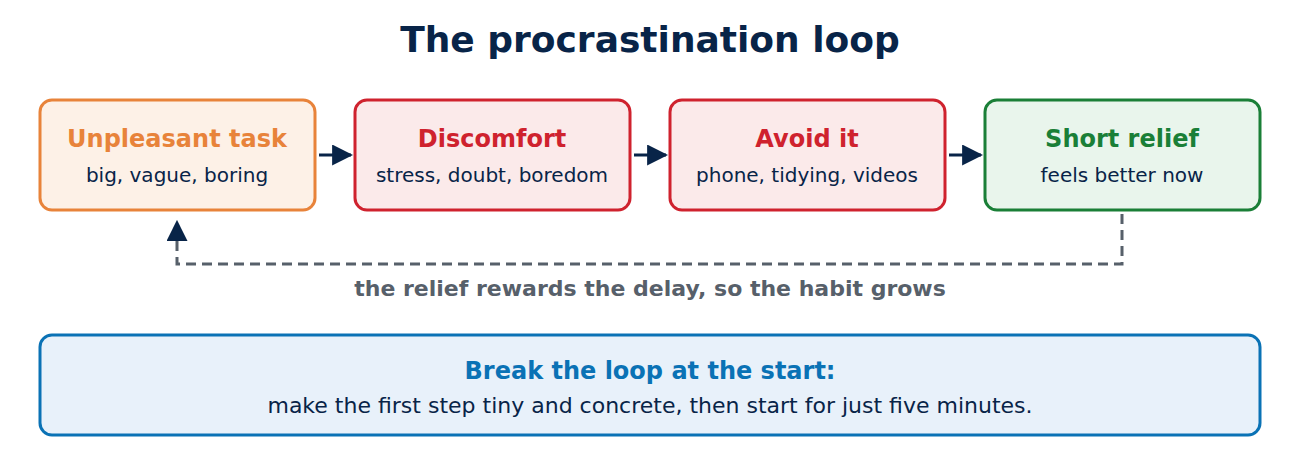
Psychologists see procrastination mainly as a problem of managing emotions, not time. A task that feels big, vague, boring or risky creates discomfort, and putting it off brings instant relief. The relief rewards the delay, so the habit grows. A large review of research by Piers Steel (2007) found that people procrastinate most when a task feels unpleasant, when the reward is far away, and when they are easily distracted or impulsive.
That is good news: each of these causes has a practical counter-strategy.
Make the task smaller and clearer
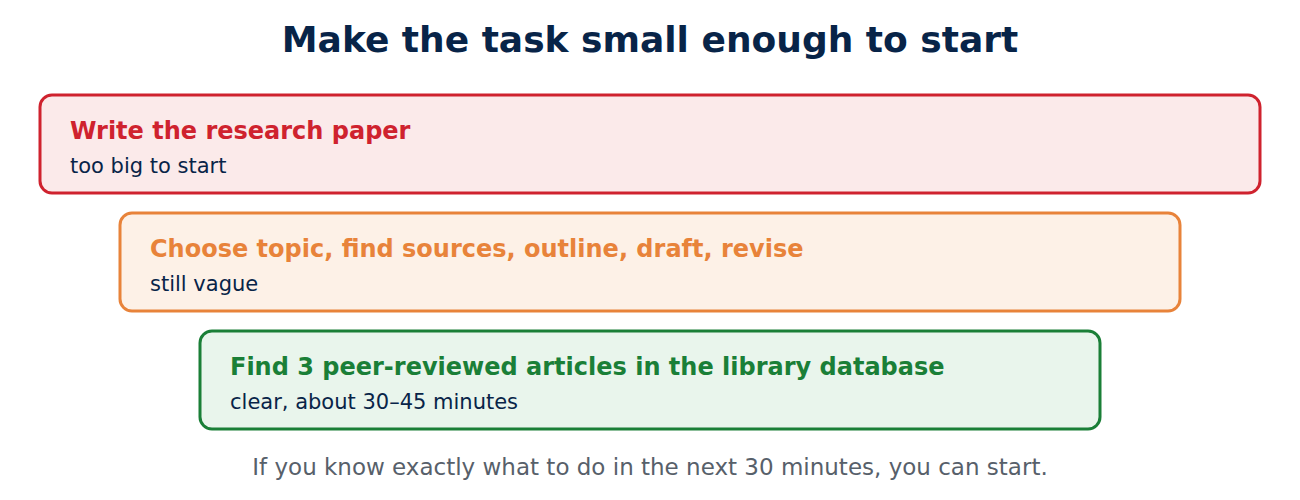
“Write the research paper” is too big to start. Break it into steps you could finish in 25 to 50 minutes, and write the very first one so concretely that you know exactly what to do: “Find three peer-reviewed articles on the topic in the library database”, not “Do research”. Our guide on how to write a research paper shows a step-by-step plan you can copy.
Use the two-minute and five-minute rules
- Two-minute rule: if something takes less than two minutes, such as replying to a group-project message, do it now.
- Five-minute rule: for bigger tasks, agree with yourself to work for only five minutes. Starting is the hardest part; once you have begun, continuing usually feels much easier.
Plan when, where and how
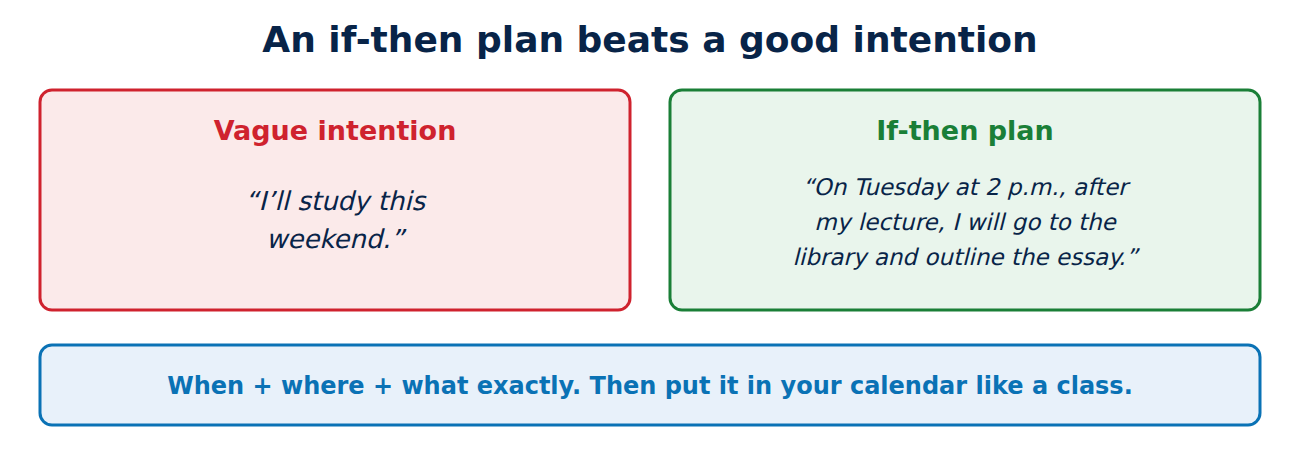
Vague intentions (“I’ll study this weekend”) rarely work. Specific plans do. Research on implementation intentions shows that “if-then” plans make people more likely to follow through: “On Tuesday at 2 p.m., after my lecture, I will go to the library and outline the essay.” Put the session in your calendar like a class. For more on planning your week, see time management tools and strategies.
Work in focused blocks
Short, timed work sessions with breaks make a task feel finite. The Pomodoro technique (25 minutes of work, 5 minutes of break) is a simple way to start. Count completed blocks instead of hours; four focused blocks a day can be more than enough to finish a paper over a week.
Remove distractions before you start
- Put your phone in another room or use a focus mode that blocks social apps during study time.
- Close all browser tabs you do not need, and use a website blocker if necessary.
- Choose a place you only use for work: a library desk, a study room or a tidy corner.
- Study with a friend who is also working (in person or on a video call), which adds gentle accountability.
Handle the feelings, not only the schedule
- Name the feeling: “I’m avoiding this because I don’t understand the reading” points to the real fix: ask a question or go to office hours.
- Lower the bar for the first draft. Perfectionism is a major cause of delay. Write a bad first version on purpose; you can only improve something that exists.
- Be kind to yourself after a slip. A study of university students found that those who forgave themselves for procrastinating on one exam procrastinated less on the next. Blaming yourself tends to make avoidance worse.
Bring the reward closer
A deadline in six weeks feels unreal. Create closer goals and rewards: set your own mini-deadlines, tell a friend or study group what you will have done by Friday, and plan something enjoyable after each completed step. Tracking progress visibly, for example crossing off steps on a list, also feels rewarding.
When procrastination is a bigger problem
If you constantly miss deadlines despite trying, feel overwhelmed or hopeless, or avoid tasks because of anxiety, talk to your academic advisor, your university’s learning center or counseling service. Procrastination can be connected to stress, depression or ADHD, and support helps. Our guide on dealing with stress in college is a good place to start.
A quick plan for today
- Pick one task you are avoiding.
- Write the first step so it takes less than 30 minutes.
- Decide exactly when and where you will do it today.
- Put your phone away, set a 25-minute timer, and start.
- When the timer rings, write down the next step before you take a break.
Conclusion
Procrastination is less about laziness than about avoiding uncomfortable feelings. Make tasks small and concrete, plan when and where you will do them, start with just five minutes, work in focused blocks without your phone, accept an imperfect first draft and forgive yourself when you slip. If it keeps getting in the way of your studies, ask your university for support.
Sources and further reading
- The Nature of Procrastination: A Meta-Analytic and Theoretical Review of Quintessential Self-Regulatory Failure (Steel, 2007, Psychological Bulletin)
- I Forgive Myself, Now I Can Study: How Self-Forgiveness for Procrastinating Can Reduce Future Procrastination (Wohl, Pychyl and Bennett, 2010, Personality and Individual Differences)
- Procrastination (The Writing Center, University of North Carolina at Chapel Hill)












Recent Comments