
Your first interviews for internships, part-time jobs or graduate programs can be nerve-racking, especially when you do not have much experience to talk about. The good news: most interviewers ask a predictable set of questions, and students who prepare their answers in advance perform far better than those who improvise.
This guide covers the most common interview questions for students, how to answer them with the STAR method, what to ask the interviewer, and how to prepare for in-person and video interviews.
What interviewers want to find out
- Motivation: why this job, this company, this field?
- Skills and potential: can you learn quickly, communicate and solve problems?
- Reliability and teamwork: will you show up, work well with others and handle pressure?
- Fit: do your goals and values match the role and team?
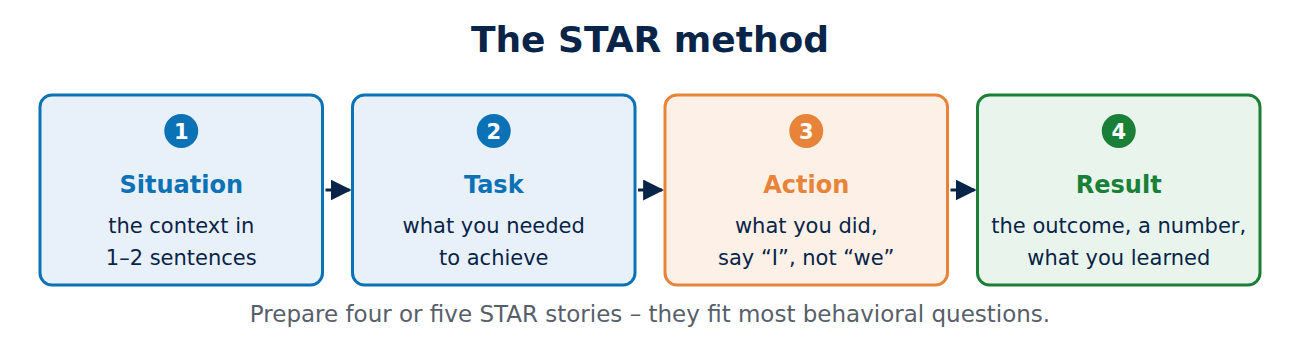
The STAR method for behavioral questions
Questions that start with “Tell me about a time when…” are behavioral questions. Answer them with a short story using STAR:
- Situation: the context, in one or two sentences.
- Task: what you needed to achieve.
- Action: what you did, step by step, using “I” rather than “we”.
- Result: the outcome, ideally with a number, and what you learned.
Aim for one to two minutes per answer. Prepare five or six stories from classes, group projects, jobs, volunteering and clubs that you can adapt to different questions.
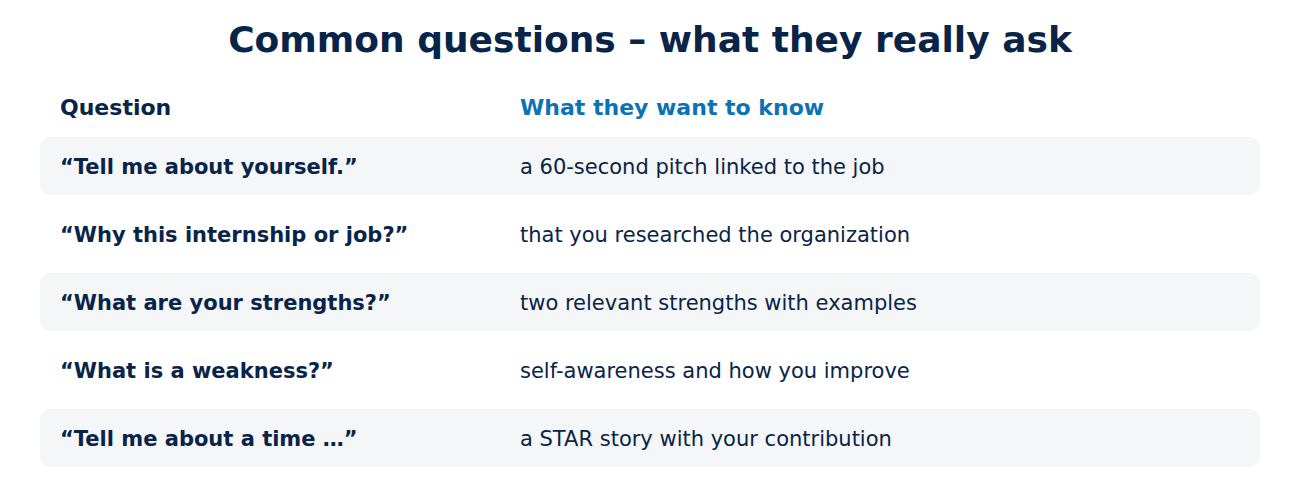
Common questions and how to answer them
- “Tell me about yourself.” A 60-second pitch: your studies, one or two relevant experiences and why you are interested in this role. Not your life story.
- “Why do you want this internship or job?” Show you researched the organization: mention a project, value or product, and connect it to your goals.
- “What are your strengths?” Name two strengths relevant to the job and give a quick example for each.
- “What is a weakness?” Choose a real but manageable weakness and explain what you are doing to improve it.
- “Tell me about a time you worked in a team.” STAR story; show how you contributed and handled any conflict. See group project tips.
- “Describe a challenge or failure.” STAR story with an honest result and what you learned.
- “How do you manage your time?” Describe your actual system: calendar, priorities, examples from busy exam weeks.
- “Where do you see yourself in five years?” Show direction and interest in growing in the field, without promising to stay forever.
- “Do you have any questions for us?” Always say yes; see below.
Questions to ask the interviewer
- “What does a typical day look like for someone in this role?”
- “What would success look like in the first three months?”
- “How does the team support interns or new employees?”
- “What do you enjoy most about working here?”
- “What are the next steps in the process?”
Avoid asking only about pay and vacation in a first interview, unless the interviewer brings it up.
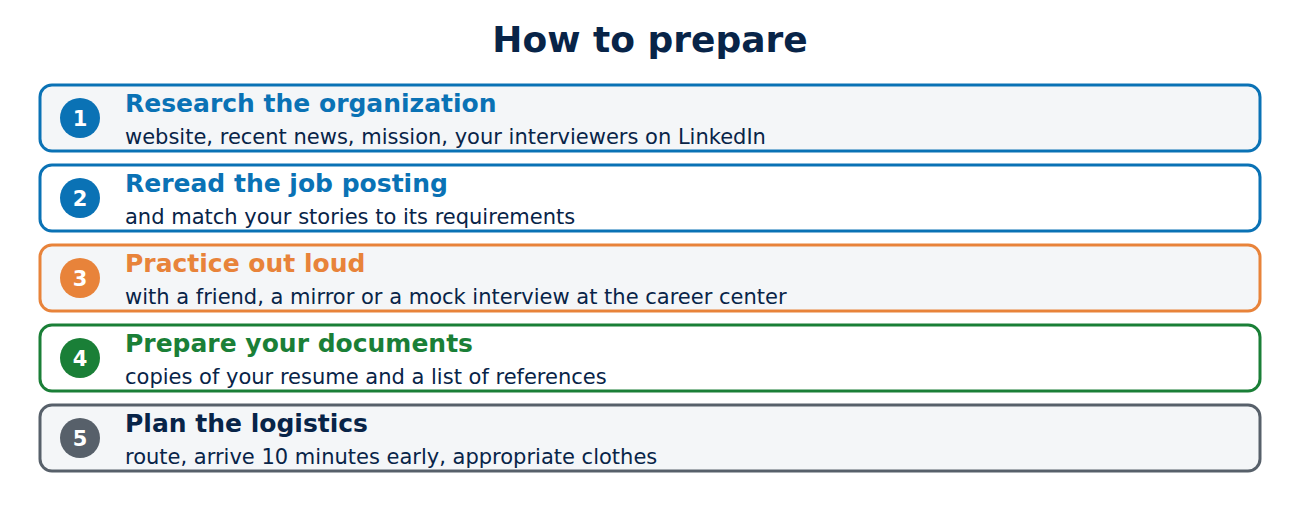
How to prepare
- Research the organization: website, recent news, products, mission and the people interviewing you on LinkedIn.
- Reread the job posting and match your stories to its requirements.
- Practice out loud, with a friend, a mirror or a mock interview at your career center.
- Prepare your documents: copies of your resume and a list of references; see how to write a resume with no experience.
- Plan the logistics: route, timing (arrive 10 minutes early) and appropriate clothes for the workplace.
Video interviews
- Test the platform, camera, microphone and internet the day before.
- Sit facing a window or a lamp, with a quiet, tidy background.
- Look at the camera when you speak, not at your own image.
- Keep notes nearby but do not read from them.
- For recorded (one-way) interviews, practice answering within the time limit.
After the interview
Send a short thank-you e-mail within 24 hours: thank the interviewer, mention one thing you discussed and confirm your interest. Many of the same principles apply as in e-mailing a professor. If you do not get the position, ask politely for feedback and keep practicing.
Conclusion
Prepare for interviews by researching the organization, rehearsing answers to the common questions and building five or six STAR stories from your studies, jobs and activities. Keep “tell me about yourself” to a minute, show genuine motivation, prepare thoughtful questions for the interviewer, test your setup for video interviews and send a thank-you note afterwards.
Sources and further reading
- Interview and negotiate (CareerOneStop, US Department of Labor)
- What employers are looking for (National Association of Colleges and Employers)













Recent Comments