
Your GPA (grade point average) sums up your academic performance in one number, and it matters for scholarships, honors, internships, graduate school applications and sometimes for keeping financial aid. Yet many students are not sure how it is calculated, why credit hours matter or what a weighted GPA is.
This guide explains the standard 4.0 scale, shows step by step how to calculate your GPA with a worked example, and gives practical ways to raise it.
The 4.0 grade scale
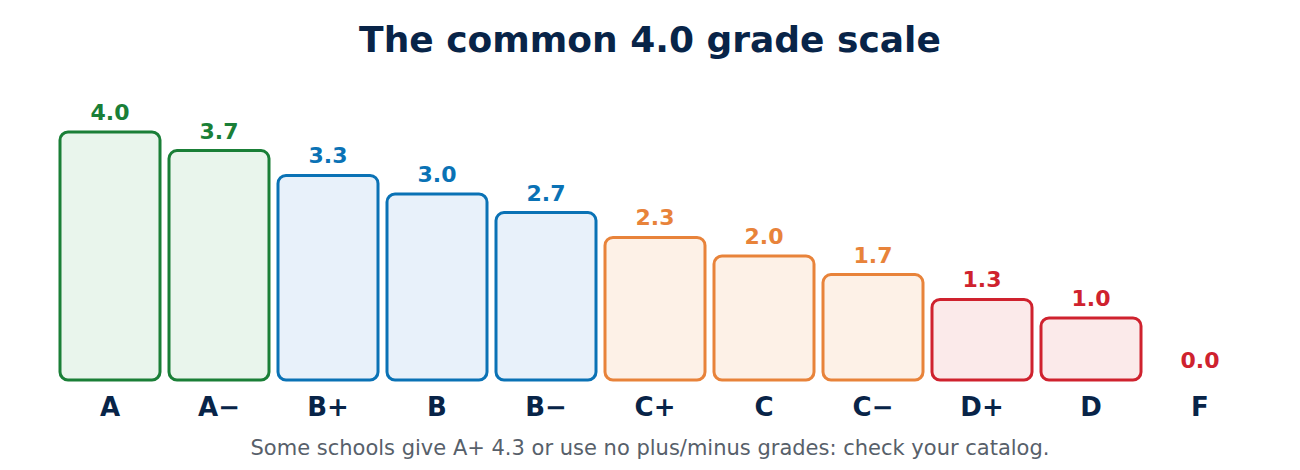
Most US colleges convert letter grades into grade points on a 4.0 scale. A common version:
- A = 4.0, A− = 3.7
- B+ = 3.3, B = 3.0, B− = 2.7
- C+ = 2.3, C = 2.0, C− = 1.7
- D+ = 1.3, D = 1.0
- F = 0.0
Some schools give an A+ 4.0 and others 4.3, and some do not use plus and minus grades at all. Always check your college’s catalog or registrar’s website for the exact scale.
How to calculate your GPA
Your GPA is weighted by credit hours: a 4-credit course counts more than a 1-credit lab.
- Convert each grade into grade points using your school’s scale.
- Multiply the grade points by the course’s credit hours. The result is the “quality points” for that course.
- Add up all quality points.
- Add up all credit hours (of courses that count toward the GPA).
- Divide the total quality points by the total credit hours.
A worked example
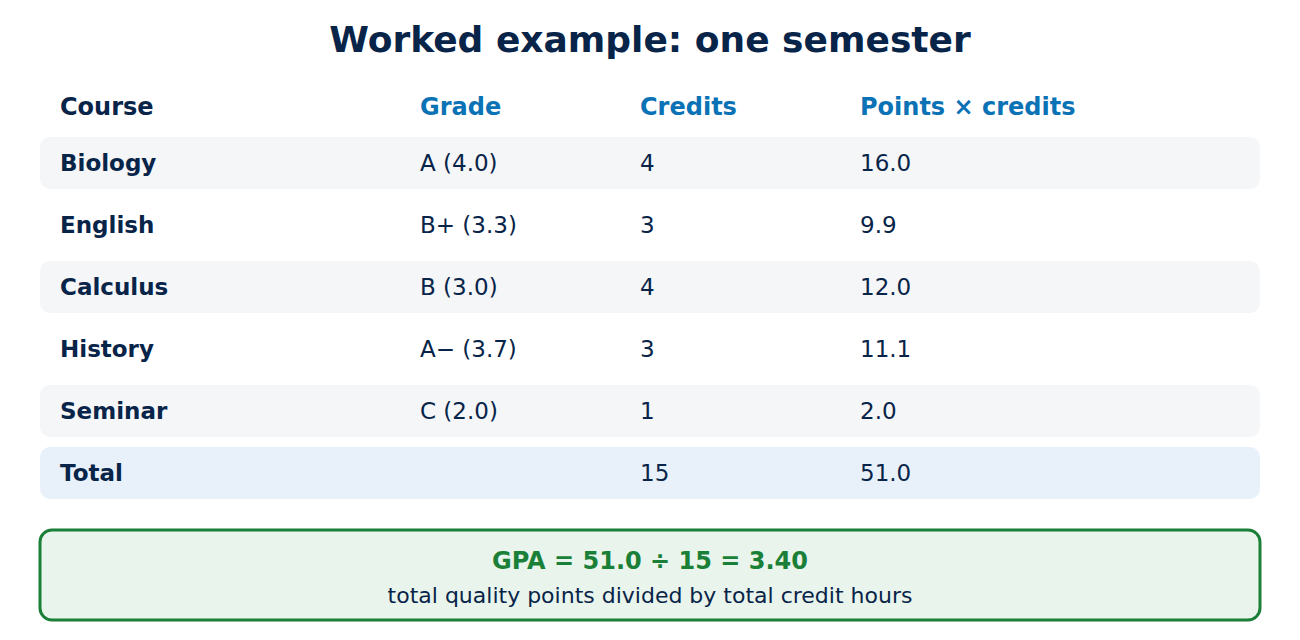
- Biology (4 credits), grade A: 4.0 × 4 = 16.0 quality points
- English (3 credits), grade B+: 3.3 × 3 = 9.9
- Calculus (4 credits), grade B: 3.0 × 4 = 12.0
- History (3 credits), grade A−: 3.7 × 3 = 11.1
- Seminar (1 credit), grade C: 2.0 × 1 = 2.0
Total quality points: 16.0 + 9.9 + 12.0 + 11.1 + 2.0 = 51.0. Total credits: 4 + 3 + 4 + 3 + 1 = 15. GPA: 51.0 ÷ 15 = 3.40.
Semester GPA vs cumulative GPA
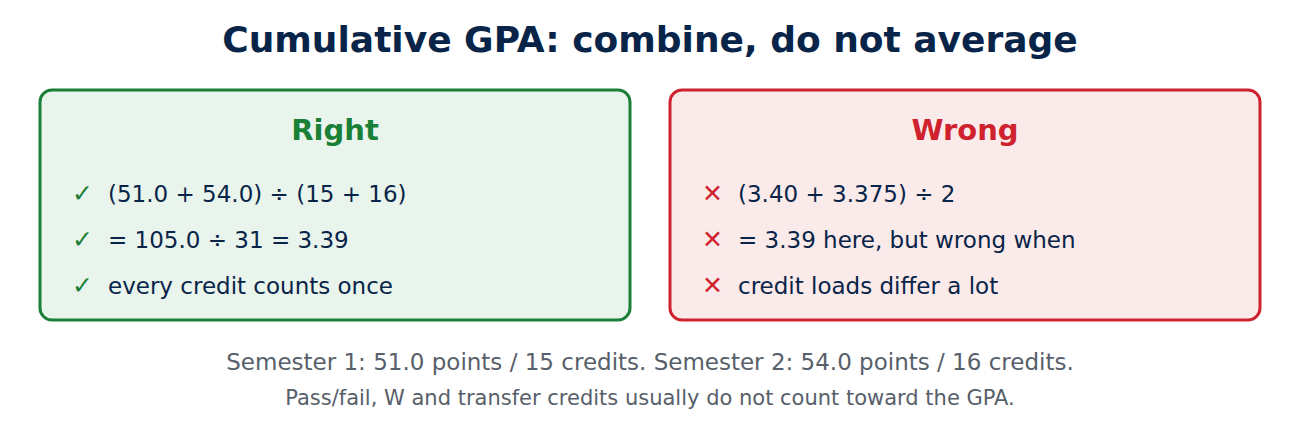
Your semester GPA covers one term. Your cumulative GPA covers all terms at that institution. To calculate it, add the quality points and credit hours of all semesters and divide once; do not average the semester GPAs, because semesters with more credits count more.
Example: semester 1 had 51.0 quality points from 15 credits (3.40), semester 2 had 54.0 from 16 credits (3.375). Cumulative GPA: (51.0 + 54.0) ÷ (15 + 16) = 105.0 ÷ 31 = 3.39.
What usually does not count
- Pass/fail courses: a pass gives credits but usually no grade points; a fail may or may not count, depending on the school.
- Withdrawals (W) usually do not affect the GPA. An incomplete (I) does not count until it is resolved, but if you do not finish the work in time, it often turns into an F.
- Transfer credits often count toward your degree but not toward your GPA at the new school.
- Repeated courses: many colleges replace the first grade with the new one (grade forgiveness), others average both. Check the policy before you retake a class.
Weighted vs unweighted GPA
High schools often report a weighted GPA, where honors, AP or IB courses earn extra points (for example 5.0 for an A in an AP class). An unweighted GPA uses the normal 4.0 scale for all classes. Colleges usually use unweighted GPAs, and many admissions offices recalculate applicants’ GPAs in their own way.
What counts as a good GPA?
It depends on your goals. As a rough guide, a 3.0 (B average) is the minimum many employers, scholarships and graduate programs ask for, 3.5 and above is strong, and Latin honors such as cum laude often start around 3.5, with thresholds set by each school. Many scholarships and federal financial aid also require “satisfactory academic progress”, often at least a 2.0 cumulative GPA.
GPA outside the US
Many countries use other systems: UK universities award degree classes (first, upper second, lower second, third), German universities use grades from 1.0 (best) to 4.0 (lowest pass), and many countries use percentages or a 10-point scale. Applications to US programs may ask you to convert your grades or to use a credential evaluation service such as WES or ECE; follow the program’s instructions instead of converting on your own.
How to raise your GPA
- Focus on high-credit courses, where each grade has the biggest effect.
- Use proven study methods: active recall and spaced repetition beat rereading; see how to study effectively.
- Go to office hours early in the semester, not the week before the final.
- Check the drop and withdrawal deadlines if a course is going badly.
- Balance your schedule: do not take all the hardest courses in one semester.
- Repeat a failed course if your college offers grade replacement.
Remember that one bad semester has less and less effect as you complete more credits, and many employers care at least as much about internships, projects and skills.
Conclusion
To calculate your GPA, convert each grade into grade points, multiply by the course’s credit hours, add up the quality points and divide by the total credits. Calculate the cumulative GPA from all quality points and credits, not by averaging semesters. Check your school’s exact scale and its rules for pass/fail, withdrawals and repeated courses, and focus your effort on high-credit courses to raise your average.
Sources and further reading
- Staying eligible for federal student aid (Federal Student Aid, US Department of Education)
- World Education Services (credential evaluation)



















Recent Comments