
Transferring colleges is far more common than many students think. According to the National Student Clearinghouse Research Center, more than a third of students who started college in fall 2008 (37.2 %) transferred at least once within six years. Some move from a community college to a four-year university, others want a different major, a cheaper school or a place closer to home. Done well, a transfer saves money and gets you where you want to be; done badly, it costs credits and time. This guide shows how to plan a transfer step by step.
Step 1: be clear about why
Write down your reasons: academic program, cost, location, family, campus culture, mental health. Then ask whether the problem can be solved at your current school: a different major, a new housing situation, counseling or a financial aid appeal. If not, your reasons become your criteria for choosing the new school and the core of your transfer essay.
Step 2: research target schools
- Program and fit: does the school have your major, and is it open to transfers? Some majors are competitive and have extra requirements.
- Transfer acceptance rate: many schools publish it in their Common Data Set; it can differ a lot from the freshman acceptance rate.
- Accreditation: credits usually transfer only between regionally (institutionally) accredited schools. See how to check accreditation.
- Cost and aid: use each school’s net price calculator, and check transfer scholarships, especially for Phi Theta Kappa members from community colleges.
Step 3: protect your credits
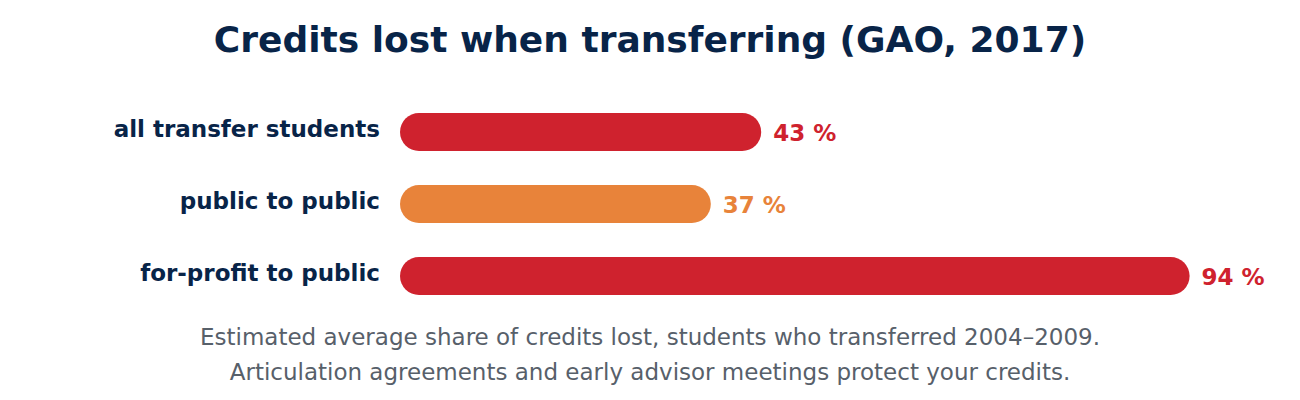
Credit loss is the biggest hidden cost of transferring. A 2017 report by the US Government Accountability Office estimated that students who transferred lost an average of 43 % of their credits. To avoid it:
- Look for articulation agreements between your current and target school, or state transfer pathways and guaranteed admission programs, which define exactly which courses count.
- Use transfer equivalency tools on the target school’s website or Transferology to see how each course transfers.
- Know the difference between credits that transfer as electives and credits that count toward your major and general education. Only the second kind shortens your path.
- Check minimum grades: many schools only accept courses with a C or better.
- Ask about residency requirements: most schools require a minimum number of credits (often 30 or more) to be earned there to graduate.
- Keep your syllabi: they are evidence when you appeal a credit decision.
Step 4: meet deadlines
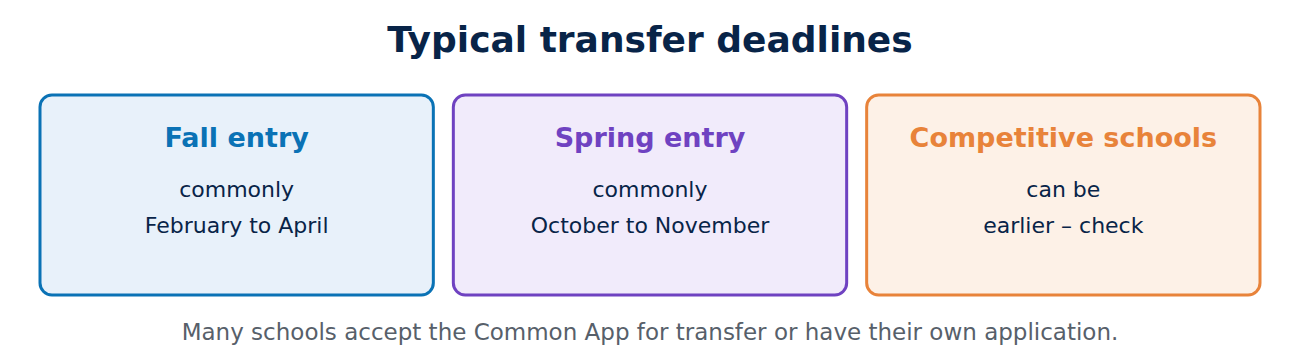
Transfer deadlines are often later than freshman deadlines: commonly February to April for fall entry and October to November for spring entry, but competitive schools can be earlier. Many schools accept the Common App for transfer or have their own application. Typical requirements:
- official transcripts from every college you attended, and sometimes your high school transcript if you have fewer than about 24–30 credits;
- a transfer essay explaining why you want to transfer and why this school;
- a college report or dean’s statement confirming good standing;
- one or two recommendation letters, ideally from college professors; see how to ask for a letter of recommendation.
Step 5: write a strong transfer essay
Focus on the future, not on complaints about your current school. Explain what you have learned and achieved so far, what you want to study, and specifically how the new school’s courses, faculty or opportunities help you get there. Be honest and concrete; see how to write an essay about yourself.
Step 6: financial aid
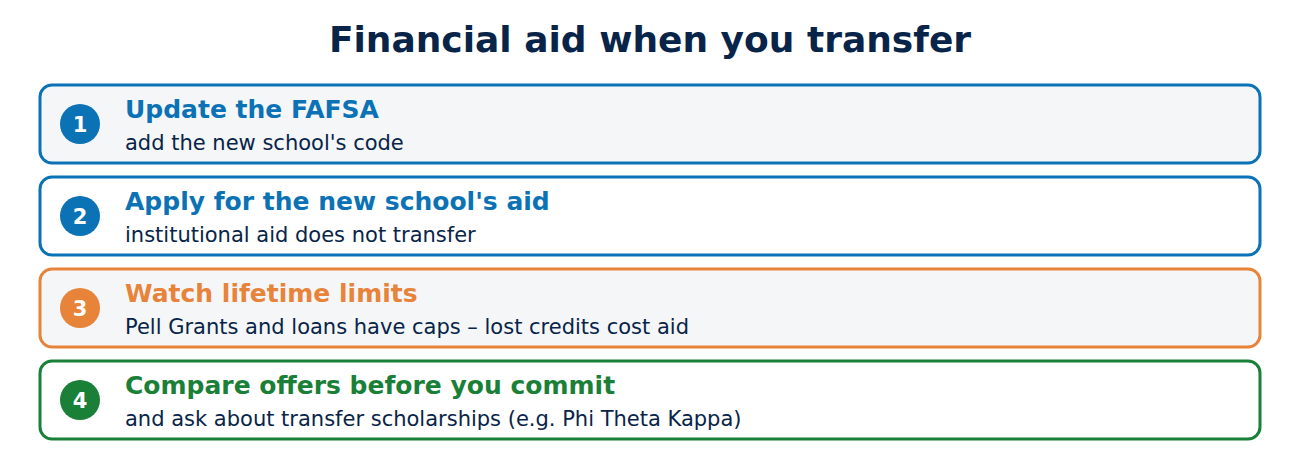
- Update the FAFSA: add the new school’s code so it receives your information.
- Institutional aid does not transfer; apply for the new school’s scholarships separately.
- Check aid limits: federal Pell Grants and loans have lifetime limits, so lost credits can cost aid.
- Compare offers before you commit, and ask about transfer-specific scholarships.
Step 7: settle in after the move
Transfer students often feel like outsiders at first: friend groups already exist and campus routines are new. Attend transfer orientation, join a transfer student group or club in your major, meet your new advisor in the first weeks, and plan your remaining courses to graduation. See how to make friends in college.
Conclusion
Know why you want to transfer, research programs, transfer acceptance rates and costs, and protect your credits with articulation agreements, equivalency tools and early advisor meetings. Meet the transfer deadlines, write a future-focused essay, update your FAFSA and apply for the new school’s aid. A planned transfer saves time and money; a rushed one can cost both.
Sources and further reading
- Higher education: Students need more information to help reduce challenges in transferring college credits (US Government Accountability Office, 2017)
- Transfer and Mobility: A National View of Student Movement (2015) (National Student Clearinghouse Research Center)
- Transferring schools and financial aid (Federal Student Aid)



















Recent Comments