
Essays are built from paragraphs, and most essay problems are really paragraph problems: a body paragraph that drifts between three ideas, quotes without explanation, or no clear point at all. Once you can write one strong paragraph, every essay gets easier. This guide explains what a paragraph needs, the popular PEEL structure, how long a paragraph should be and how to connect paragraphs smoothly, with a worked example.
One paragraph, one idea
A paragraph develops one main idea that supports your thesis. If you notice you are starting a new point, start a new paragraph. This unity makes your writing easy to follow and lets the reader see the structure of your argument at a glance.
The PEEL structure
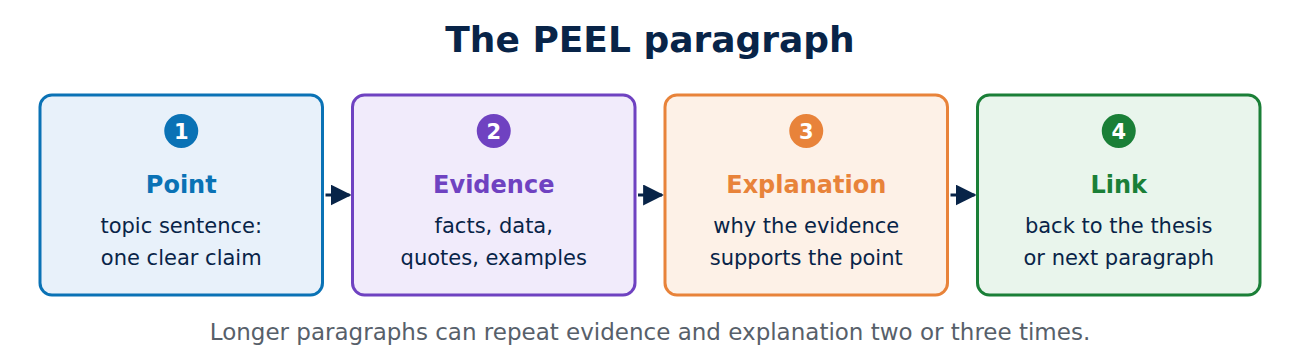
Many teachers use PEEL (or similar models such as PEE, PEA, TEEL or claim–evidence–reasoning):
- Point: the topic sentence states the paragraph’s main claim.
- Evidence: facts, data, quotations, examples or research that support it.
- Explanation: how and why the evidence supports your point: the analysis.
- Link: a closing sentence that connects back to the thesis or leads to the next paragraph.
For longer paragraphs you can repeat evidence and explanation two or three times before the link.
Write a strong topic sentence
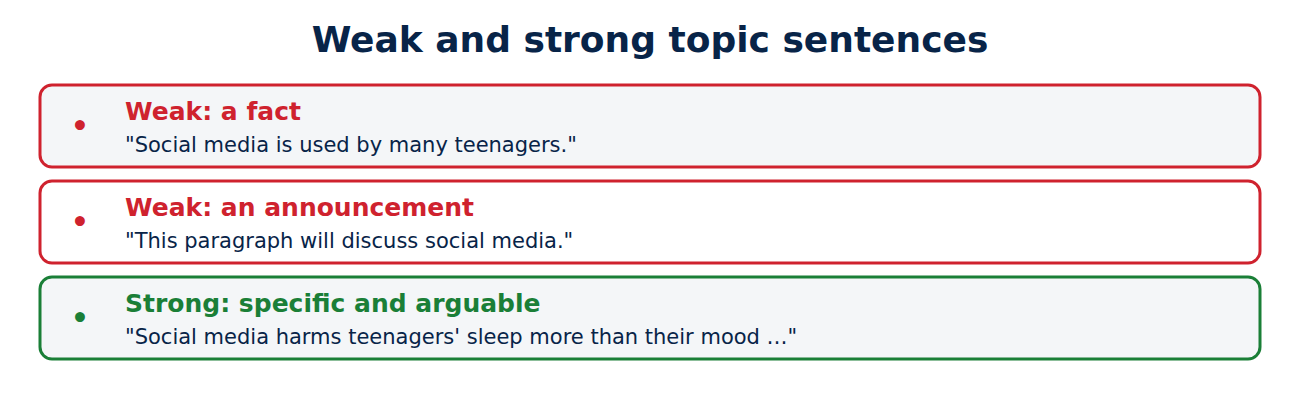
The topic sentence is a mini-thesis for the paragraph. It should be specific and arguable, not a fact or a vague announcement:
- Weak: “Social media is used by many teenagers.”
- Weak: “This paragraph will discuss social media.”
- Strong: “Social media harms teenagers’ sleep more than their mood, because the main damage happens late at night.”
Test: if someone reads only your topic sentences, they should understand the outline of your essay.
Explain more than you quote
The most common weakness is evidence without explanation. After every quote or statistic, answer: what does this show, and why does it matter for my point? A good rule of thumb is at least as many words of explanation as of evidence. Introduce quotations with context (“According to a 2023 survey by…”) and cite them correctly; see how to avoid plagiarism.
A worked example
(Point) Requiring laptops to be closed during lectures would help most students learn more. (Evidence) In a well-known experiment, Mueller and Oppenheimer (2014) found that students who took notes by hand answered conceptual questions better than those who typed, because typists tended to copy lectures word for word. (Explanation) Writing by hand is slower, which forces students to summarize and rephrase ideas in their own words, the kind of processing that builds understanding. Laptops also invite multitasking, which distracts not only the user but students sitting nearby. (Link) A closed-laptop policy therefore addresses both how students take notes and what distracts them, although, as the next section shows, exceptions are needed for students with accommodations.
Note how the explanation goes beyond the study and the link sets up the next paragraph. Later replication studies found smaller effects, which a full essay would mention; see the Cornell note-taking method for better notes on any device.
How long should a paragraph be?
In academic essays, body paragraphs are typically 100–250 words, often four to eight sentences. That is a guideline, not a rule: a paragraph needs enough room to make and support its point. If a paragraph runs past about half a page, check whether it contains two ideas. Very short paragraphs (one or two sentences) usually lack evidence or explanation, except in journalism, emails and online writing, where short paragraphs are normal.
Transitions between paragraphs
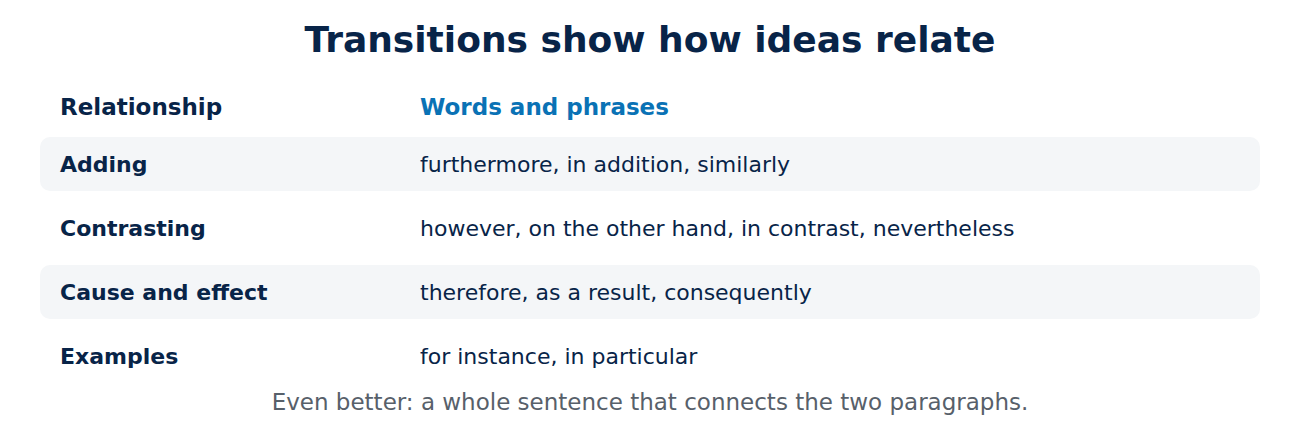
Readers need to know how each paragraph relates to the one before it. Use transitional words and phrases that show the relationship:
- Adding: furthermore, in addition, similarly.
- Contrasting: however, on the other hand, in contrast, nevertheless.
- Cause and effect: therefore, as a result, consequently.
- Examples: for instance, in particular.
Even better than a transition word is a sentence that links ideas: “While closing laptops improves note-taking, it creates a problem for students who rely on assistive software.”
Introductions and conclusions are different
Introduction and conclusion paragraphs follow their own patterns: from hook to thesis, and from restated thesis to a closing thought. See how to write an essay introduction and how to write a conclusion.
Paragraph checklist
- Does the topic sentence state one clear, arguable point?
- Is every sentence about that point?
- Is there specific evidence, correctly cited?
- Is the explanation at least as long as the evidence?
- Does the last sentence link to the thesis or the next paragraph?
Conclusion
A strong paragraph has one idea: a specific topic sentence, evidence, explanation that shows why the evidence matters, and a link. Keep body paragraphs around 100–250 words, explain more than you quote, and connect paragraphs with transitions that show how the ideas relate.
Sources and further reading
- Paragraphs (UNC Writing Center)
- On paragraphs (Purdue Online Writing Lab)
- Mueller and Oppenheimer (2014): The pen is mightier than the keyboard (Psychological Science)


















Recent Comments