
An internship is often the bridge between college and your first job: you test a career, build real experience and make contacts. Many employers recruit a large share of their entry-level hires from their own intern programs. But landing your first internship can feel like a catch-22: you need experience to get experience. This guide shows when to start, where to look, how to apply and how to stand out, even as a first- or second-year student.
When to start looking
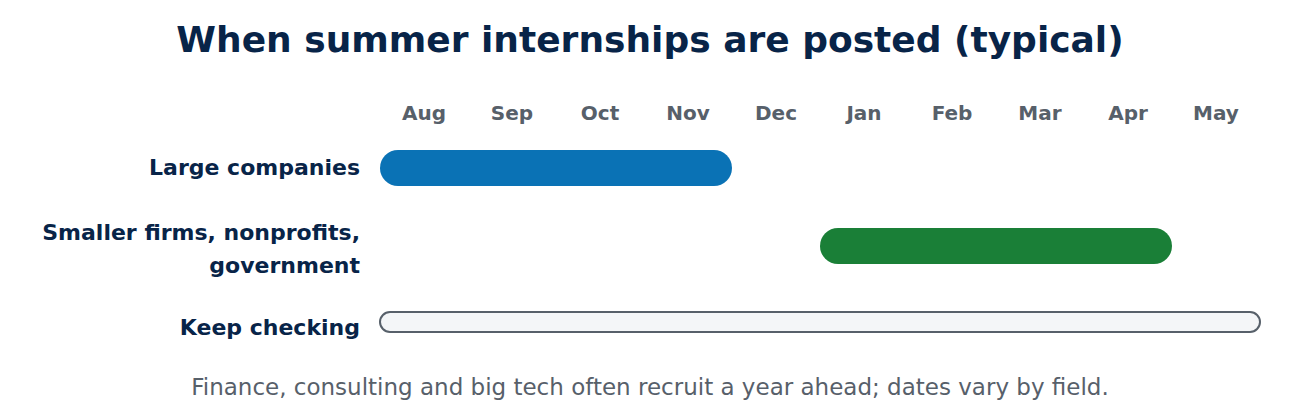
- Large companies (finance, consulting, tech, big engineering firms) recruit for summer internships early, often in the fall of the year before, sometimes from August.
- Small and mid-size companies, nonprofits and government agencies often hire in January to April for the summer.
- Semester internships during the school year are posted a few months ahead.
Rule of thumb: start researching in early fall, apply between September and March, and keep checking into late spring.
Step 1: figure out what you want
List two or three fields or roles you would like to test, and what you can offer: courses, skills (Excel, writing, coding, design, languages), projects and activities. You do not need a perfect career plan; internships are for exploring. See how to choose a college major if you are unsure.
Step 2: prepare your materials
- Resume: one page, with education, relevant courses, projects, activities and any job. Use bullet points with actions and results. Template: how to write a resume with no experience.
- Cover letter: tailored to each application; see how to write an internship cover letter.
- LinkedIn profile: a clear photo, a headline such as “Biology student | Lab research | Science communication”, and your experience and skills.
- Portfolio for creative and technical fields: writing samples, design work, a GitHub profile with projects.
Have your college’s career center review your resume; it is free and they know what local employers expect.
Step 3: search in the right places
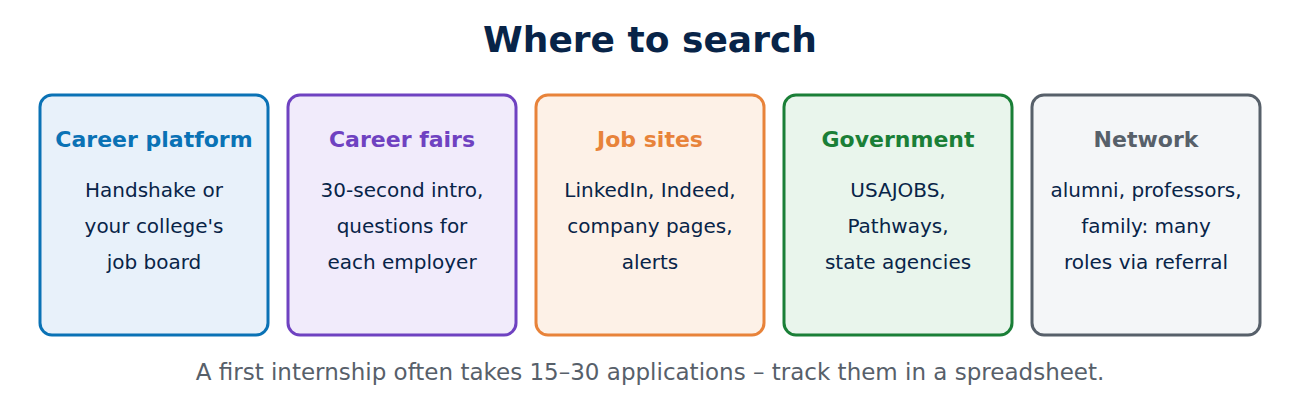
- Your college’s career platform (often Handshake): employers there are actively looking for students from your school.
- Career fairs, on campus and virtual. Prepare a 30-second introduction and questions for each employer.
- LinkedIn, Indeed and company career pages: search for “intern” plus your field; set alerts.
- Government and nonprofit programs: in the US, USAJOBS and the Pathways Internship Program, state agencies, and organizations in your area.
- Professors and departments: research assistant roles and contacts in industry.
- Your network: family, alumni, former teachers. Many internships are filled through referrals.
Step 4: use networking and informational interviews
Message alumni or professionals in your target field on LinkedIn and ask for a 15-minute informational interview: “I’m a sophomore studying economics and interested in urban planning. Would you be open to a short call about your path?” Ask about their work and advice, not directly for a job. People often remember students who showed genuine interest and pass on openings.
Step 5: apply strategically
- Apply widely: 15–30 applications for a first internship is normal; response rates are low.
- Tailor every application: match your resume keywords honestly to the posting; many companies use applicant tracking systems.
- Track your applications in a spreadsheet: company, role, date, contact, status, follow-up.
- Prepare for interviews with the STAR method: common interview questions for students. Afterwards, send a thank-you email.
No experience? Build it
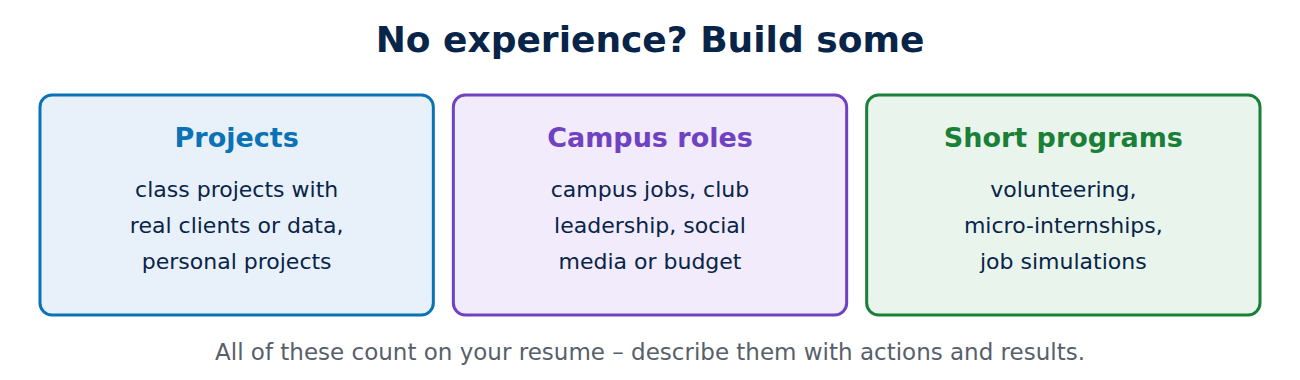
- Class projects with real clients or data count as experience on your resume.
- Campus jobs and student organizations: leadership in a club, running the club’s social media or budget.
- Volunteering for nonprofits that need help with marketing, events or data.
- Micro-internships and virtual job simulations: short paid projects or free online programs from companies.
- Personal projects: a website, an app, a blog, a research poster.
Paid or unpaid?
Prefer paid internships when you can: they are fairer and, according to NACE surveys, paid interns receive job offers more often than unpaid interns. In the US, for-profit companies may only use unpaid interns if the internship primarily benefits the student, under the Department of Labor’s “primary beneficiary” test. Some colleges offer stipends for unpaid nonprofit or government internships, and many internships can earn academic credit.
Conclusion
Start researching in early fall, prepare a one-page resume, tailored cover letters and a LinkedIn profile, and search through your career center, fairs, LinkedIn, government programs and your network. Apply widely and track your applications, use informational interviews, and build experience through projects, campus roles and volunteering if you have none yet.
Sources and further reading
- Fact Sheet #71: Internship programs under the FLSA (US Department of Labor)
- National Association of Colleges and Employers (NACE)
- Pathways Programs for students and recent graduates (US Office of Personnel Management)


















Recent Comments