
Germany is one of the most popular study destinations for international students, and for good reason: most public universities charge no tuition fees, degrees are recognised worldwide, and there are well over a thousand programmes taught entirely in English. But “free” does not mean cheap, and the visa process needs months of preparation.
This guide explains what studying in Germany really costs, how admission and the student visa work, how to find English-taught programmes, and what you are allowed to do during and after your studies. For an overview of the best-known universities, see our guide to top universities in Germany.
Is studying in Germany really free?
At most public universities, bachelor’s degrees and most master’s degrees that follow directly on a bachelor’s have no tuition fees, also for students from outside the EU. There are important exceptions:
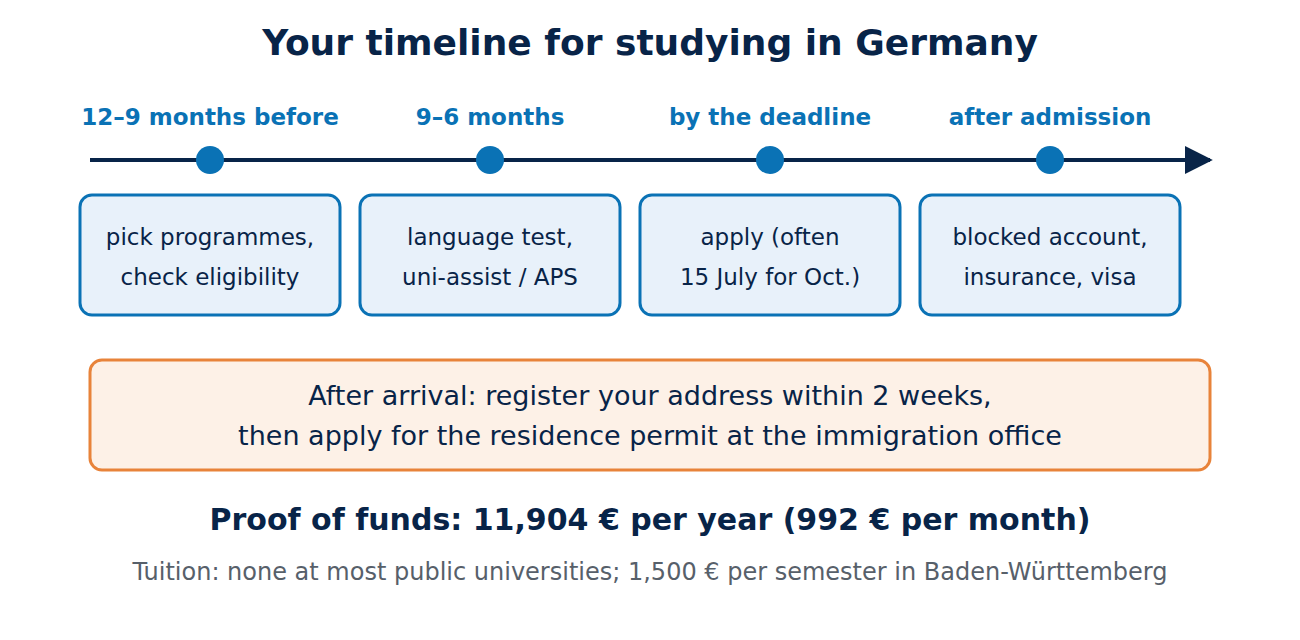
- Baden-Württemberg (for example Heidelberg, Freiburg, Stuttgart, Tübingen and KIT) charges non-EU students 1,500 euros per semester.
- The Technical University of Munich (TUM) has charged most non-EU students tuition since winter semester 2024/25, set per programme (for bachelor’s degrees typically 2,000 to 3,000 euros per semester, more for master’s).
- Private universities charge tuition everywhere, often 5,000 to 15,000 euros per year or more.
- Non-consecutive master’s programmes, such as many MBAs, can have fees at public universities too.
Every student also pays a semester contribution of roughly 100 to 400 euros. It covers student services and administration and often includes a public transport ticket for the region or the national Deutschlandsemesterticket.
How much money you need
To get a student visa, you must prove that you can pay for your living costs. Since September 2024 the required amount has been 11,904 euros for the first year (992 euros per month). The amount is linked to the German student grant (BAföG) and can change, so check the website of the German embassy in your country before you apply.
Most students prove this with a blocked account (Sperrkonto): you deposit the full amount, and after arrival you can withdraw only the monthly share. Other options are a scholarship, a formal declaration of commitment by someone living in Germany, or a bank guarantee.
Typical monthly costs, depending on the city:
- Rent: the biggest item. A room in a student residence or a shared flat (WG) costs much less in Leipzig or Chemnitz than in Munich, Frankfurt or Hamburg, where rooms often cost well over 500 euros.
- Health insurance: compulsory. Students under 30 at public universities usually join the statutory insurance at a reduced student rate, currently around 140 to 150 euros per month including long-term care insurance.
- Food, phone, internet, study materials and leisure: plan at least 300 to 400 euros.
Apply for a place in a student residence as early as possible: in many cities the waiting lists are long. Our tips on making study abroad more affordable help with budgeting.
Admission: are you eligible?
For a bachelor’s degree you need a school leaving certificate that is recognised as equivalent to the German Abitur (the “Hochschulzugangsberechtigung”). Some certificates qualify directly, others need one year of university study in your home country, and some require a foundation course at a Studienkolleg and an assessment test. The DAAD’s admission database shows the rules for your country.
Other points to plan for:
- Language: English-taught programmes usually ask for IELTS or TOEFL, German-taught ones for the TestDaF or DSH exam.
- uni-assist: many universities let the uni-assist service check international applications first. This takes several weeks and costs a fee.
- APS certificate: applicants from China, India and Vietnam need an APS certificate from the German embassy that verifies their documents.
- Deadlines: for the winter semester (starting in October) the deadline is often 15 July, for international applicants sometimes much earlier. For the summer semester (April) it is often 15 January.
Finding English-taught programmes
The DAAD International Programmes database lists programmes taught in English. Most of them are master’s degrees; English bachelor’s degrees exist but are rarer and more competitive. Even in an English programme, learn some German: it makes everyday life, part-time jobs and finding work after graduation much easier.
Germany has two main types of universities: research universities (Universitäten) and universities of applied sciences (Fachhochschulen or Hochschulen für angewandte Wissenschaften), which are more practical and often include internships. Both award recognised bachelor’s and master’s degrees.
The student visa step by step
- Get admission (or, if you are still waiting, apply for a visa for the purpose of applying to university).
- Prove your finances, usually with a blocked account, and arrange health insurance.
- Book an appointment at the German embassy or consulate. In many countries waiting times are several months, so book early. Some missions now accept applications through the online Consular Services Portal.
- After arrival, register your address at the local registration office within two weeks and apply for a residence permit for study at the immigration office (Ausländerbehörde).
Students from the EU and EEA do not need a visa. Citizens of some countries, including the US, Canada, Australia, Japan and South Korea, can enter without a visa and apply for the residence permit in Germany.
Working during and after your studies
Non-EU students may work 140 full days or 280 half days per year, plus jobs as student assistants at the university. During the semester the limit is about 20 hours a week. Many students work in cafés, offices or as working students (Werkstudent) at companies in their field.
After graduating you can get a residence permit of up to 18 months to look for a job that fits your qualification, and you may work without restrictions during that time. Germany is short of skilled workers in engineering, IT, health and many other fields, so this is a real advantage over many other countries.
Conclusion
Studying in Germany combines low or no tuition with good career chances, but you need about 1,000 euros a month for living costs, proof of that money before you get a visa, and several months of preparation. Start a year ahead: check your eligibility, choose programmes in the DAAD database, plan the blocked account and book your visa appointment early. If you are still deciding where to go, read 5 tips to choose your study abroad destination.
Sources and further reading
- Studying in Germany (DAAD, German Academic Exchange Service)
- Study in Germany (official DAAD portal)
- Visa requirements for Germany (Federal Foreign Office)
- International Programmes in Germany (DAAD database)
















Recent Comments