
An abstract is a short summary of a research paper, thesis or conference presentation, usually 150–250 words. It is often the only part people read: databases show it, reviewers decide based on it, and readers use it to judge whether the full paper is worth their time. Writing a good one is a skill you will use in lab reports, capstone projects, conference applications and graduate school. This guide explains the types of abstracts, the four-part structure and a step-by-step method, with an example.
Descriptive vs informative abstracts
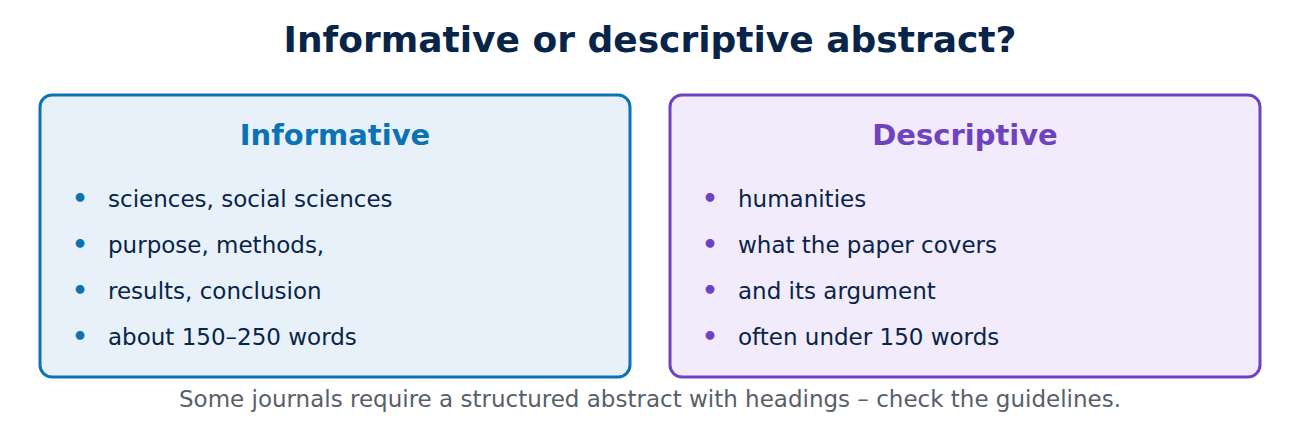
- Informative abstracts (the usual type in the sciences and social sciences) report the purpose, methods, main results and conclusion. A reader can understand the key findings without the paper.
- Descriptive abstracts (common in the humanities) describe what the paper covers and its argument, but not necessarily the results. They are shorter, often under 150 words.
Some journals and courses require a structured abstract with headings such as Background, Methods, Results and Conclusions. Always check the instructions or the journal’s author guidelines.
The four parts of an informative abstract
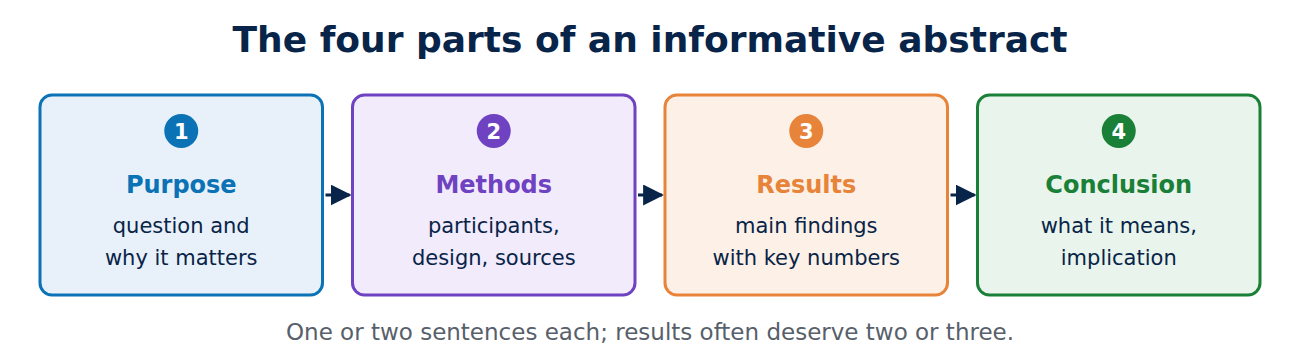
- Purpose or problem (1–2 sentences): what question did you study, and why does it matter?
- Methods (1–2 sentences): how did you study it? Participants, materials, design or sources.
- Results (2–3 sentences): the main findings, with key numbers where possible.
- Conclusion (1–2 sentences): what the results mean, and the main implication or recommendation.
Step-by-step method
- Write it last. You can only summarize a paper that is finished.
- Reread your paper and highlight the research question, method, key results and main conclusion. Your introduction, methods, results and discussion sections map onto the four parts.
- Draft one or two sentences for each part, in your own words, not copied sentences from the paper.
- Cut to the word limit. Remove background, examples, citations and phrases like “This paper will discuss”.
- Check it stands alone: no undefined abbreviations, no references to figures or tables, nothing that is not in the paper.
- Add keywords if required: three to five terms people would search for.
An example (student lab project, illustrative)
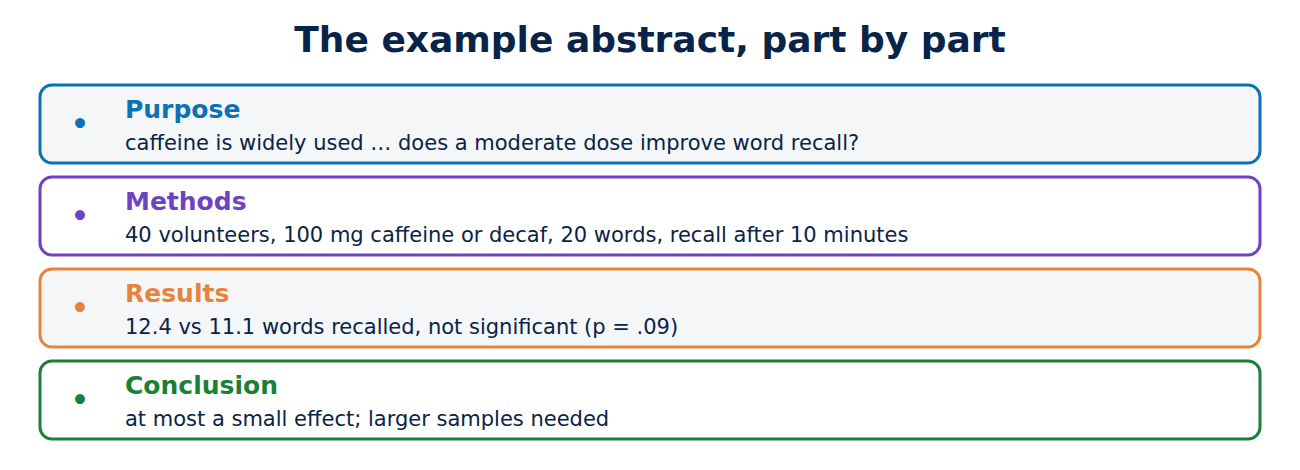
“Caffeine is widely used by students to improve alertness, but its effect on short-term memory is unclear. This study tested whether a moderate dose of caffeine improves word recall. Forty undergraduate volunteers were randomly assigned to drink coffee with 100 mg of caffeine or decaffeinated coffee, then memorized a list of 20 words and recalled them after ten minutes. The caffeine group recalled a mean of 12.4 words compared with 11.1 in the control group, a difference that was not statistically significant (p = .09). These results suggest that a moderate dose of caffeine has at most a small effect on short-term recall, and that larger samples are needed to detect it.”
This abstract has 112 words: purpose (sentences 1–2), methods (3), results (4) and conclusion (5). The data are an invented example.
Style tips
- Tense: past tense for what you did and found (“participants completed”), present tense for conclusions and established facts (“these results suggest”).
- Voice: many fields now accept “we” or “I”; follow your discipline’s style guide. APA 7 allows first person.
- Be specific: “recall improved by 12 %” is better than “results were positive”.
- Keep the format: APA papers place the abstract on its own page after the title page, with the heading “Abstract” centered and bold, as one paragraph without indentation. See the APA 7th edition guide.
Common mistakes
- Too much background and too little about results.
- Promising results (“will be discussed”) instead of stating them.
- Information or claims that are not in the paper.
- Going over the word limit; many submission systems cut it off.
- Jargon and abbreviations a non-specialist cannot follow.
Abstracts for conferences and proposals
A conference abstract is often written before the research is finished. Describe your question, methods and expected or preliminary results honestly, and explain why it is interesting for that audience. For a research plan, see how to write a research proposal. For the full paper, see how to write a research paper and how to write a lab report.
Conclusion
Write the abstract last, summarize purpose, methods, results and conclusion in one or two sentences each, and stay within the word limit, usually 150–250 words. Make it stand alone without citations or undefined abbreviations, report specific results, and check your instructor’s or journal’s format.
Sources and further reading
- Abstracts (UNC Writing Center)
- Abstract and keywords guide (APA Style)
- Abstracts (Purdue Online Writing Lab)



















Recent Comments