
Business, nursing, education, social work, law and psychology courses all love case studies: a realistic situation, often a company, a patient or a classroom, with a problem to solve. Your task is to analyze what is going on, apply course concepts and recommend what to do. Many students lose points by retelling the case instead of analyzing it. This guide shows a step-by-step method and a structure that works for most case study assignments.
What instructors want to see
- You can identify the real problem, not just the symptoms.
- You apply theories, models and evidence from the course.
- You compare options realistically, including costs and risks.
- You make a clear, justified recommendation and explain how to implement it.
Note: “writing a case study” can also mean researching and writing up a case yourself (common in psychology and research methods). This guide focuses on case study analysis, the more common assignment.
Step 1: read the case twice
Read once for the story. Then read again with a pen: mark facts, numbers, people and their goals, constraints (budget, time, laws) and quotes that reveal problems. Separate facts from opinions of the people in the case. Note what information is missing; you may need to state assumptions later.
Step 2: define the core problem
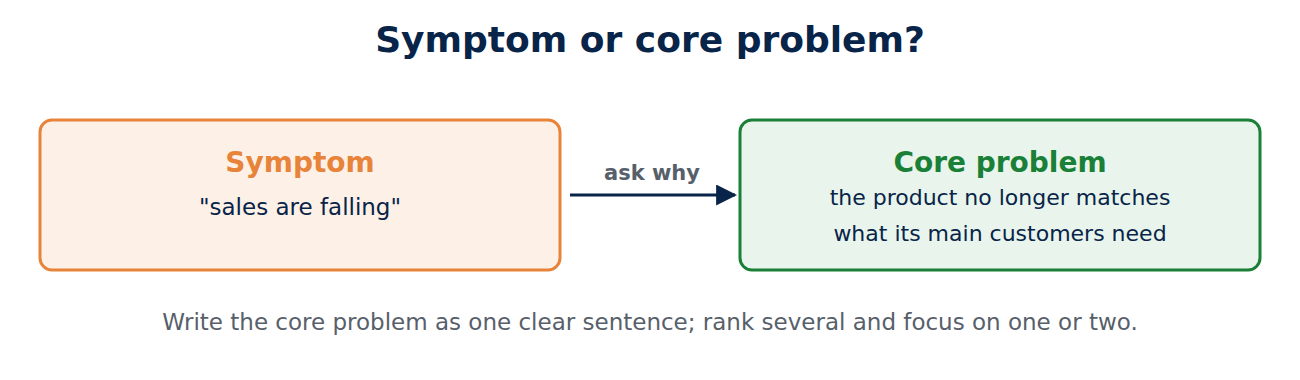
Symptoms are what people complain about; the core problem is what causes them. In a business case, “sales are falling” is a symptom; “the company’s product no longer matches what its main customers need” might be the problem. Write the problem as one clear sentence. If you find several, rank them and focus on the most important one or two.
Step 3: analyze with course frameworks
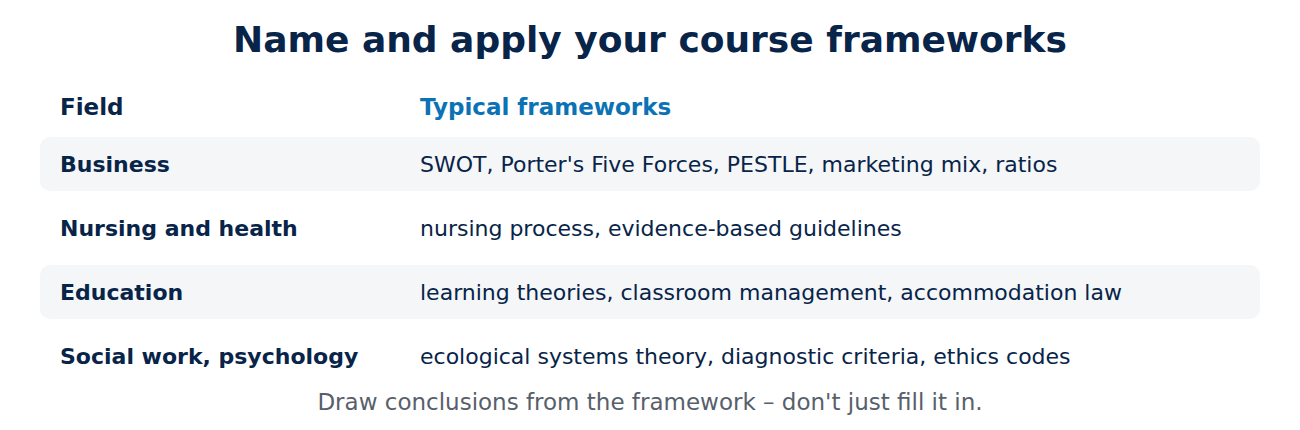
Use the tools your course has taught, and name them explicitly:
- Business: SWOT, Porter’s Five Forces, PESTLE, the marketing mix, financial ratios.
- Nursing and health: the nursing process (assessment, diagnosis, planning, implementation, evaluation), evidence-based guidelines.
- Education: learning theories, classroom management models, accommodation laws.
- Social work and psychology: ecological systems theory, diagnostic criteria, ethical codes.
Do not just fill in a framework; draw conclusions from it. “The SWOT shows that the company’s main strength, its loyal local customer base, is exactly what a new competitor threatens.”
Step 4: develop and compare alternatives
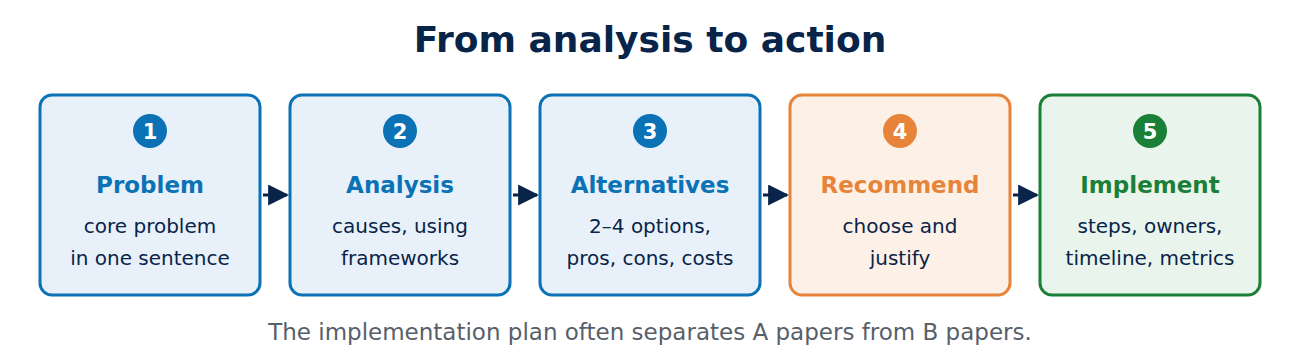
Propose two to four realistic solutions. For each, discuss advantages, disadvantages, costs, risks and how well it solves the core problem. A simple comparison table in your notes (or in the paper, if allowed) helps you choose and shows the instructor you considered options fairly.
Step 5: recommend and plan implementation
Choose the best option and justify it with evidence from the case and your analysis. Then explain how to implement it: steps, who is responsible, timeline, resources and how success will be measured. Address the main risk and how to reduce it. This practical part often separates A papers from B papers.
A structure that works
- Introduction: the organization or person, the situation, and a one-sentence statement of the core problem and your recommendation.
- Background: only the key facts needed to follow the analysis (short!).
- Problem statement and analysis: the core problem and its causes, using course frameworks.
- Alternatives: two to four options, evaluated.
- Recommendation: the chosen solution and justification.
- Implementation plan: steps, timeline, responsibilities, metrics.
- Conclusion: a brief summary and the expected outcome.
- References and appendices: sources in the required style (often APA) and supporting tables or calculations.
Many instructors allow or expect headings; check the rubric.
Tips for a stronger analysis
- Use evidence beyond the case: textbook concepts, journal articles, industry data or clinical guidelines.
- State assumptions when information is missing: “Assuming the budget cannot exceed last year’s…”
- Use numbers: calculate the cost of options, the break-even point or the effect on staff hours if data is available.
- Be decisive: “the company could consider…” is weaker than “the company should… because…”.
- Protect privacy: in clinical or social work cases based on real placements, remove names and identifying details.
Common mistakes
- Summarizing the case for pages before any analysis.
- Treating a symptom as the problem.
- Recommending something the case makes impossible (no budget, no staff).
- Theories named but not applied.
- No implementation plan.
Working on a case in a team? See group project tips. Presenting your analysis? How to give a presentation.
Conclusion
Read the case twice, define the core problem behind the symptoms, analyze it with named course frameworks, compare realistic alternatives, and make a clear recommendation with an implementation plan. Keep the background short, support your analysis with evidence and numbers, and follow the structure and citation style in your rubric.
Sources and further reading
- Writing a case analysis paper (USC Libraries Research Guides)
- The HBS case method (Harvard Business School)
- APA general format (Purdue Online Writing Lab)



















Recent Comments