
Writing your first resume can feel impossible when you have never had a “real” job. But employers who hire students and recent graduates know that, and they look for different things: skills, initiative, reliability and potential. Classes, projects, volunteering, clubs and part-time work all count if you present them well.
This guide shows how to write a strong resume with little or no work experience, section by section, with examples of how to turn everyday activities into convincing bullet points.
Resume or CV?
In the US, a resume is a one-page summary for job and internship applications; a CV is a longer academic document for research and graduate programs. Outside the US, “CV” often means what Americans call a resume. See CV vs resume: the differences.
The best format for students
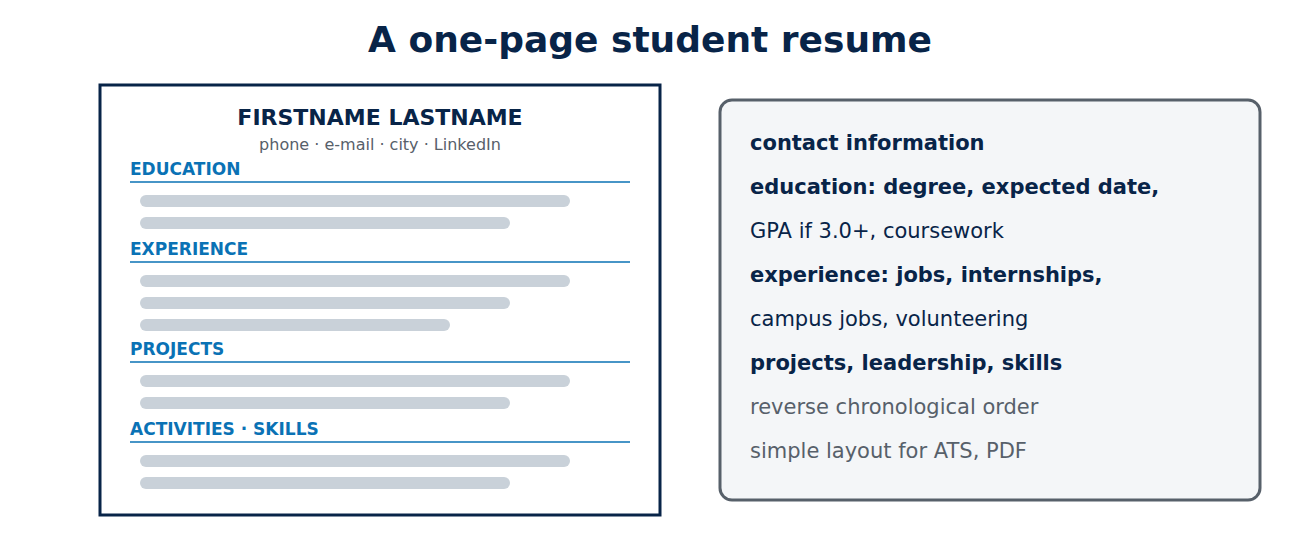
- One page, clean layout, readable font (10–12 point), consistent formatting.
- Reverse chronological order within each section: most recent first.
- Simple design: many employers use applicant tracking systems (ATS) that read text best from simple, single-column layouts without tables or graphics.
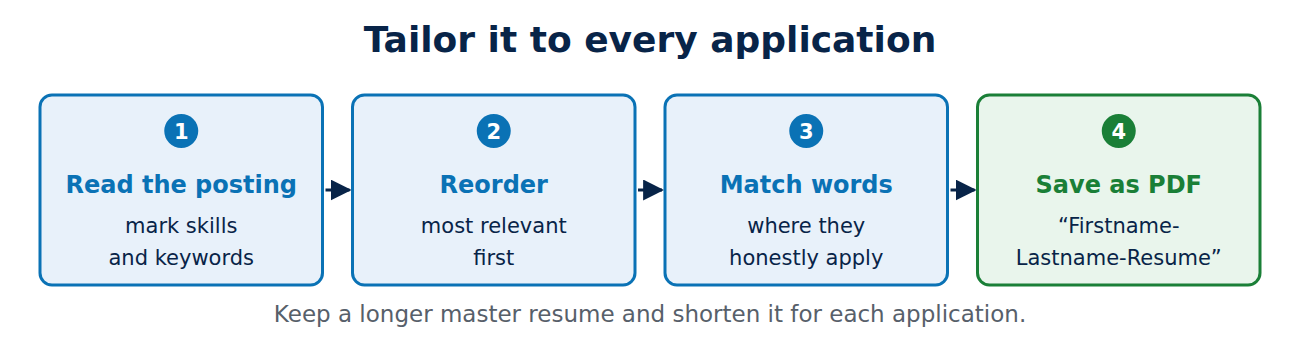
- Save as PDF unless the application asks for another format, with a clear file name: “Firstname-Lastname-Resume.pdf”.
Sections to include
- Contact information: name, phone, professional e-mail, city and state, and a LinkedIn or portfolio link if you have one. No photo, age or marital status in the US.
- Summary (optional): two lines about who you are and what you are looking for, tailored to the job.
- Education: school, degree, major, expected graduation date, GPA if 3.0 or higher, relevant coursework, honors.
- Experience: part-time jobs, internships, campus jobs, volunteering, freelance work.
- Projects: class projects, research, personal projects, competitions.
- Leadership and activities: clubs, sports, student government, organizing events.
- Skills: software, languages, technical skills, certifications.
With little experience, place Education and Projects first.
Write bullet points that show results
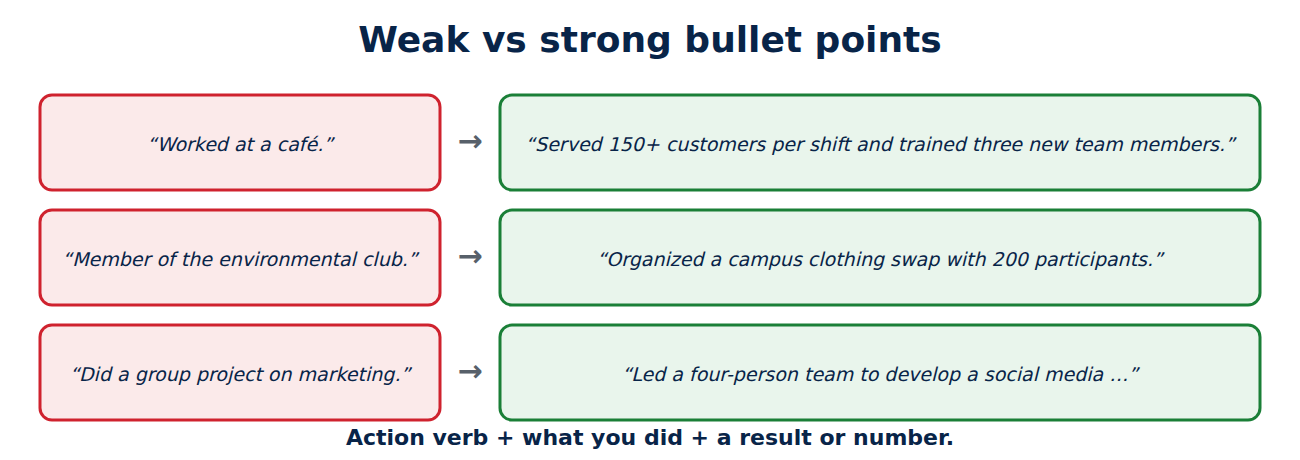
Use the pattern action verb + what you did + result or scale:
- Weak: “Worked at a café.” Strong: “Served 150+ customers per shift and trained three new team members on the register system.”
- Weak: “Member of the environmental club.” Strong: “Organized a campus clothing swap with 200 participants, diverting about 400 items from landfill.”
- Weak: “Did a group project on marketing.” Strong: “Led a four-person team to develop a social media plan for a local bakery; the owner adopted two of our recommendations.”
Good action verbs: organized, led, created, analyzed, designed, coordinated, improved, trained, wrote, presented.
Tailor it to every application
- Highlight the skills and keywords in the job posting.
- Put the most relevant experience and projects first.
- Use the same words as the posting where they honestly apply, so the ATS and recruiters see the match.
- Keep a longer master resume and shorten it for each application.
Pair your resume with a tailored cover letter; see how to write an internship cover letter.
Gaining experience quickly
- Campus jobs, research assistant roles and tutoring.
- Volunteering in a field related to your goals.
- Personal projects: a website, an app, a blog, a portfolio of designs or writing.
- Free online courses and certifications in tools employers use.
Ideas for paid work are in how to make money as a student.
Common mistakes
- Typos and inconsistent formatting: ask the career center or a friend to proofread.
- Listing duties instead of achievements.
- Unprofessional e-mail addresses.
- Exaggerating or inventing experience; it can be checked and may cost you the job.
- Letting an AI tool write generic bullet points without real details.
Frequently asked questions
Should I include my GPA?
Include it if it is 3.0 or higher, or if the employer asks for it. You can also list your major GPA if it is higher than your overall GPA, labeled clearly.
Can I include high school achievements?
In your first year or two of college, yes, if they are relevant or impressive. Replace them with college experience as you gain it.
How long should a student resume be?
One page. Recruiters spend only seconds on a first scan, so keep the most relevant information at the top.
Conclusion
A student resume with little experience should be one clean page that leads with education and projects, then shows jobs, volunteering, leadership and skills. Write bullet points with action verbs and results, tailor each resume to the job posting, and keep the format simple for applicant tracking systems. Proofread carefully, and prepare for the next step with common interview questions for students.
Sources and further reading
- Résumés and CVs (Purdue Online Writing Lab)
- What are employers looking for when reviewing college students’ resumes? (National Association of Colleges and Employers)















Recent Comments