
When you apply for your first internship, your resume is usually short: a few courses, a part-time job, maybe a club or a project. The cover letter is where you can make up for that. It shows why you want this particular internship, what you can already offer and that you can write clearly, which is exactly what recruiters look for in students.
This guide explains how to structure an internship cover letter, what to write in each paragraph, and how to tailor it quickly for every application, with a full example.
Do you really need a cover letter?
If the application asks for one, yes, and even when it is optional, a short, tailored letter often helps a student application stand out. Do not send a generic letter: a recruiter can spot “Dear Sir or Madam, I am applying for the position at your company” in a second. One tailored page is better than ten copies of the same text.
The structure
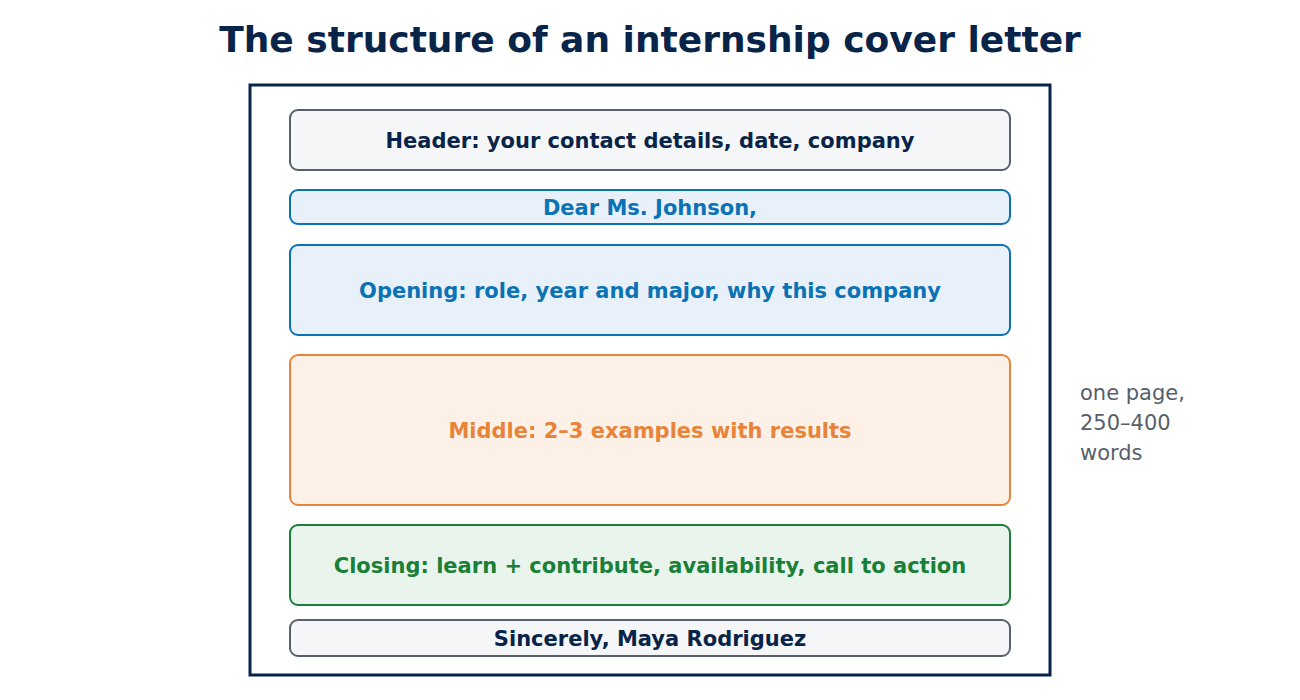
- Header: your name and contact details, the date, and the company’s name and address (or just the company name for online applications).
- Greeting: address a person if you can find the name of the recruiter or team lead (“Dear Ms. Johnson,”). Otherwise use “Dear Hiring Team,” or “Dear [Team name] Team,”.
- Opening paragraph: the internship you are applying for, your year and major, and one sentence on why this company or role interests you.
- Middle paragraph or two: two or three examples that show relevant skills, with results.
- Closing paragraph: what you would like to learn and contribute, your availability, and a polite call to action.
- Sign-off: “Sincerely,” or “Best regards,” and your full name.
Keep it to one page, around 250 to 400 words.
The opening: why them, why you
Skip the clichés and get to the point. Mention something specific about the company: a product you use, a project you read about, their mission or the team’s work. Then connect it to your studies or interests in one sentence. This shows real motivation, which matters a lot for internships.
The middle: show evidence, not adjectives
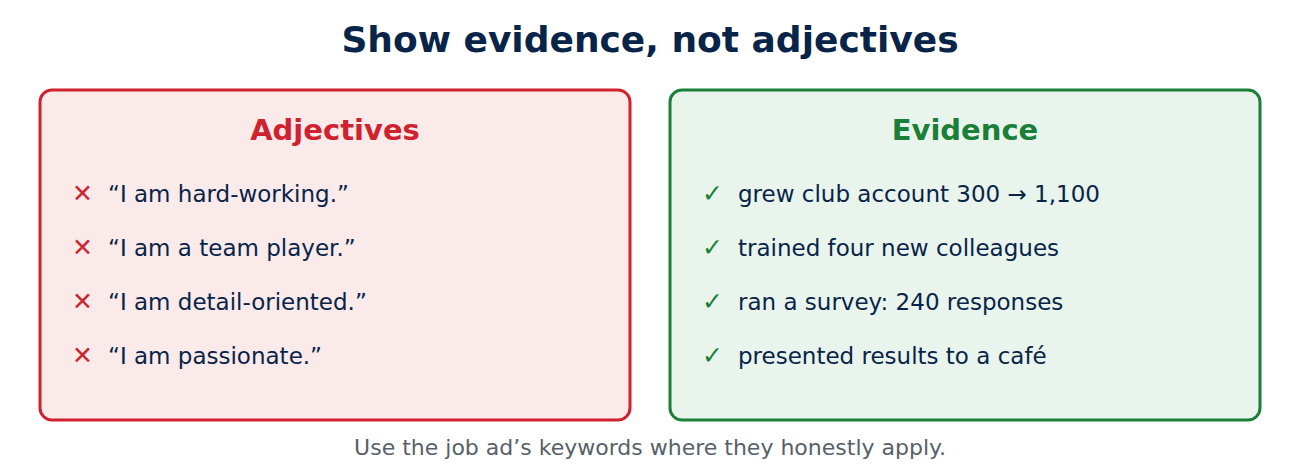
“I am hard-working, a team player and detail-oriented” tells the reader nothing. Instead, pick two or three experiences that match the job ad and describe them briefly:
- Coursework and projects: “In my data analysis course, I cleaned and analyzed a data set of 12,000 survey responses in Python and presented the results to the class.”
- Part-time jobs: “As a cashier, I trained four new colleagues and handled customer complaints during busy weekend shifts.”
- Clubs and volunteering: “As social media lead of our student association, I grew our Instagram account from 300 to 1,100 followers in one year.”
Use the job ad’s keywords where they honestly apply, because many companies screen applications with software before a person reads them.
The closing: confident, not pushy
Say what you hope to learn and what you can contribute, mention when you are available (dates and hours per week if it is part-time) and invite them to contact you: “I would welcome the opportunity to discuss how I could contribute to your team.” Thank them for their time.
A full example
Dear Ms. Johnson,
I am a third-year marketing student and would like to apply for the Digital Marketing Internship for summer 2027. I have followed your company’s campaigns for local nonprofits for some time, and I would love to learn how your team plans and measures campaigns with such a small budget.
Last year I led social media for our university’s environmental club. I planned a weekly content calendar, made short videos for Instagram and TikTok, and grew our following from 300 to 1,100 in two semesters, which doubled attendance at our events. In my consumer behavior course, I worked in a team of four on a market research project for a local café, ran a survey with 240 responses and presented recommendations that the owner put into practice.
I am comfortable with Canva, Google Analytics and basic HTML, and I am eager to learn more about paid social campaigns and reporting. I am available full-time from May 18 to August 14 and would welcome the chance to discuss how I can support your team.
Thank you for your time and consideration.
Sincerely,
Maya Rodriguez
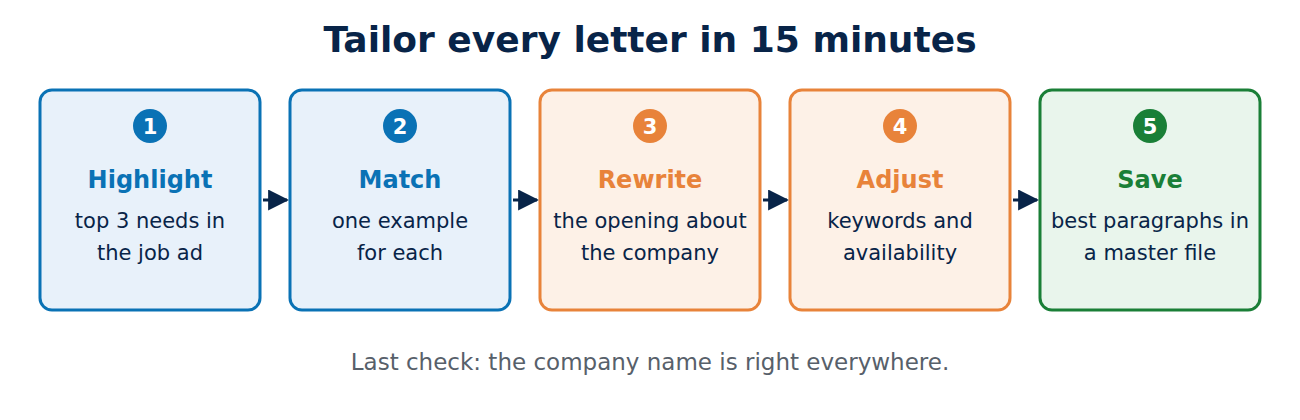
Tailoring in 15 minutes
- Highlight the three most important requirements in the job ad.
- Pick one example from your experience for each.
- Rewrite the opening sentence about the company.
- Adjust the keywords and your availability.
- Keep a master document with your best example paragraphs so you can reuse and adapt them.
Common mistakes
- Repeating your resume line by line instead of telling the story behind one or two points.
- Writing about what the internship will do for you only, and not about what you bring.
- Wrong company names left over from another application.
- Typos and very long paragraphs. Read it aloud and ask a friend or your career center to check it.
- Letting an AI tool write a generic letter. Recruiters recognize the style; if you use AI for ideas, rewrite in your own words and add real examples.
Your resume or CV should match the letter; see CV vs resume: the differences. Preparing for the interview next? Read what recruiters look for in an interview.
Conclusion
A strong internship cover letter is one page long, addressed to a person where possible, and tailored to the role: say why you want this internship, back up two or three relevant skills with concrete examples from courses, jobs or clubs, and close with your availability and a friendly invitation to talk. Tailor every letter, proofread carefully and save your best paragraphs for the next application.
Sources and further reading
- What are employers looking for when reviewing college students’ resumes? (National Association of Colleges and Employers)
- Cover Letters: Quick Tips (Purdue Online Writing Lab)















Recent Comments