
Paraphrasing means expressing someone else’s idea in your own words and sentence structure, and still citing the source. It is one of the most useful academic skills: it shows you understood a text, lets you blend sources into your own writing, and keeps your paper from turning into a string of quotations. Done badly, it is also one of the most common causes of accidental plagiarism. This guide explains a reliable method, shows a good and a bad paraphrase side by side, and explains when to quote or summarize instead.
Paraphrase, summary or quotation?
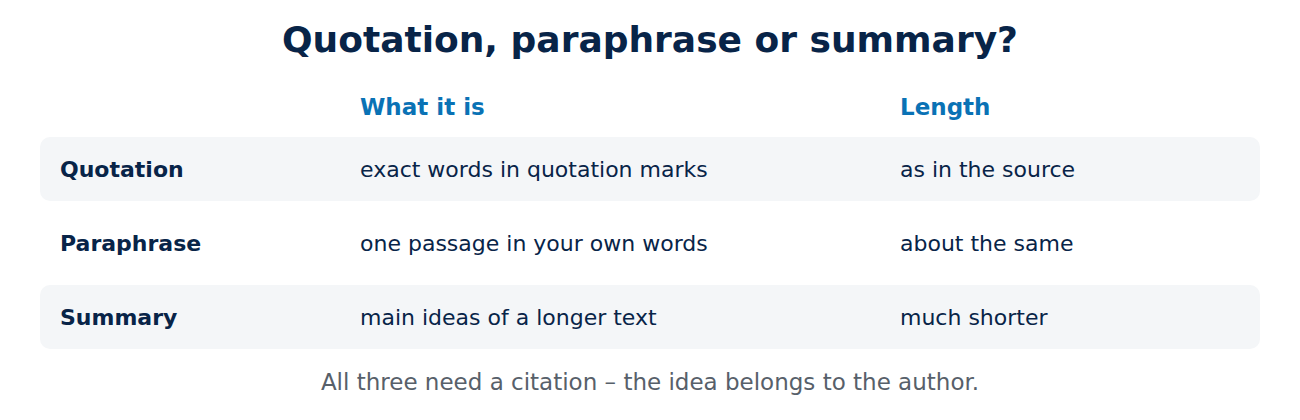
- Quotation: the exact words, in quotation marks, with a citation. Use it when the wording itself matters: a definition, a striking phrase, a statement you analyze.
- Paraphrase: one specific passage in your own words, roughly the same length as the original, with a citation. Use it for most evidence from sources.
- Summary: the main ideas of a longer text, much shorter than the original, with a citation; see how to write a summary.
All three need a citation. The idea belongs to the author even when the words are yours.
A five-step method
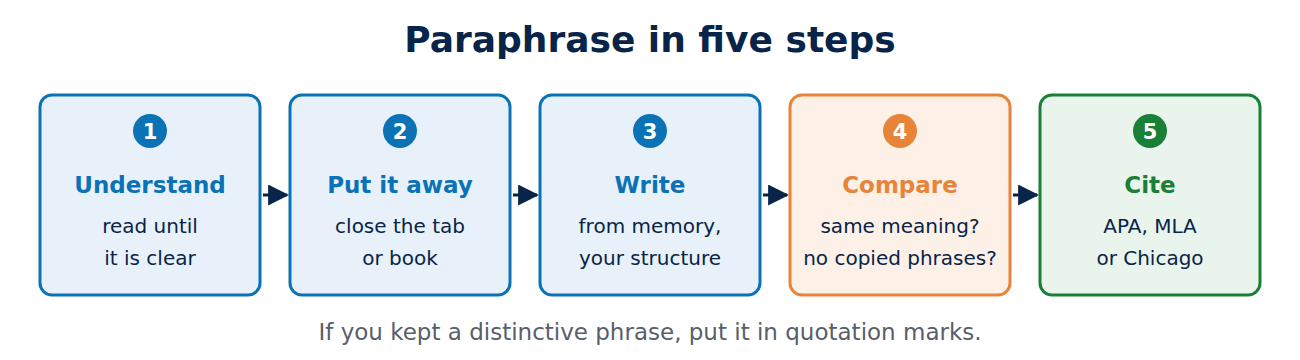
- Read the passage until you understand it. Look up unfamiliar terms. You cannot paraphrase what you do not understand.
- Put the source away. Close the tab or turn the page over.
- Write the idea from memory, as if explaining it to a classmate. Start differently than the original, and use your own sentence structure.
- Compare with the original. Check that the meaning is accurate and that you did not reuse distinctive phrases. If you kept a unique phrase, put it in quotation marks or change it.
- Add the citation in the required style, such as APA, MLA or Chicago.
Good and bad paraphrases
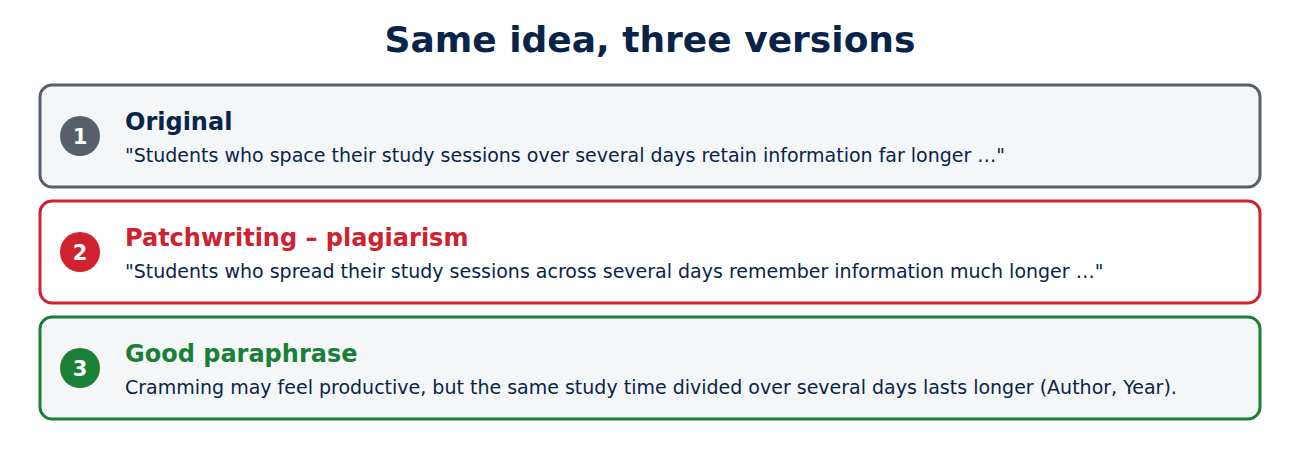
Original (an example passage): “Students who space their study sessions over several days retain information far longer than students who cram the same amount of study into a single night.”
- Plagiarized (“patchwriting”): Students who spread their study sessions across several days remember information much longer than students who cram the same amount of studying into one night. (Same structure, a few synonyms swapped, even with a citation this is too close.)
- Acceptable paraphrase: Cramming may feel productive, but the same total study time leads to much better long-term memory when it is divided into shorter sessions on different days (Author, Year).
The good version changes the structure (it starts with cramming, not with the students), uses different words, keeps the meaning and is cited. Spaced study is a real, well-researched effect; see spaced repetition.
Techniques that help
- Change the structure: turn a passive sentence into an active one, split a long sentence into two, or combine two short ones.
- Change the starting point: begin with a different part of the idea.
- Change word forms: “the analysis showed” → “analyzing the data revealed”.
- Keep technical terms: words like “photosynthesis”, “GDP” or “cognitive load” have no real synonym and do not need to be changed.
- Use a signal phrase: “According to Smith (2021)…” or “Smith argues that…” makes clear where the source’s idea starts.
What about AI paraphrasing tools?
Paraphrasing apps and AI chatbots can rewrite text in seconds, but they carry risks: many schools treat submitting tool-rewritten text as plagiarism or misuse of AI, the tools can change the meaning or invent details, and you skip the understanding that paraphrasing is supposed to build. Check your course’s AI policy. If tools are allowed, use them at most to check your own paraphrase, never to replace it. More in how to avoid plagiarism.
Citing paraphrases
- APA 7: author and year, (Nguyen, 2022); page numbers are encouraged but not required for paraphrases.
- MLA 9: author and page number, (Nguyen 45).
- Chicago: a footnote or author-date citation.
See the guides to APA, MLA and Chicago.
Quick checklist
- Did I understand the passage before writing?
- Did I write it without looking at the original?
- Is the sentence structure different, not just the words?
- Is the meaning still accurate?
- Did I cite it?
Conclusion
A paraphrase restates one passage in your own words and structure, keeps the meaning and always has a citation. Understand the passage, put it away, write from memory, compare and cite. Swapping synonyms is not enough, technical terms can stay, and AI rewriting tools are no shortcut: check your school’s policy.
Sources and further reading
- Paraphrasing (Purdue Online Writing Lab)
- Paraphrasing (APA Style)
- Plagiarism (UNC Writing Center)












Recent Comments