
Many students who are accused of plagiarism did not set out to cheat. They copied a sentence into their notes and forgot where it came from, paraphrased too closely, reused an old paper or let an AI tool write a paragraph without checking the rules. The consequences can still be serious, from a failing grade to suspension.
This guide explains what counts as plagiarism, the most common types, how to paraphrase and cite correctly, and how to stay safe when you use AI tools.
What counts as plagiarism?
Plagiarism means presenting someone else’s words, ideas, data or work as your own without giving credit. It does not matter whether the source is a book, a website, a classmate’s essay, a lecture or an AI chatbot, and it does not matter whether you did it on purpose. Most universities treat it as a breach of academic integrity.
The most common types
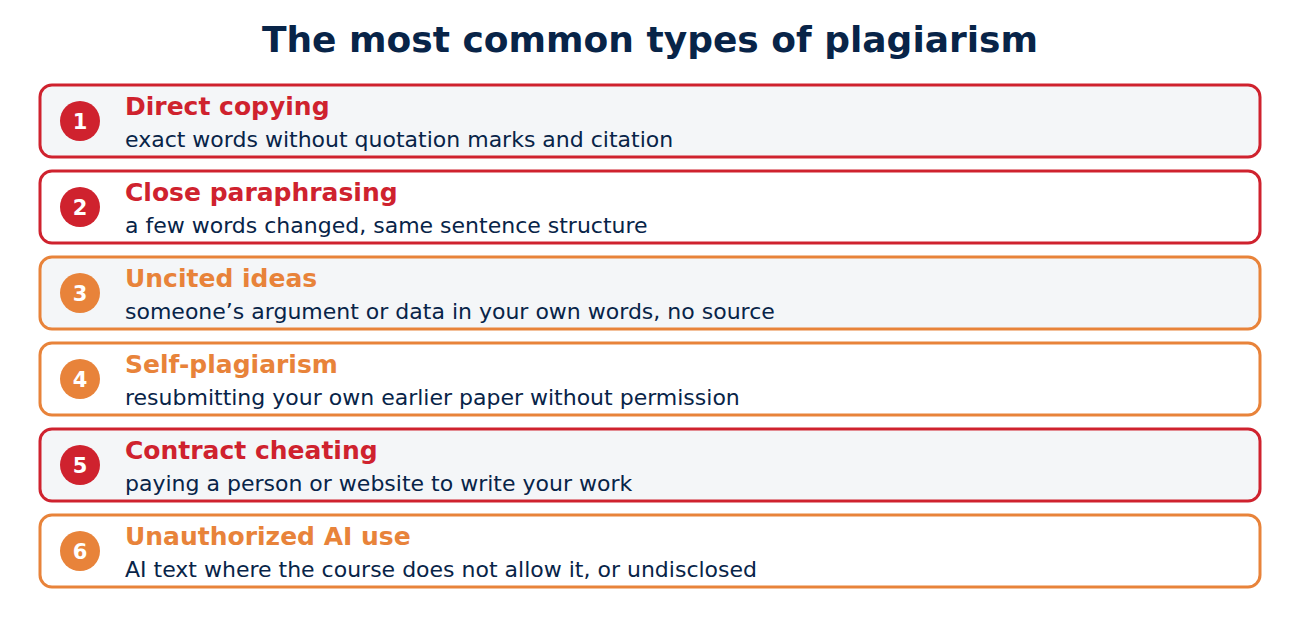
- Direct copying: using exact words without quotation marks and a citation.
- Close paraphrasing (“patchwriting”): changing a few words or the order of a sentence but keeping the original structure.
- Missing citations for ideas: putting an author’s argument or data in your own words without saying where it came from.
- Self-plagiarism: submitting a paper, or large parts of it, that you already handed in for another course without permission.
- Contract cheating: paying someone, or a website, to write work for you. Universities treat this as one of the most serious offenses.
- Unauthorized AI use: submitting text generated by AI where your course does not allow it, or without disclosing it where disclosure is required.
Quote, paraphrase or summarize?
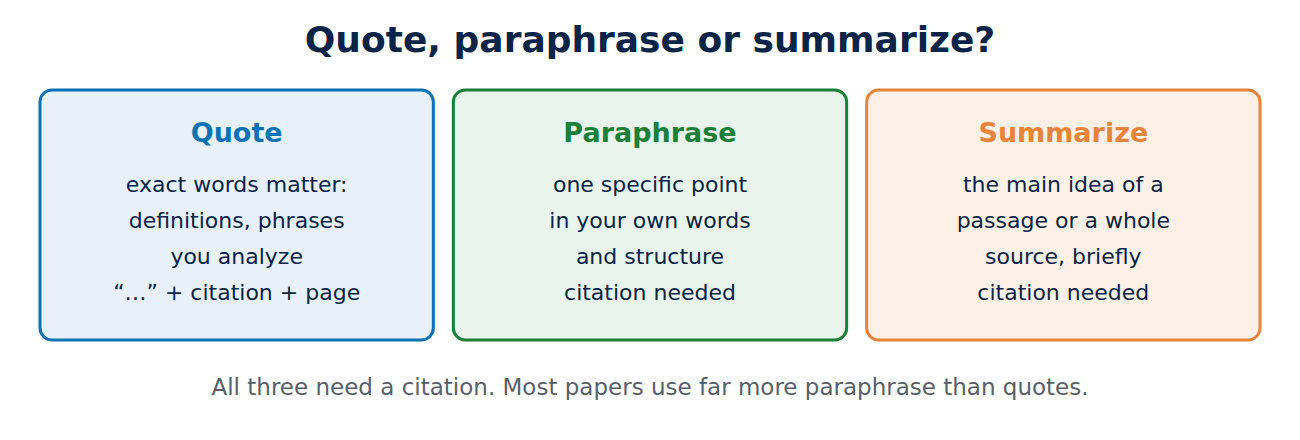
- Quote when the exact wording matters: a definition, a striking phrase, or a passage you analyze. Use quotation marks and a citation with the page number.
- Paraphrase when you want to explain a specific point in your own words. Paraphrases also need a citation.
- Summarize when you want to give the main idea of a longer passage or a whole source in a few sentences, with a citation.
In most papers, paraphrases and summaries should far outnumber quotations.
How to paraphrase correctly
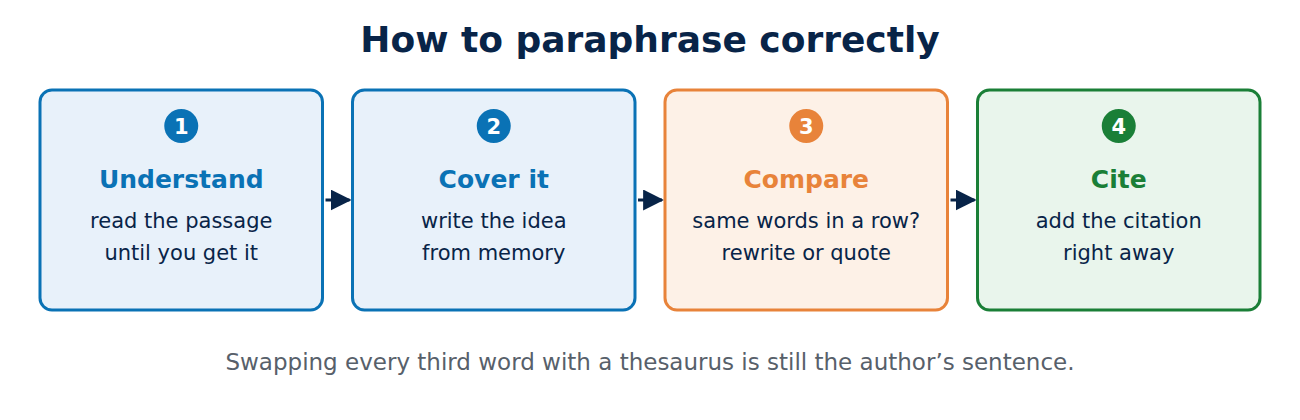
- Read the passage until you understand it.
- Close or cover the source and write the idea from memory, in your own words and sentence structure.
- Compare with the original: if you reused more than a few distinctive words in a row, rewrite or quote them.
- Add the citation right away.
Changing every third word with a thesaurus is not paraphrasing; it is still the author’s sentence.
What does not need a citation?
- Common knowledge: facts that are widely known and easy to find in many general sources, such as “World War II ended in 1945” or “Paris is the capital of France”. When in doubt, cite.
- Your own ideas, analysis and conclusions.
- Your own data from an experiment or survey you ran, described in your methods.
Specific statistics, quotations, theories and opinions always need a source.
Keep notes that protect you
Most accidental plagiarism starts in the notes. When you research:
- Put copied text in quotation marks in your notes, with the page number.
- Mark your own thoughts clearly, for example with your initials or a different color.
- Save every source in a reference manager such as Zotero from the start, so you never lose track of where something came from.
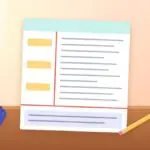
The Cornell note-taking method works well for readings, because it separates notes, your questions and your summary.
Cite in the right style
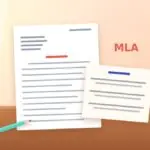
Follow the citation style your instructor requires and use it consistently: MLA in the humanities, APA 7th edition in the social sciences and psychology, and Chicago style in history and many other fields. Every in-text citation needs a matching entry in the reference list.
Using AI tools without plagiarizing
- Check the policy for each course: some ban AI, some allow it for brainstorming or editing, and some require you to disclose any use.
- Never submit AI-generated text as your own unless the assignment allows it, and cite or disclose it as required. MLA, APA and Chicago all have guidance on citing AI.
- Verify every fact and source an AI tool gives you. Chatbots can invent quotations and references that do not exist.
- Keep your drafts and version history, which can show how your work developed if questions come up.
Read more in our guide to using AI for college assignments.
Checking your work before you submit
Many universities let you run a draft through their similarity checker, such as Turnitin, before the deadline. A similarity report does not prove plagiarism; it shows matching text, and properly quoted and cited passages are fine. Use it to find forgotten quotation marks or missing citations. Your university’s writing center can also help.
Conclusion
Avoiding plagiarism comes down to a few habits: mark quotations and sources in your notes, paraphrase from understanding rather than from the page, cite every idea, quote and statistic that is not your own, follow your course’s AI policy, and check your draft before submitting. When you are unsure whether something needs a citation, add one or ask your instructor.
Sources and further reading
- Avoiding Plagiarism (Purdue Online Writing Lab)
- Academic integrity (Quality Assurance Agency for Higher Education, UK)









Recent Comments