
MLA style is the citation format used in most English, literature, language and humanities courses. If your instructor asks for “MLA format,” they mean two things: a specific page layout for your paper, and a consistent way to cite every source in the text and in a Works Cited list. The current version is the ninth edition of the MLA Handbook, published in 2021.
This guide explains the system behind MLA citations, gives examples for the most common sources, and shows how to format your paper and Works Cited page.
How MLA citations work: the core elements
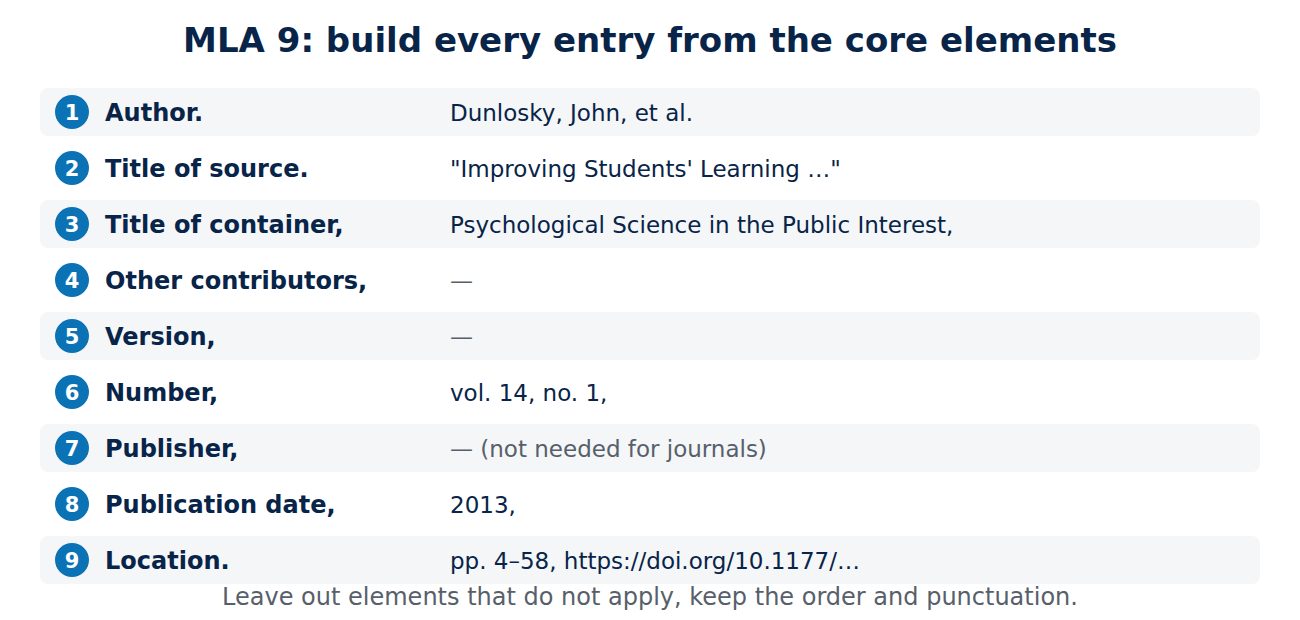
MLA does not have a separate rule for every type of source. Instead, every Works Cited entry is built from the same core elements, in this order, each followed by the punctuation shown. You leave out elements that do not apply:
- Author.
- Title of source.
- Title of container, (the larger work the source is part of: a journal, website, book or streaming service)
- Other contributors, (editors, translators, directors)
- Version, (edition)
- Number, (volume and issue)
- Publisher,
- Publication date,
- Location. (page numbers, a DOI or a URL)
Once you understand this template, you can cite almost anything, including sources that no guide lists.
Works Cited examples
Book
Kimmerer, Robin Wall. Braiding Sweetgrass. Milkweed Editions, 2013.
Journal article
Dunlosky, John, et al. “Improving Students’ Learning with Effective Learning Techniques: Promising Directions from Cognitive and Educational Psychology.” Psychological Science in the Public Interest, vol. 14, no. 1, 2013, pp. 4–58, https://doi.org/10.1177/1529100612453266.
For three or more authors, give the first author followed by “et al.” If an article has a DOI, use it instead of a URL.
Web page
“MLA Formatting and Style Guide.” Purdue Online Writing Lab, Purdue University, owl.purdue.edu/owl/research_and_citation/mla_style/mla_formatting_and_style_guide/mla_formatting_and_style_guide.html. Accessed 21 Oct. 2026.
MLA recommends leaving out “https://” in URLs (but keep the “https://doi.org/” form for DOIs). Add an access date when a page has no publication date or may change.
Chapter in an edited book
Author Last Name, First Name. “Title of Chapter.” Title of Book, edited by First Name Last Name, Publisher, Year, pp. 12–34.
Online video
“Title of the Video.” YouTube, uploaded by Channel Name, 5 Mar. 2025, www.youtube.com/watch?v=xxxx.
Generative AI
MLA recommends describing what the tool generated or quoting your prompt, then giving the tool, version, company, date and location, for example:
“Describe the symbolism of the green light in the book The Great Gatsby by F. Scott Fitzgerald” prompt. ChatGPT, 13 Feb. version, OpenAI, 8 Mar. 2023, chat.openai.com/chat.
Always check your course rules first: many instructors limit or forbid AI use, and a citation does not make an unauthorized use acceptable.
In-text citations
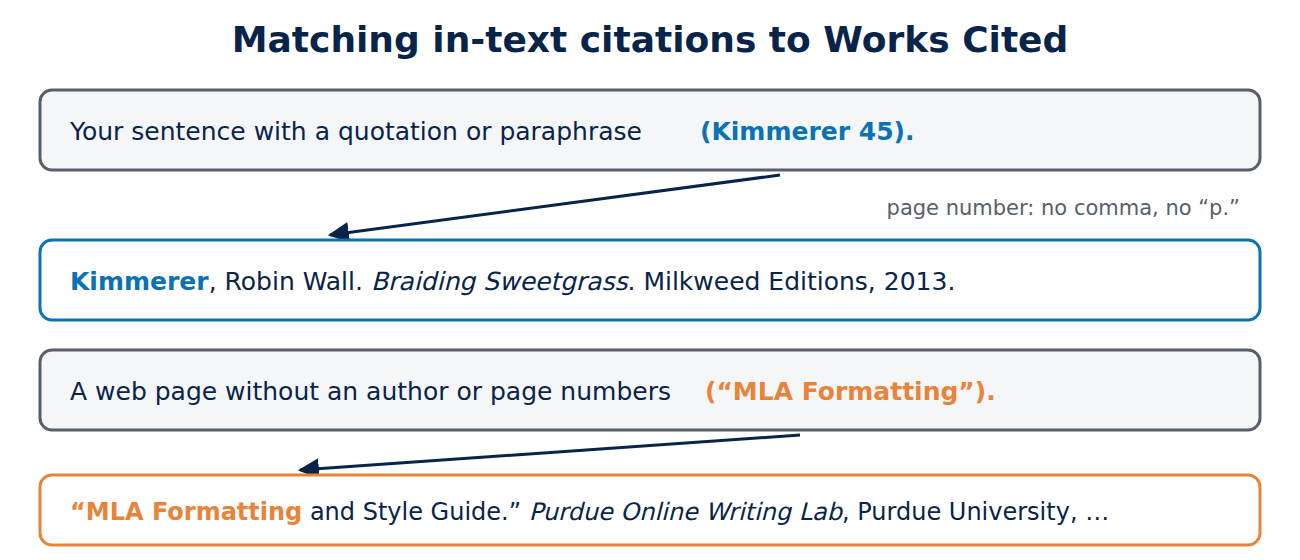
In the text, MLA uses short parenthetical citations with the author’s last name and the page number, without a comma and without “p.”:
- One author: (Kimmerer 45)
- Two authors: (Smith and Jones 112)
- Three or more authors: (Dunlosky et al. 7)
- No page numbers (web pages, videos): (Author) or, with no author, a short title: (“MLA Formatting”)
- Author named in your sentence: Kimmerer argues that … (45).
The first word of the in-text citation must match the first word of the Works Cited entry, so readers can find the source.
How to format an MLA paper
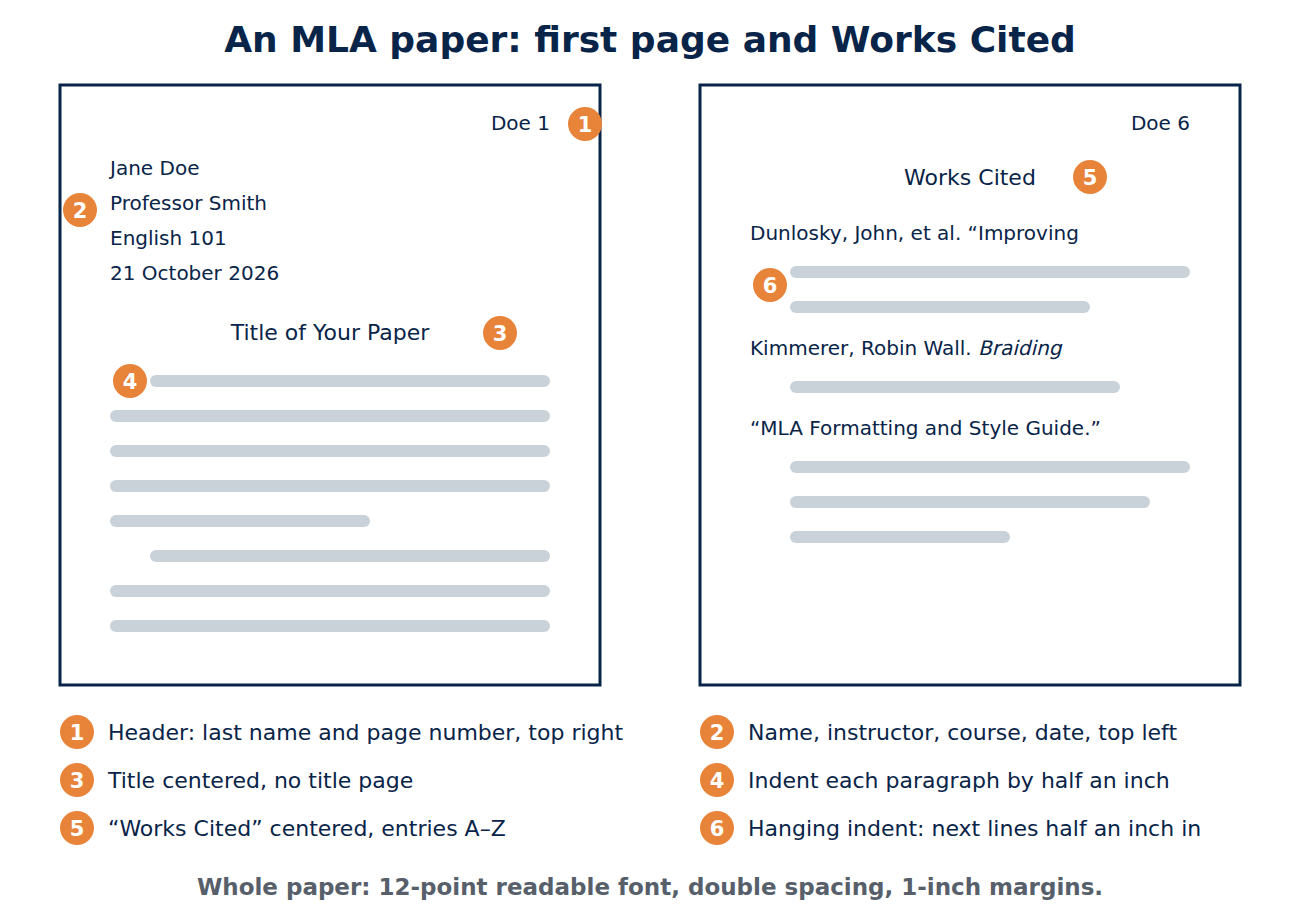
- 1-inch margins on all sides and a readable 12-point font such as Times New Roman.
- Double spacing throughout, including quotations and the Works Cited page.
- A header in the top right corner with your last name and the page number.
- No title page unless your instructor asks for one. Instead, put your name, your instructor’s name, the course and the date (for example, 21 October 2026) on separate lines at the top left of the first page, then the centered title.
- Indent the first line of each paragraph by half an inch.
How to format the Works Cited page
- Start it on a new page with the centered title Works Cited (not bold, not underlined).
- Sort entries alphabetically by the first word of each entry, usually the author’s last name.
- Use a hanging indent: the first line starts at the margin, following lines are indented by half an inch.
- Abbreviate months longer than four letters (Jan., Feb., Aug., Sept., Oct., Nov., Dec.).
Common mistakes
- Mixing MLA with APA: MLA uses the full first name and puts the date near the end; APA uses initials and puts the year right after the author. See our APA 7th edition guide for the differences.
- Forgetting the container: a journal article or web page always needs the journal or website name.
- Listing sources you did not cite in the text. Works Cited contains only what you actually cite.
- Trusting citation generators blindly. They save time, but check capitalization, authors and dates. A reference manager such as Zotero, from our list of the best apps for university students, keeps everything in one place.
Conclusion
MLA style becomes easy once you know the nine core elements: author, title, container, contributors, version, number, publisher, date and location. Build each Works Cited entry from them, use short author-page citations in the text, and format the paper with double spacing, 1-inch margins and a hanging indent in the Works Cited list. Before you start writing, make sure your argument is clear: our guide to writing a strong thesis statement helps.
Sources and further reading
- MLA Style Center (Modern Language Association)
- MLA Formatting and Style Guide (Purdue Online Writing Lab)

















Recent Comments