
Summarizing is one of the most useful academic skills: instructors ask for summaries of articles and chapters, research papers need summaries of sources, and studying gets easier when you can sum up a chapter in a few sentences. Yet many summaries end up too long, too close to the original wording, or full of the writer’s own opinions.
This guide shows how to write a clear, accurate summary in five steps, how long it should be, how it differs from a paraphrase and an analysis, and how to cite it correctly.
What is a summary?
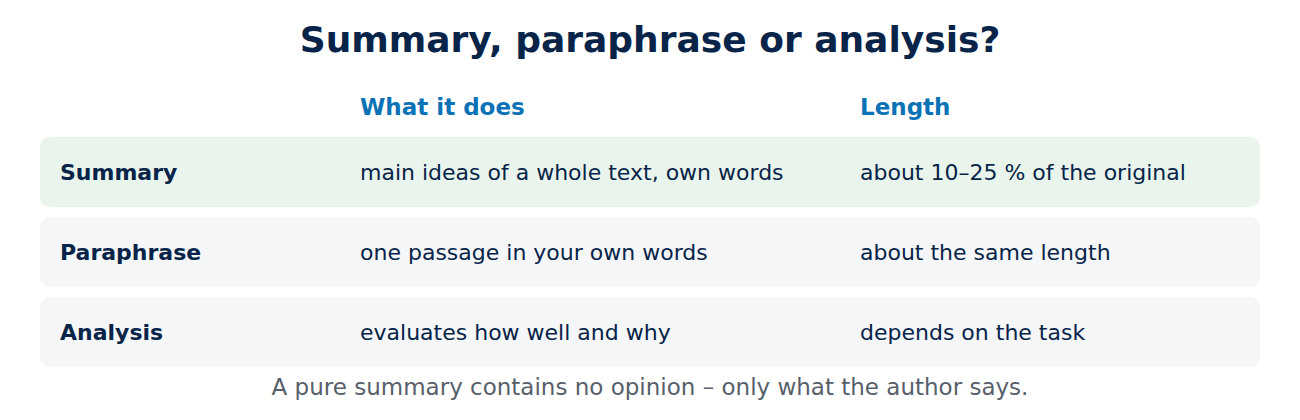
A summary is a short, objective restatement of the main ideas of a text in your own words. It includes the central argument and the key supporting points, and leaves out details, examples and your own opinion. A reader of your summary should understand what the original says without having read it.
- Summary vs paraphrase: a paraphrase restates a specific passage in your own words at roughly the same length; a summary condenses a whole text or long section.
- Summary vs analysis: a summary reports what the author says; an analysis evaluates how well and why. Some assignments ask for both; keep them in separate parts.
How long should a summary be?
Follow the assignment. As a rule of thumb, a summary is about 10 to 25 percent of the original length: a one-paragraph summary for an article, one page for a book chapter. In a research paper, summarizing a source may take just one or two sentences.
How to write a summary in five steps
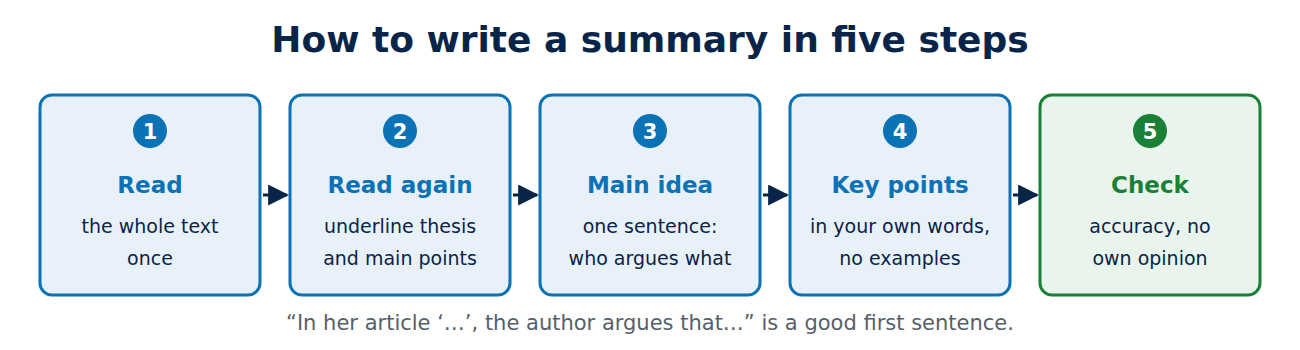
- Read the whole text once to understand the overall point. Look at the title, introduction, headings and conclusion.
- Read again actively: underline the thesis and the main point of each section or paragraph, and note them in the margin in a few words.
- Write the main idea in one sentence: who argues what, in which text. “In ‘X’, Smith argues that…”
- Add the key supporting points in a logical order, in your own words, without examples and minor details.
- Check and revise: compare with the original for accuracy, cut anything that is your own opinion, and make sure you have not copied phrases.
Useful phrases
- “In her article ‘…’, the author argues that…”
- “The author supports this claim by…”
- “She also points out that… / He concludes that…”
- “According to the study, …”
Keep mentioning the author (“she argues”, “the study finds”) so the reader knows these are not your ideas.
An example
A summary of a short article on multitasking might read: “In ‘The Myth of Multitasking’, the author argues that people who believe they multitask well are usually switching rapidly between tasks, which reduces accuracy and increases the time needed. Drawing on laboratory studies, the article shows that frequent task-switching raises error rates and that heavy media multitaskers are often more easily distracted. The author concludes that working on one task at a time, with planned breaks, is more productive.” Three sentences cover the thesis, the evidence and the conclusion, with no personal opinion.
Summaries in studying
Writing a short summary from memory after reading a chapter is also a powerful study technique: it forces you to recall and organize the material. Combine it with active recall and the summary section of Cornell notes. For reading textbooks efficiently first, see how to read a textbook.
Citing a summary
A summary contains someone else’s ideas, so it always needs a citation, even though the words are your own. Name the author in the text and add the citation in the required style:
- APA: author and year, for example (Smith, 2024); see our APA guide.
- MLA: author and page number if you refer to a specific part; see our MLA guide.
Common mistakes
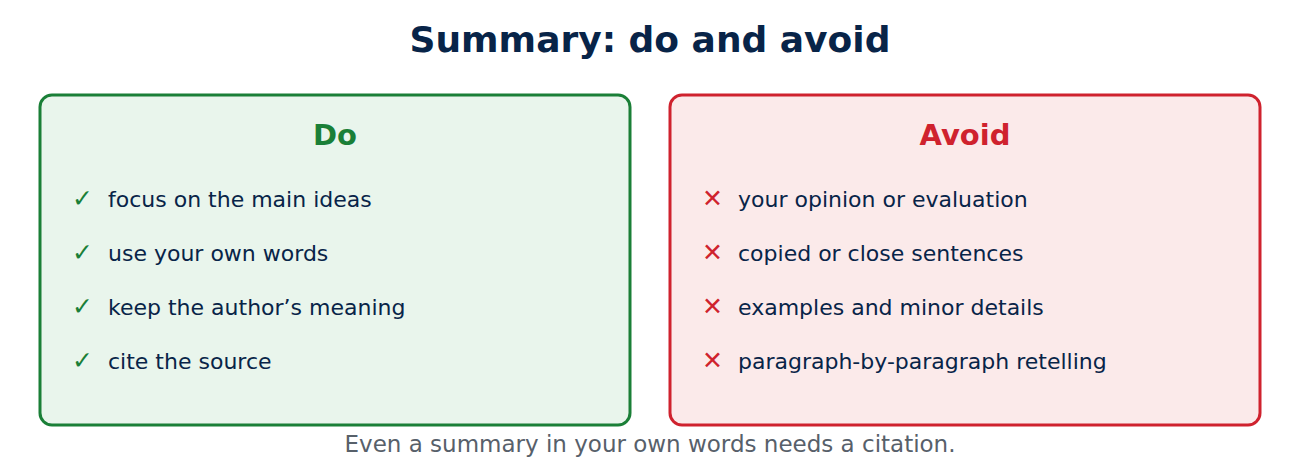
- Including your opinion or evaluation in a pure summary.
- Copying sentences or close paraphrases from the original; see how to avoid plagiarism.
- Getting lost in examples and details instead of main ideas.
- Changing the author’s meaning or emphasis.
- Following the original paragraph by paragraph instead of focusing on the key ideas.
Conclusion
A good summary states the main idea and key points of a text in your own words, objectively and briefly, usually 10 to 25 percent of the original. Read twice, mark the main points, write the central idea in one sentence, add the essential support, then check accuracy and remove your opinions. Always name the author and cite the source.
Sources and further reading
- Quoting, Paraphrasing, and Summarizing (Purdue Online Writing Lab)
- Summary: Using It Wisely (The Writing Center, University of North Carolina at Chapel Hill)


















Recent Comments