
You finally made it to college, and now you miss your family, your friends, your dog, your own bed and even your town’s boring main street. Homesickness is one of the most common experiences of first-year students, and it is not a sign that you made the wrong choice. It usually eases within weeks to a few months, and there is a lot you can do to speed that up. This guide explains why homesickness happens, practical strategies that help, and when to reach out for support.
Why homesickness happens
Homesickness is the distress of being away from familiar people, places and routines. At college, almost everything changes at once: where you sleep, what you eat, who you see every day and how your time is structured. Your brain misses the predictability and the people who know you well. It often peaks in the first weeks, around the first holidays and after visiting home, and it can also hit later, in a stressful exam period or a dark winter month.
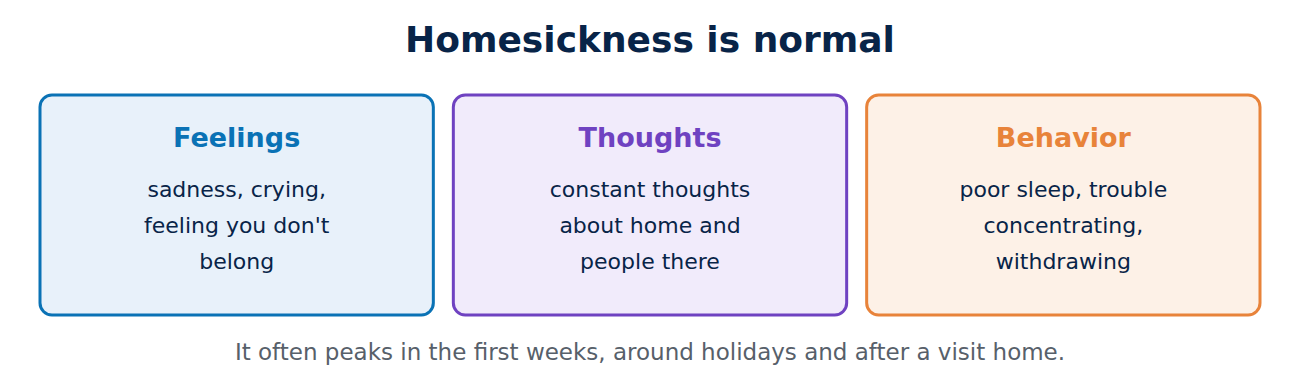
Signs include sadness and crying, constant thoughts about home, trouble sleeping or concentrating, irritability, withdrawing from new people and feeling you “don’t belong”. These feelings are normal; they mean you have people and places you love.
1. Build new routines quickly
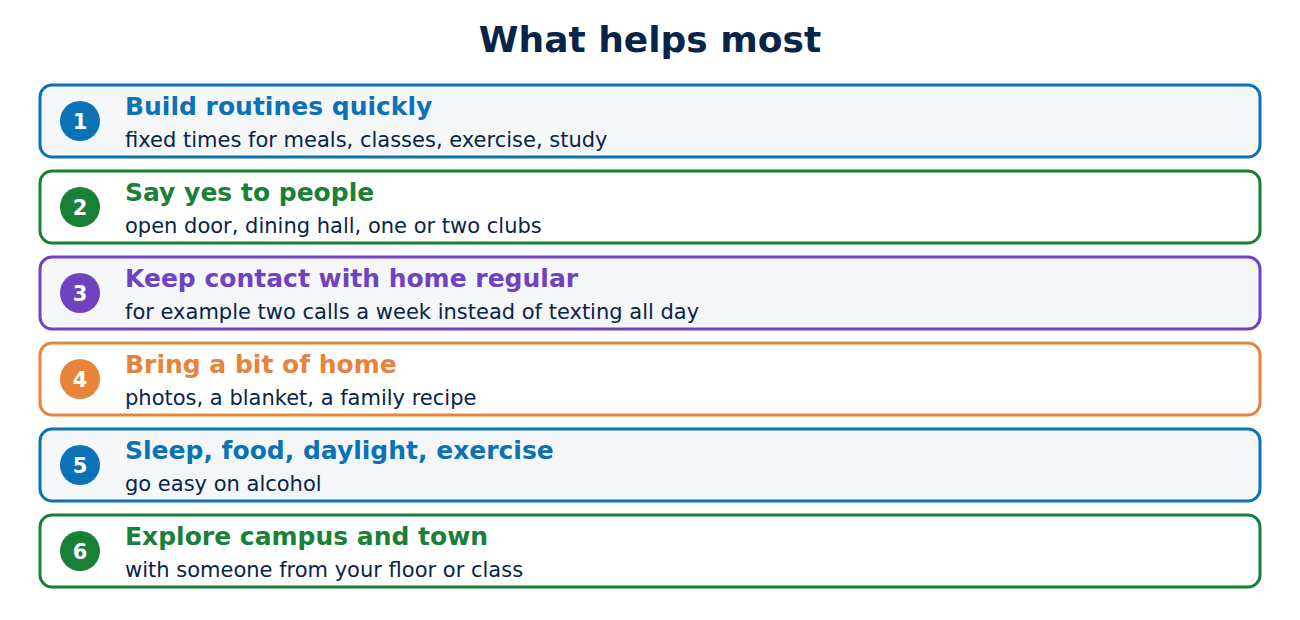
Routine is the fastest antidote. Set fixed times for waking up, meals, classes, exercise and study. Find your places: a favorite study spot, a café, a running route. Familiar patterns make a new place feel like yours.
2. Say yes to people
It feels easier to stay in your room and video call home, but connection is what helps most. Leave your door open in the residence hall, eat in the dining hall instead of taking food to your room, join one or two clubs, and accept invitations even when you do not feel like it. Repeated contact turns acquaintances into friends; see how to make friends in college. Remember: most first-year students feel the same and are looking for friends too.
3. Stay in touch with home, in balance
Contact with family and old friends is good, but constant contact can keep you emotionally at home and away from campus. Many students find it helpful to agree on a regular call, for example twice a week, rather than texting all day. Share good moments, not only problems. Plan your first visit home for a few weeks in, not every weekend, so you have time to settle.
4. Bring a bit of home with you
Photos, a familiar blanket, a favorite mug, your usual tea or a playlist from home make your room more comforting. Cooking a family recipe in the shared kitchen is also a good way to meet people.
5. Take care of the basics
Sleep, food and movement have a big effect on mood. Keep a regular sleep schedule (see sleep tips for students), eat regular meals (how to eat healthy in college), go outside in daylight and exercise; many campuses offer free fitness classes. Be careful with alcohol as a way to cope; it worsens sleep and mood.
6. Explore your new place
Learn your campus and town: go to campus events, museums, local markets or the nearest park. Explore with someone from your floor or class. The more you know the place, the more it starts to feel like home.
7. Give it time, and talk about it
Expect ups and downs. Write down small wins each week: a good conversation, a class you enjoyed. Talk about how you feel with your roommate, an RA (resident assistant) or a friend; you will be surprised how many share the feeling.
International students
Homesickness can be stronger when home is far away, in a different time zone and culture, and when visits are expensive. Connect with your international student office and cultural student associations, look for food from home in local shops, and schedule calls at times that work for both sides. Culture shock usually follows a pattern: excitement, frustration, adjustment and finally adaptation. Knowing this helps you get through the hard phase.
When to get help
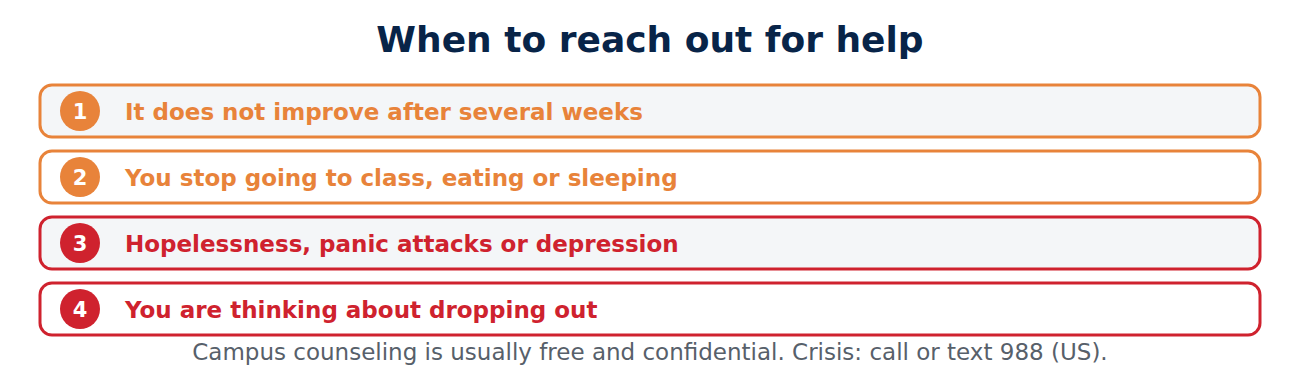
Reach out to your campus counseling center if homesickness:
- does not improve after several weeks or gets worse;
- stops you from going to class, eating or sleeping;
- comes with hopelessness, panic attacks or feelings of depression;
- makes you think about dropping out.
Counseling is usually free for students and confidential. If you ever have thoughts of harming yourself, get help right away; in the US, call or text 988. Thinking about leaving? Talk to your advisor first, and read how to transfer colleges if you decide another school is a better fit.
Conclusion
Homesickness is normal, common and usually temporary. Build routines, say yes to people and activities, keep contact with home regular but balanced, take care of sleep, food and exercise, and explore your new surroundings. Give yourself time, talk about it, and use the counseling center if it does not get better.
Sources and further reading
- Healthy ways to handle life’s stressors (American Psychological Association)
- How to deal with homesickness in college (The Jed Foundation)
- 988 Suicide & Crisis Lifeline



















Recent Comments