
Before you write a thesis, a dissertation or a major research project, many programs ask for a research proposal: a short document that explains what you want to study, why it matters and how you will do it. It is also required for graduate school applications, research grants and many senior projects. A clear proposal helps you get approval and gives you a plan you can actually follow.
This guide explains the sections of a research proposal, what to write in each, how long it should be and the mistakes that get proposals sent back.
What a research proposal must show
- A clear, focused research question worth answering.
- Knowledge of the existing research and the gap your project addresses.
- A realistic method to answer the question.
- Feasibility: that you can complete it with the time, resources and skills you have.
The typical sections
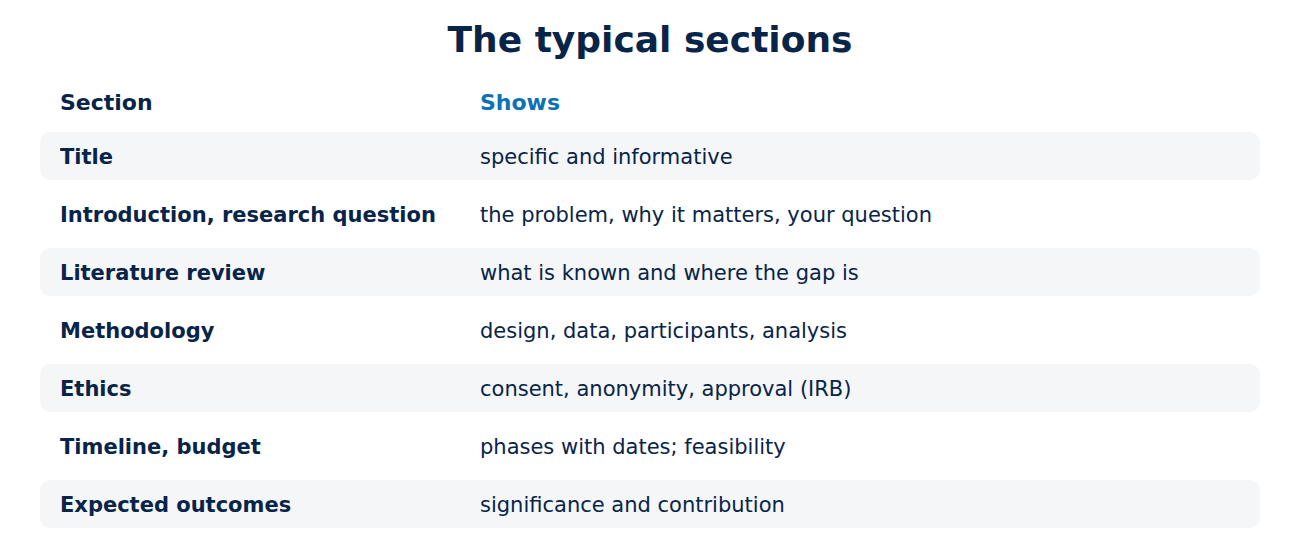
- Title: specific and informative.
- Introduction and background: the topic, its context and why it matters.
- Research question(s) and objectives, and hypotheses if appropriate.
- Literature review: what is known, what is debated and where the gap is.
- Methodology: research design, data, participants, methods of analysis.
- Ethical considerations for research with people or sensitive data.
- Timeline and, if needed, budget.
- Expected outcomes and significance.
- References.
Always follow the template or guidelines from your department or funder; they take priority.
Introduction and research question
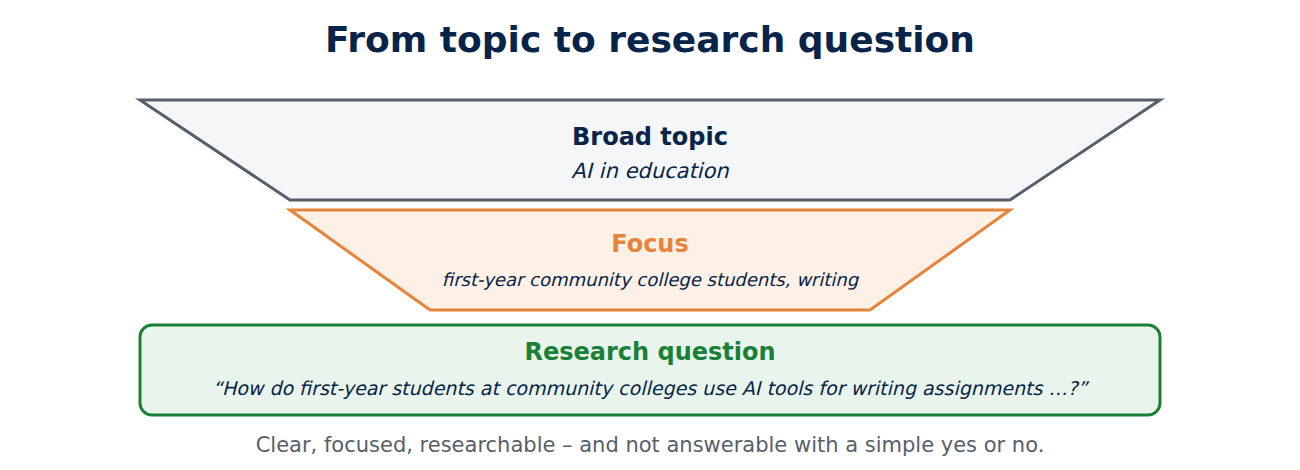
Open with the problem: what do we not know, or what is not working? Narrow quickly from the broad topic to your specific question. A good research question is clear, focused, researchable and not answerable with a simple yes or no. “How do first-year students at community colleges use AI tools for writing assignments, and how do instructors respond?” is better than “Is AI good for students?” See how to narrow a topic in how to write a research paper.
Literature review
Summarize the most relevant research, organized by theme, and show where your project fits: which gap it fills, which debate it contributes to or which method it improves. Do not list sources one by one; synthesize them. See how to write a literature review and start with an annotated bibliography.
Methodology
Explain exactly how you will answer the question, and why this method suits it:
- Design: qualitative (interviews, case studies), quantitative (surveys, experiments, data analysis) or mixed methods.
- Data and participants: who or what, how many, how you will recruit or collect them.
- Analysis: statistical tests, coding of interviews, software you will use.
- Limitations: what your method cannot show, and how you will reduce bias.
Ethics and approval
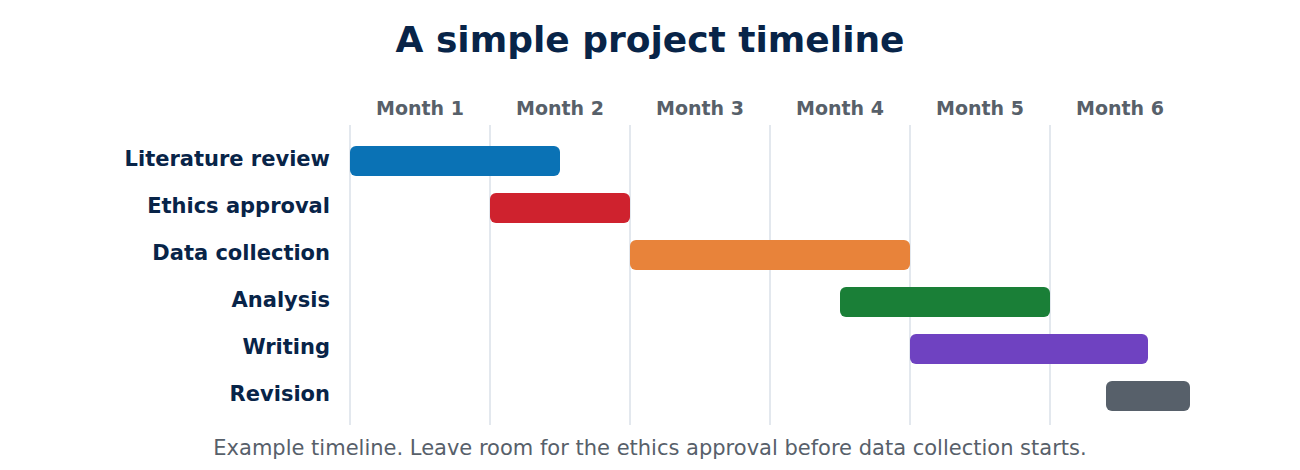
Research with human participants usually needs approval from your institution’s ethics committee or Institutional Review Board (IRB) before data collection. Describe informed consent, anonymity, data storage and any risks to participants. Leave time for the approval process in your timeline.
Timeline and feasibility
Break the project into phases with dates: literature review, ethics approval, data collection, analysis, writing, revision. A simple table or Gantt chart works well. Be realistic: reviewers are more impressed by a modest project that can be finished than an ambitious one that cannot.
How long should it be?
It varies widely: one to two pages for a course project, five to ten pages for a master’s thesis, and fifteen or more for a doctoral proposal or grant application. Check the word limit and stay within it.
Common mistakes
- A research question that is too broad or vague.
- A literature review that summarizes sources without showing the gap.
- Methods that do not match the question, or are not explained in enough detail.
- An unrealistic timeline or forgetting ethics approval.
- Missing or inconsistent citations; see our APA guide.
- Not asking your supervisor for feedback on a draft.
Frequently asked questions
How long is a research proposal?
From one or two pages for a course project to five to ten for a master’s thesis and 15 or more for doctoral proposals and grants. Follow the given limit.
Do I need results in a research proposal?
No. A proposal describes what you plan to do and what outcomes you expect, not results.
What is the difference between a proposal and a literature review?
A literature review summarizes and synthesizes existing research. A proposal uses a shorter literature review to justify a new research question and plan.
Conclusion
A research proposal shows what you want to study, why it matters and how you will do it. Start with a focused research question, show the gap in the literature, explain a method that fits, address ethics, and present a realistic timeline. Follow your department’s template, stay within the length, and get feedback from your supervisor before you submit.
Sources and further reading
- Research Papers (Purdue Online Writing Lab)
- Tips and Tools (The Writing Center, University of North Carolina at Chapel Hill)
- 45 CFR 46: Protection of Human Subjects (US Department of Health and Human Services)



















Recent Comments