
The first sentence of an essay decides whether a reader leans in or starts skimming. That opening line is called the hook, and a good one makes your instructor, an admissions officer or a scholarship committee want to keep reading. The good news: writing a strong hook is a skill you can learn, with a handful of reliable techniques.
This guide explains what a hook is, shows eight types of hooks with examples, and helps you choose the right one for your essay type, plus the openings to avoid.
What is a hook?
A hook is the opening sentence or two of an essay that grabs attention and leads into your topic. It is part of the introduction, which typically moves from the hook to some background and ends with your thesis statement. A hook should be interesting, relevant to your argument and appropriate for the type of essay. A dramatic hook in a lab report would feel as wrong as a dry one in a personal essay.
Eight types of hooks with examples
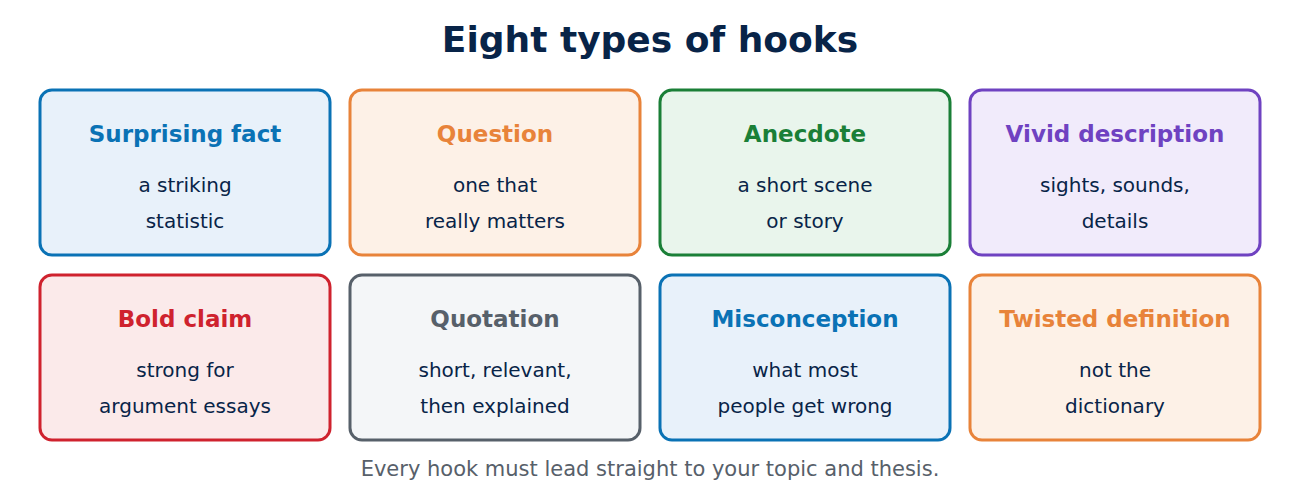
- A surprising fact or statistic: “Each year, an estimated 30 to 40 percent of the US food supply goes to waste.” Use a reliable source and cite it.
- A question: “What would you give up to have an extra hour every day?” Ask a question that matters, not one with an obvious yes-or-no answer.
- A short anecdote: “At 6 a.m., before her first class, Maria was already on her second shift at the bakery.” Ideal for personal and narrative essays.
- A vivid description: “The library was silent except for the hum of the radiator and the frantic tapping of forty keyboards.” Draws the reader into a scene.
- A bold claim: “Homework, as most schools assign it, does more harm than good.” Strong for argumentative essays, if you can back it up.
- A quotation: use a short, relevant quote, then explain why it matters. Avoid overused quotes and do not leave a quote without comment.
- A common misconception: “Most people believe multitasking makes them more productive. Research suggests the opposite.”
- A definition with a twist: skip the dictionary; instead show how a term is misunderstood or has changed.
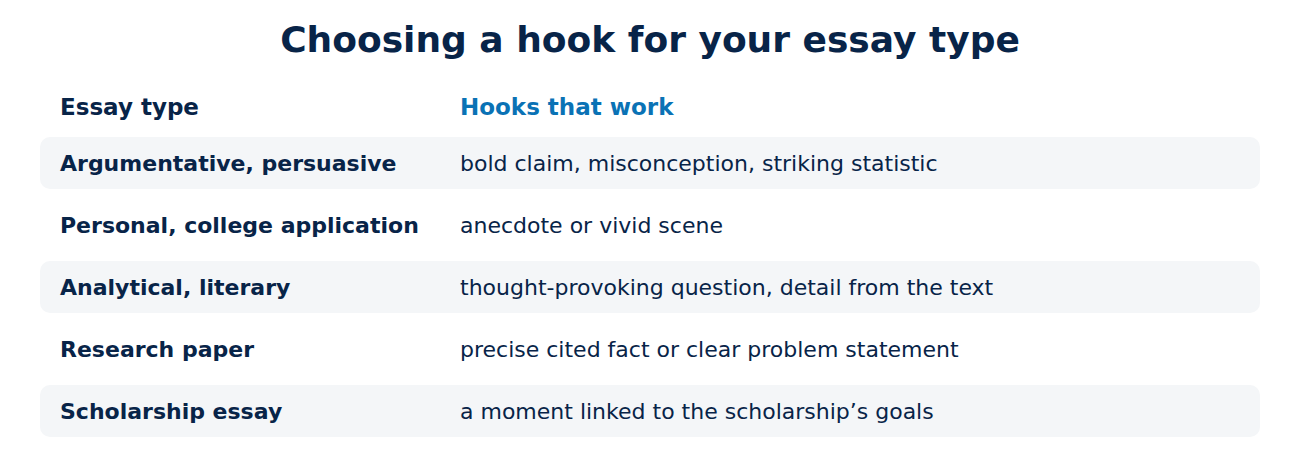
Choosing a hook for your essay type
- Argumentative and persuasive essays: a bold claim, a misconception or a striking statistic; see how to write an argumentative essay.
- Personal essays and college applications: an anecdote or vivid scene; see how to write an essay about yourself.
- Analytical and literary essays: a thought-provoking question or an interesting detail from the text.
- Research papers: a precise, cited fact or a clear statement of the problem rather than a dramatic story; see how to write a research paper.
- Scholarship essays: a specific moment that connects to the scholarship’s goals.
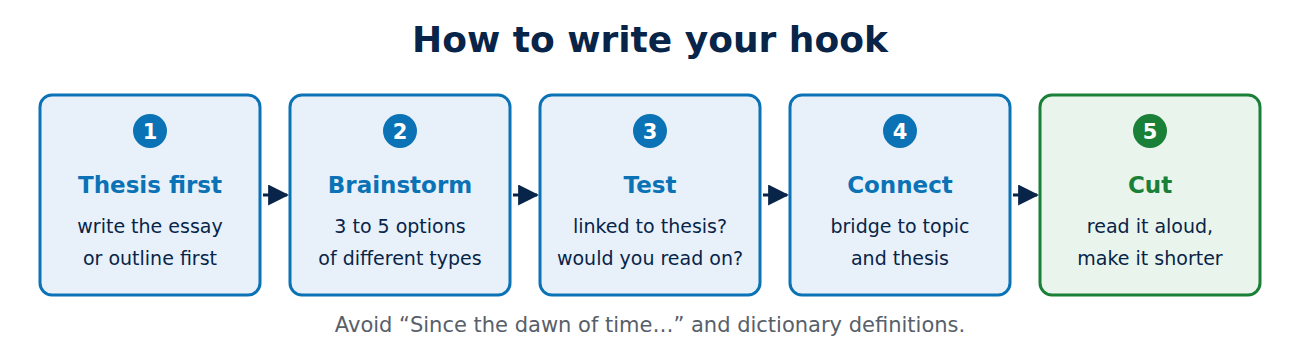
How to write your hook
- Write the essay first, or at least the thesis and outline. It is much easier to find the right hook when you know what you are arguing.
- Brainstorm three to five options using different hook types.
- Test each one: does it relate directly to your thesis? Would it make you keep reading?
- Connect it: the next sentences should bridge from the hook to your topic and thesis; see how to write an essay introduction.
- Read it aloud and cut unnecessary words. Most hooks get better when they get shorter.
Hooks to avoid
- Dictionary definitions: “Webster’s defines courage as…”
- Clichés and sweeping claims: “Since the dawn of time…”, “In today’s society…”
- Announcing the essay: “In this essay I will talk about…”
- Rhetorical questions with obvious answers: “Have you ever been tired?”
- Unverified statistics or “facts” from social media.
- Shock for its own sake that has nothing to do with your argument.
Before and after
Weak: “Social media is a big part of our lives today.”
Stronger: “The average teenager unlocks their phone dozens of times a day, and many cannot say why they did it the last time.”
Weak: “In this essay, I will discuss climate change.”
Stronger: “Some coastal towns are already planning which neighborhoods to give up to the sea.”
Conclusion
A hook is the attention-grabbing opening of your essay. Choose a type that fits your essay: a fact, question, anecdote, scene, bold claim, quotation, misconception or fresh definition. Write it after your thesis, brainstorm several versions, connect it smoothly to your topic, and avoid clichés, dictionary definitions and announcements. A specific, relevant first sentence is worth the extra ten minutes.
Sources and further reading
- Introductions (The Writing Center, University of North Carolina at Chapel Hill)
- Essay Writing (Purdue Online Writing Lab)

















Recent Comments