
For many scholarships, the essay is what decides between applicants with similar grades. The committee wants to know who you are, why you deserve their support and what you will do with it, in a few hundred words. That sounds hard, but scholarship essays follow a pattern you can learn, and one strong essay can be adapted for many applications.
This guide walks you through the process: understanding the prompt, finding your story, structuring the essay, writing a strong opening and polishing the final draft.
Step 1: understand the scholarship and the prompt
Every scholarship has a purpose: rewarding academic achievement, supporting students with financial need, promoting a field of study, a community or a value such as leadership or service. Read the organization’s mission and the selection criteria, and underline the key words in the prompt. Then note the word limit, the format and the deadline. An essay that does not answer the question is out, no matter how well it is written.
Common prompts
- “Tell us about yourself and your goals.”
- “Describe a challenge you have overcome.”
- “Why do you deserve this scholarship?”
- “How have you contributed to your community?”
- “Why did you choose your field of study?”
They all ask the same underlying question: what makes you a good investment for this organization?
Step 2: brainstorm your story
Spend 20 minutes collecting material: experiences that shaped you, problems you solved, people you helped, moments when your goals became clear, work or family responsibilities. Then pick one or two specific stories that connect to the scholarship’s purpose. A concrete moment (“the night I translated my mother’s hospital forms”) is more memorable than a list of achievements. Our guide on how to write an essay about yourself has more brainstorming questions.
Step 3: structure the essay
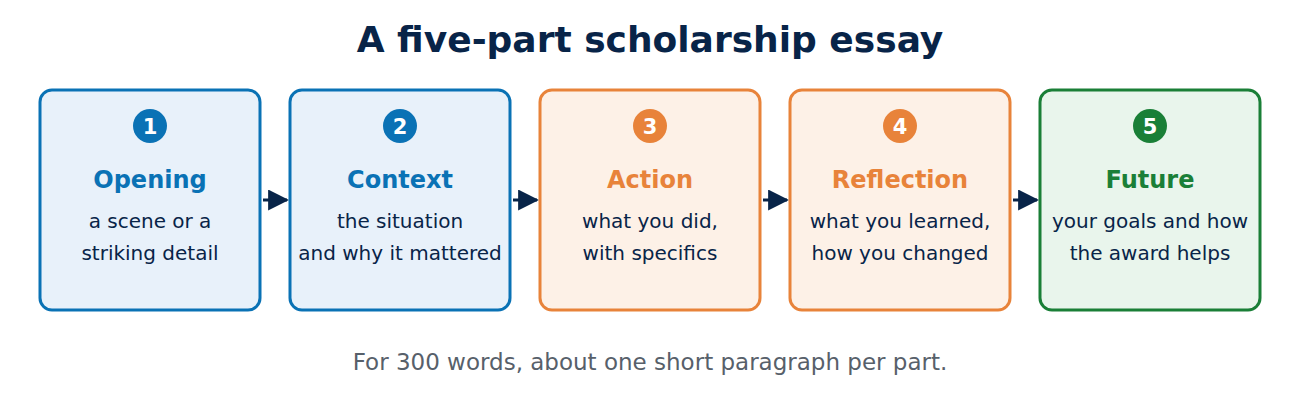
- Opening: start with a scene, a moment or a striking detail that draws the reader in.
- Context: briefly explain the situation and why it mattered.
- Action: what you did, with specifics.
- Reflection: what you learned and how it changed you.
- Future: your goals, and how this scholarship helps you reach them and give back.
Most scholarship essays are 250 to 650 words. For a 300-word essay, that means about one paragraph per part, or even combining context and action.
Step 4: write a strong opening
Avoid openings like “My name is…” or “I am honored to apply for this scholarship” and dictionary definitions. Instead:
- Start in a moment: “At 6 a.m., before my first class, I was already unloading boxes at the food bank.”
- Start with a question you had: “Why did the river behind my school turn green every summer?”
- Start with a specific detail that only you could write.
Step 5: show, do not tell
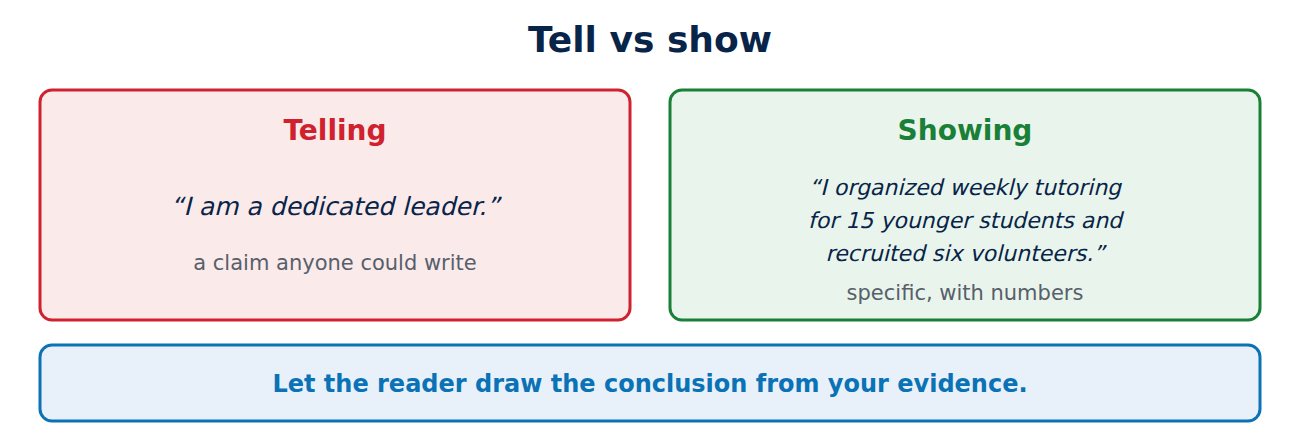
“I am a dedicated leader” is a claim. “I organized weekly tutoring for 15 younger students and recruited six volunteers to keep it running after I left” is evidence. Use numbers, names of projects and concrete results wherever you can, and let the reader draw the conclusion.
Step 6: connect to the scholarship’s goals
Make the link explicit in the final paragraph: what you want to study or do, why it matters to you, and how this scholarship makes a difference, for example by allowing you to work fewer hours, take an unpaid internship or continue a project. If the scholarship is about community, say how you will give back.
Step 7: edit and proofread
- Cut what does not support your main message, even if you like it.
- Check that you answered every part of the prompt.
- Read it aloud to catch awkward sentences.
- Stay within the word limit, and use the exact format requested.
- Ask a teacher, advisor or writing center to read it, and give it a day before your final proofread.
Reusing essays for several scholarships
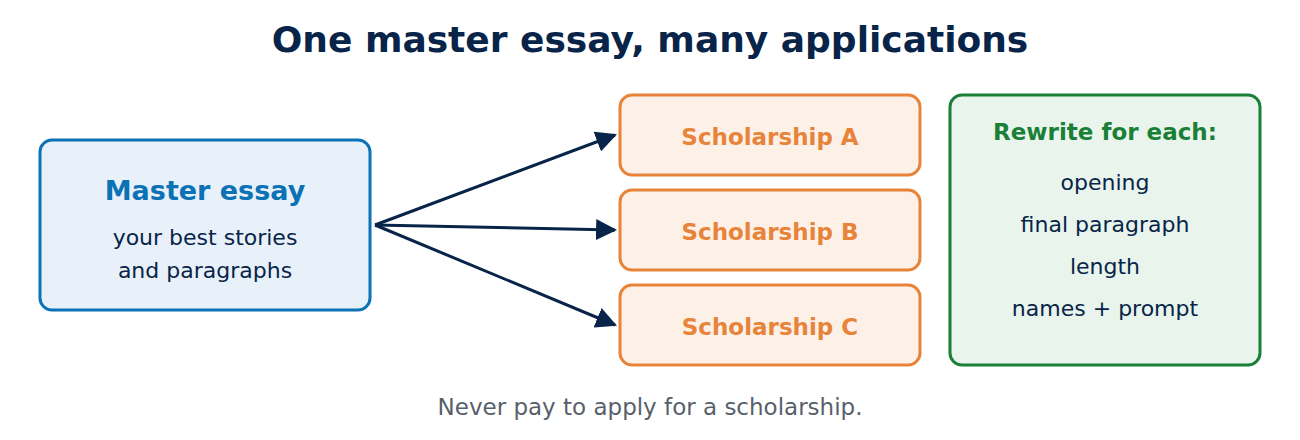
Keep a master essay and a collection of strong paragraphs about your key experiences. For each application, rewrite the opening and the final paragraph to fit the prompt and the organization, and adjust the length. Never reuse an essay without checking that the names, the organization and the prompt still match.
Mistakes to avoid
- Writing a list of achievements (that is what the resume or activities section is for).
- Focusing only on financial need without showing who you are and what you will do.
- Clichés, overly dramatic language and generic statements anyone could write.
- Submitting AI-generated text. Committees look for a personal voice, and many scholarships forbid it; if you use tools for ideas or grammar, the story and wording must be yours.
- Missing the deadline. Put every scholarship deadline in your calendar with a reminder a week before.
Watch out for scholarship scams, too. The US Federal Trade Commission’s advice is clear: never pay to apply for a scholarship, and be wary of anyone who guarantees that you will win one.
Conclusion
A winning scholarship essay answers the prompt directly, tells one or two specific stories that match the scholarship’s purpose, shows your qualities with concrete evidence instead of claims, reflects on what you learned and ends with clear goals and how the award helps you reach them. Start early, keep a master essay you can adapt, and get feedback before you submit.
Sources and further reading
- Finding and applying for scholarships (Federal Student Aid, US Department of Education)
- How to avoid scholarship and financial aid scams (US Federal Trade Commission)


















Recent Comments