
After pages of careful argument, many essays end with a weak, rushed paragraph: “In conclusion, there are many reasons why…” followed by a word-for-word repeat of the introduction. That is a missed opportunity. The conclusion is the last thing your reader sees, and a strong one leaves a lasting impression and often makes the difference between a good and a great grade.
This guide explains what a conclusion should do, gives a simple structure with an example, shows how conclusions differ by essay type and lists the mistakes to avoid.
What a conclusion should do
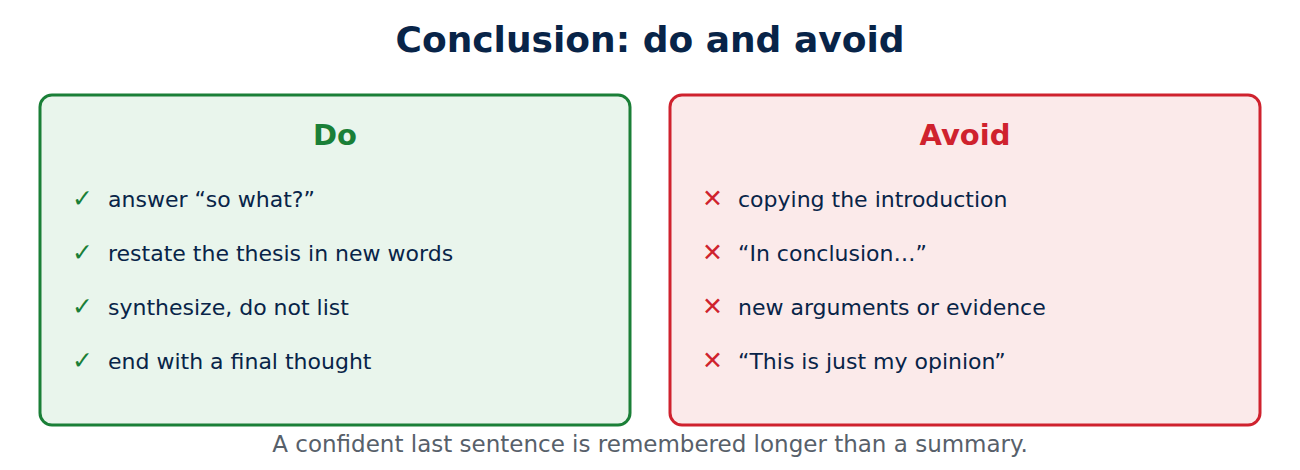
- Answer the “so what?” question: why does your argument matter?
- Restate your thesis in new words, showing how the essay has supported it.
- Synthesize, not summarize: show how your main points fit together rather than listing them again.
- Leave the reader with a final thought: an implication, a recommendation, a question or a broader connection.
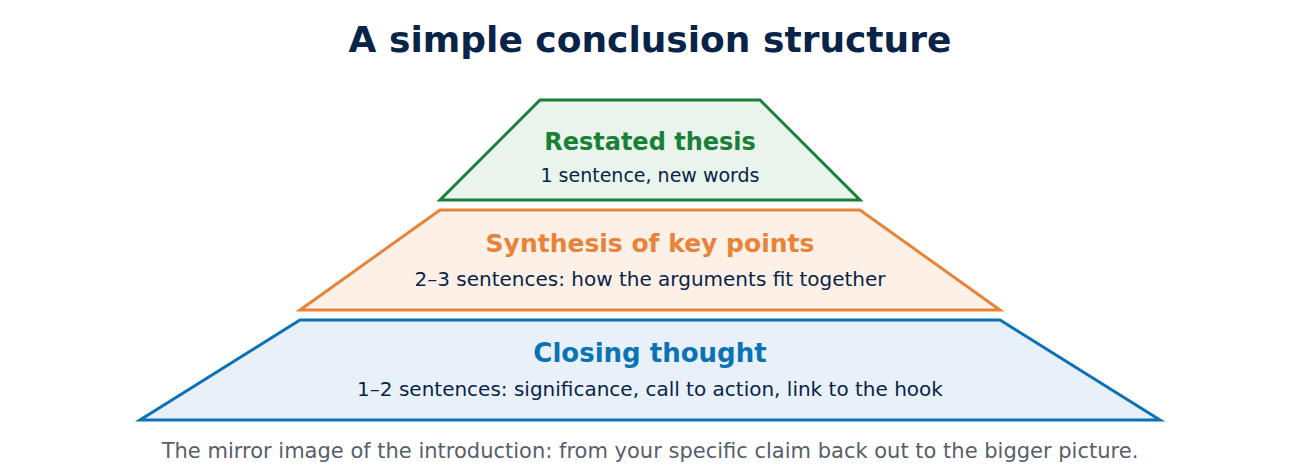
A simple structure
- Restated thesis (1 sentence): your main claim, rephrased in light of the evidence you presented.
- Synthesis of key points (2–3 sentences): how your main arguments connect and what they show together.
- Closing thought (1–2 sentences): the significance, a call to action, a prediction or a link back to your hook.
An example
For an essay arguing that colleges should teach focused digital note-taking instead of banning laptops:
“Banning laptops treats the symptom rather than the cause of distraction in lectures. As research on note-taking and the experiences of disabled students show, technology can support learning when students use it with intention. Colleges that teach students how to take focused digital notes, and design lectures that invite active participation, will prepare graduates for workplaces where screens are unavoidable. The question is not whether laptops belong in the classroom, but whether we teach students to use them well.”
Notice how it restates the argument in new words, ties the points together, and ends with a clear, memorable idea that echoes the opening.
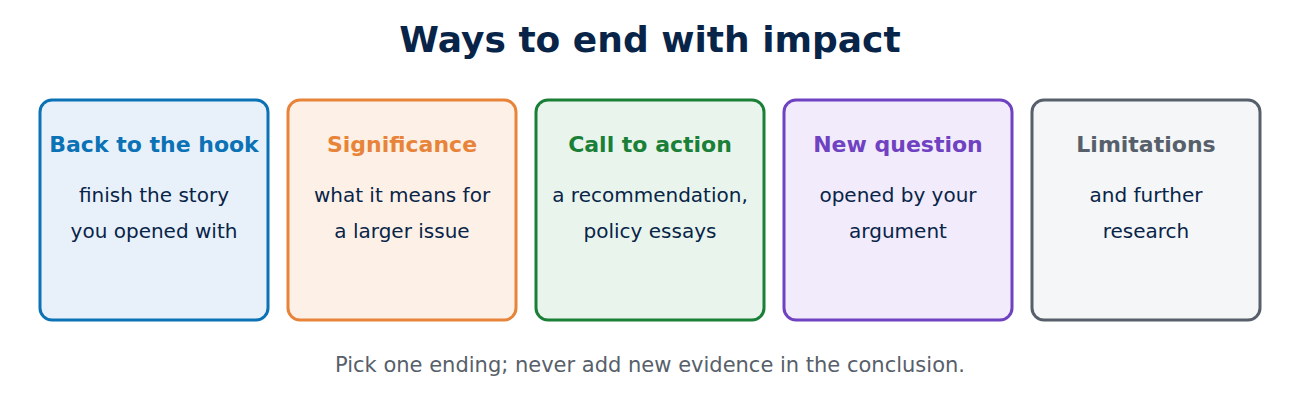
Ways to end with impact
- Return to your hook: complete the story or scene you opened with; see how to write a hook.
- Show the broader significance: what does your argument mean for a larger issue, group or future?
- Make a recommendation or call to action, especially in argumentative and policy essays.
- Raise a new question that your argument opens up, without introducing new evidence.
- Acknowledge limitations and suggest further research, typical in research papers.
Conclusions by essay type
- Argumentative essay: reaffirm your position, address why it outweighs the counterargument and end with an implication or call to action. See how to write an argumentative essay.
- Literary analysis: explain what your interpretation reveals about the work as a whole.
- Research paper: answer the research question, state the main findings, note limitations and suggest future research. See how to write a research paper.
- Personal or reflective essay: reflect on what you learned and how it shapes you going forward; see how to write a reflection paper.
Mistakes to avoid
- Copying the introduction word for word.
- Starting with “In conclusion” or “To sum up”; in most essays the reader already knows it is the end.
- Introducing new arguments or evidence that you have not discussed.
- Apologizing or weakening your claim: “This is just my opinion” or “I may be wrong, but…”
- Overreaching: claiming your essay solves a huge problem.
- Being too long: as with the introduction, about 10 percent of the essay is a good guide.
A quick checklist
- Does it restate the thesis in fresh words?
- Does it show how the points connect, not just list them?
- Does it answer “so what?”
- Does it avoid new evidence?
- Does the final sentence feel like an ending?
Frequently asked questions
How long should a conclusion be?
About 10 percent of the essay, so one paragraph of four to six sentences for most essays.
Can I start with “In conclusion”?
It is not wrong, but it is usually unnecessary and sounds formulaic. Start by restating your thesis in new words instead.
Can I add a quote in the conclusion?
You can end with a short, relevant quote if it reinforces your point, but do not introduce new evidence that needs discussion.
Conclusion
A strong conclusion restates your thesis in new words, synthesizes your main points and ends with why your argument matters: a broader implication, a recommendation, a new question or a return to your opening. Avoid repeating the introduction, adding new evidence or weakening your claim. Write it after the body, read your introduction and conclusion together, and make sure they frame the same argument. Then check citations and paraphrasing before you submit; see how to avoid plagiarism.
Sources and further reading
- Conclusions (The Writing Center, University of North Carolina at Chapel Hill)
- Essay Writing (Purdue Online Writing Lab)

















Recent Comments