
Exam season goes much better with a plan. Without one, students tend to spend too long on the subjects they like, leave the hard ones until the last days and end up cramming all night. A good study schedule spreads the work out, mixes subjects, builds in self-testing and still leaves time for sleep and a life.
This guide shows you step by step how to make a revision timetable for your exams, with a sample week and tips to stick to it.
Step 1: collect your exam dates and topics
Write down every exam with its date, time and format (multiple choice, essays, problem solving, open book). Then list the topics for each course from the syllabus, the lecture slides or the exam guidance. This list is the backbone of your plan, and it shows you how much material you really have.
Step 2: rate each topic
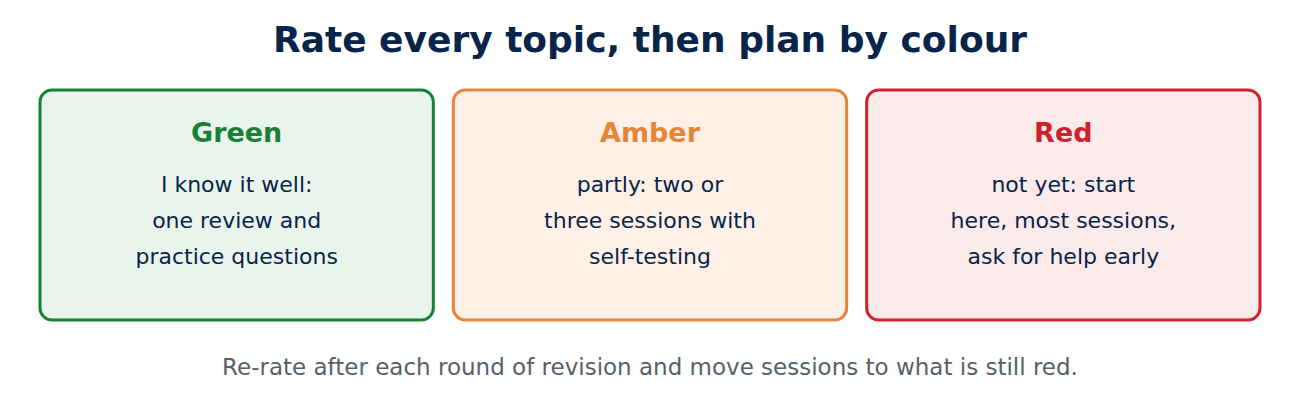
Go through your topic list and mark each one with a simple traffic light: green (I know it well), amber (partly) or red (I do not understand it yet). Red and amber topics get more sessions. Re-rate after every round of revision, so the plan adapts to your progress.
Step 3: count your available time
Count the days until your first exam and block out fixed commitments: classes, work shifts, sports, travel and meals. What remains is your study time. Be realistic: four to six focused hours on a free day is a lot; ten hours on paper usually means four in reality.
Step 4: plan in sessions, not days
- Divide your study time into sessions of 30 to 50 minutes with short breaks, for example with the Pomodoro technique.
- Give each session one specific topic and task: “Biology: cell respiration, practice questions”, not “Biology”.
- Plan two or three subjects per day and switch between them. Mixing topics (interleaving) is harder in the moment but helps you remember and apply what you learn.
- Schedule harder topics for the time of day when you concentrate best.
Step 5: build in spaced review
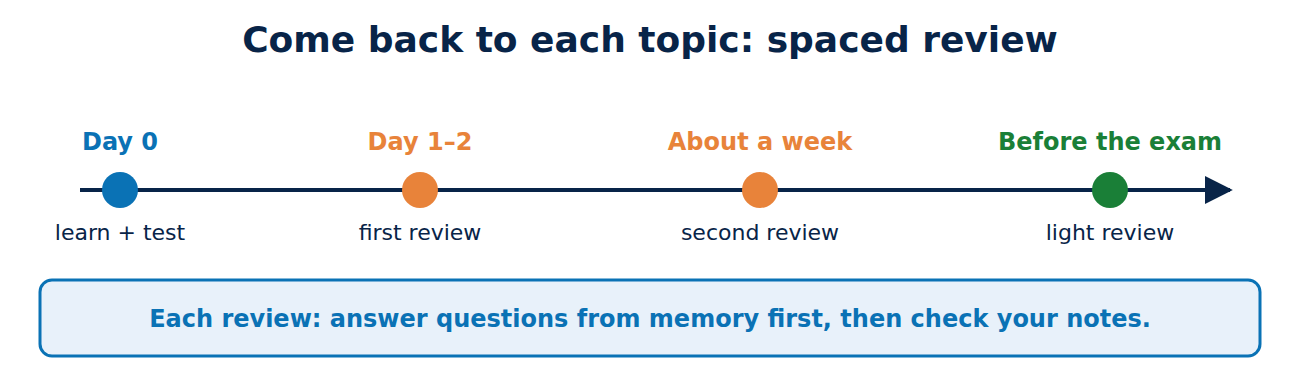
Do not revise a topic once and move on. Come back to it after a day or two, then after about a week, and again before the exam. This spaced repetition is one of the most effective ways to make knowledge stick. In your timetable, mark short review slots for topics you covered earlier.
Step 6: test yourself, do not just reread
Rereading notes and highlighting feel productive but help little. Fill most of your sessions with active methods:
- past papers and practice questions under timed conditions
- flashcards and answering questions from memory (active recall)
- explaining a topic aloud in simple words, as in the Feynman technique
- blank-page summaries: write everything you remember, then check what you missed
Step 7: leave buffer time and rest
- Keep one or two empty slots every few days to catch up when something takes longer.
- Plan at least one half day off per week.
- Protect sleep: memory consolidation happens at night, and all-nighters before exams usually cost more than they gain.
- Plan lighter review the day before each exam rather than new material.
A sample revision week
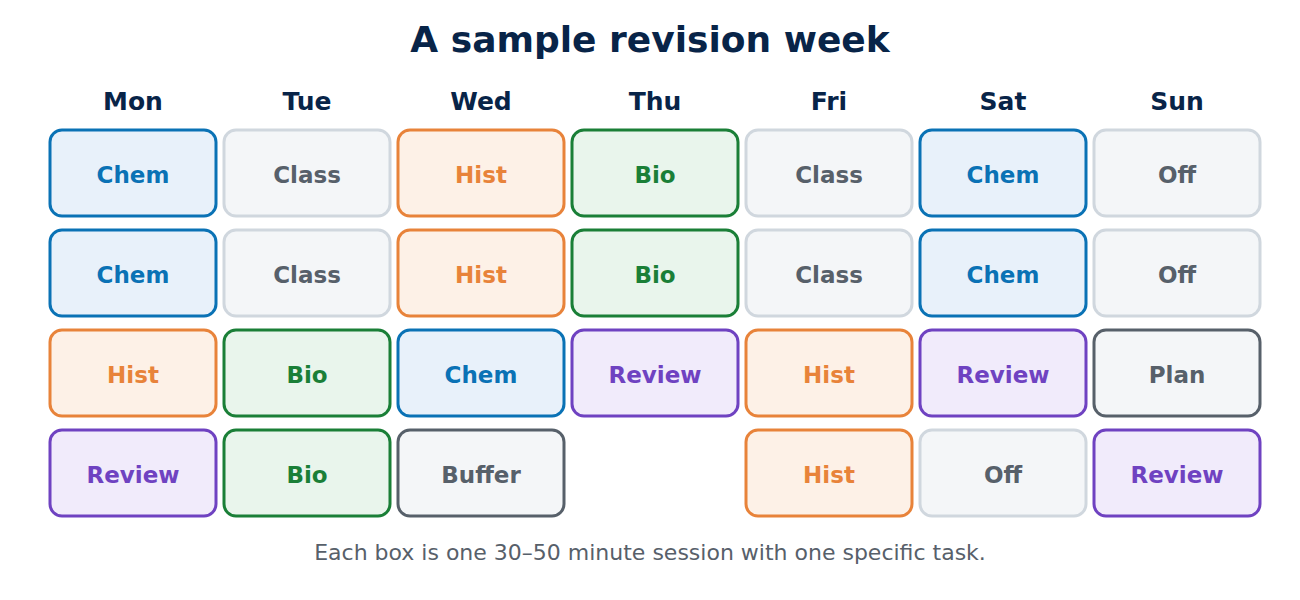
- Monday: Chemistry red topic (2 sessions), History essay plan (1), review Biology from last week (1)
- Tuesday: classes; evening: Biology practice questions (2)
- Wednesday: History past paper (2), Chemistry flashcards (1), buffer (1)
- Thursday: Biology red topic (2), review Chemistry from Monday (1)
- Friday: classes; afternoon: History red topic (2)
- Saturday: timed Chemistry past paper (2), review History (1), evening off
- Sunday: morning off; afternoon: re-rate all topics and plan the next week (1), Biology review (1)
Tools that help
A paper wall planner, a spreadsheet or a calendar app all work; what matters is that you can see the whole period at once. Flashcard apps such as Anki or Quizlet schedule reviews for you, and our list of the best apps for university students includes planners and focus timers.
How to stick to your timetable
- Start each day by checking the plan and setting up the first session before you open your phone.
- Tick off completed sessions; visible progress is motivating.
- If you fall behind, do not throw the plan away. Move the missed session into a buffer slot or drop a green topic.
- Revise with a friend for some sessions, quizzing each other.
Conclusion
A good revision timetable starts with your exam dates and a topic list rated green, amber and red. Count your real study time, plan focused sessions with one specific task each, mix two or three subjects a day, come back to topics at spaced intervals, test yourself instead of rereading, and keep buffers, rest and sleep in the plan. Re-rate your topics every week and adjust.
Sources and further reading
- Improving Students’ Learning with Effective Learning Techniques (Dunlosky et al., 2013, Psychological Science in the Public Interest)
- Studying for and Taking Exams (Cornell University Learning Strategies Center)


















Recent Comments