
Math exams test something different from most other subjects. You cannot pass by reading your notes and memorizing definitions: you need to solve problems you have not seen before, under time pressure. Many students who “understand it in class” are surprised by how hard it feels in the exam. The fix is a study method built around solving problems, not reviewing them.
This guide shows how to prepare for a math exam step by step, from understanding concepts and practicing problems to exam-day strategies and dealing with math anxiety.
Why reading solutions is not enough
Following a worked solution feels easy, because every step makes sense when someone else has done it. But in the exam you must decide which step comes next yourself. That skill only develops by solving problems on your own, getting stuck and working your way out. Studying math means doing math.
Start early and keep up
- Do homework the same week: math builds on itself; a gap in week 3 becomes a wall in week 8.
- Ask early: go to office hours, tutoring or study groups as soon as something does not make sense. See how to email a professor.
- Plan your exam preparation over at least one to two weeks; see how to make a revision timetable.
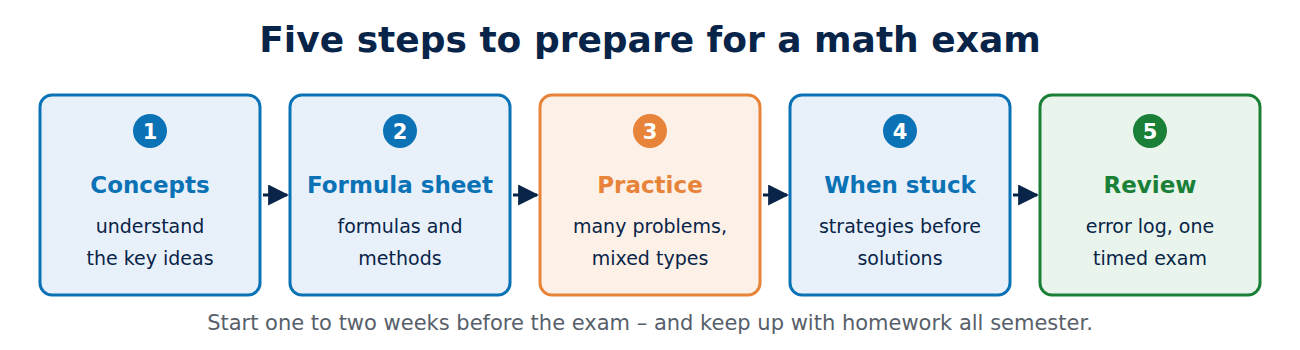
Step 1: understand the key concepts
For each topic, make sure you can explain in your own words what a concept means and when to use it, not just recite the formula. Ask yourself: why does this method work? What would change if a condition changed? Explaining a concept as if teaching a friend, the Feynman technique, quickly shows where your understanding has gaps.
Step 2: make a formula and method sheet
Write one page per topic with the key formulas, definitions, typical problem types and the first step for each. Even if you cannot bring it into the exam, creating it is excellent revision. Then practice recalling it from memory.
Step 3: practice problems, a lot of them
- Redo examples from class without looking at the solution.
- Work through homework and textbook exercises again, especially the ones you got wrong.
- Mix problem types: after learning each topic, practice mixed sets where you must first identify the method. This “interleaving” mirrors the exam.
- Do past exams under exam conditions: timed, with no notes, then grade yourself honestly.
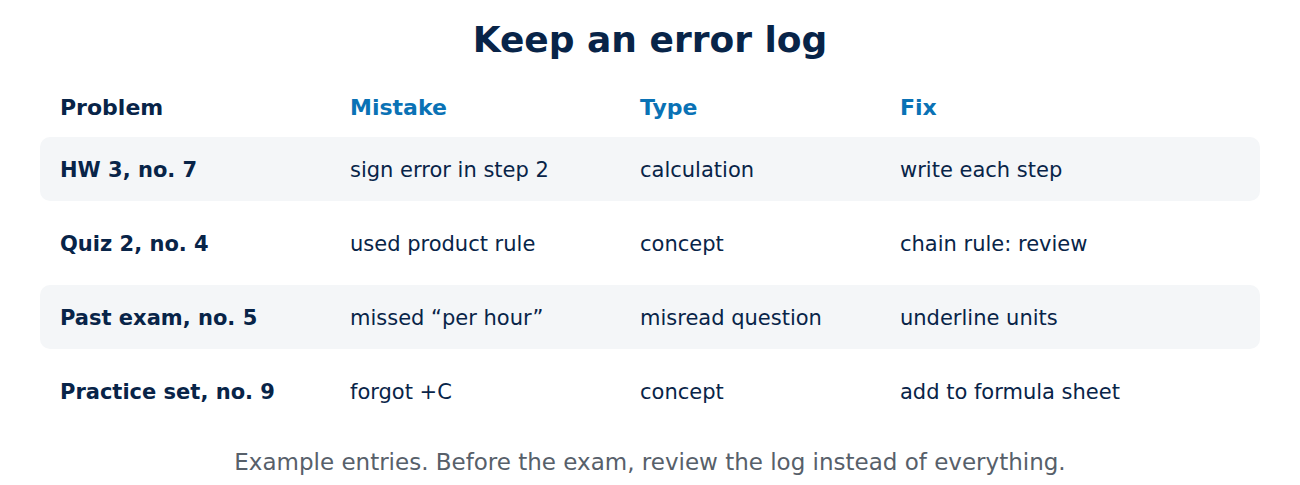
- Keep an error log: write down every mistake, why it happened (concept, calculation, misread question) and the correct approach. Review it before the exam.
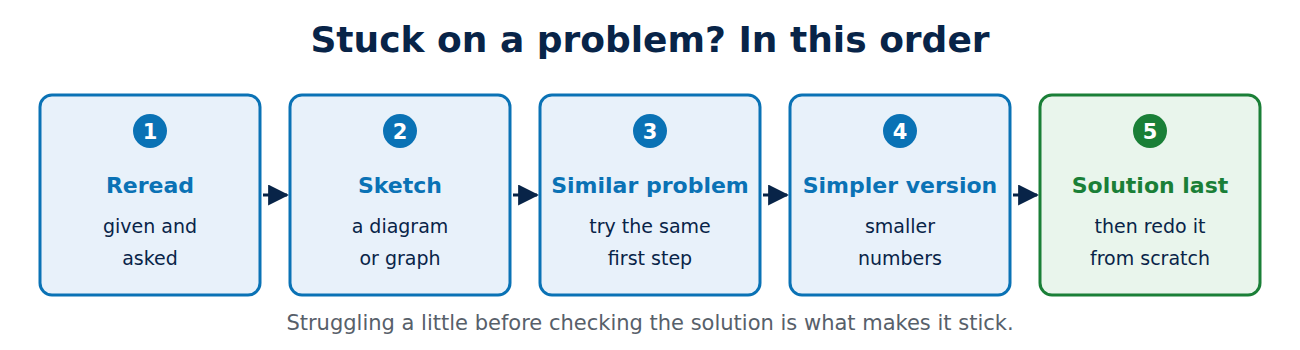
Step 4: when you get stuck
- Reread the question and write down what is given and what is asked.
- Draw a diagram or sketch a graph.
- Look for a similar problem you have solved, and try the same first step.
- Try a simpler version with smaller numbers.
- Only then look at the solution, and afterwards solve the problem again from scratch without it.
Step 5: review smartly in the last days
- Focus on the topics and problem types in your error log.
- Do one last timed practice exam two or three days before.
- Review your formula sheet with spaced repetition.
- Sleep: memory and problem-solving suffer badly after an all-nighter; see sleep tips for students.
Exam-day strategies
- Scan the whole exam first and start with the problems you are confident about.
- Show your work: partial credit is common, and a clear layout helps you spot errors.
- Watch the clock: divide your time by points; do not get stuck on one problem.
- Check units, signs and whether the answer is reasonable.
- Use leftover time to recheck calculations, especially in the problems worth the most points.
Dealing with math anxiety
Math anxiety is common and can block thinking during an exam. What helps: thorough practice under exam conditions, so the situation feels familiar; a few slow breaths before you start; writing down worries for a few minutes before the exam; and starting with an easy problem to build momentum. If anxiety seriously affects your results, talk to your school’s counseling or disability services about support or accommodations, and see dealing with stress in college.
Conclusion
To prepare for a math exam, keep up with homework, make sure you understand why each method works, and above all practice: redo examples without solutions, mix problem types, take past exams under timed conditions and keep an error log. In the exam, start with what you know, show your work and check your answers. Steady practice beats last-minute cramming in math more than in any other subject.
Sources and further reading
- Studying for and Taking Exams (Cornell University Learning Strategies Center)
- Improving Students’ Learning with Effective Learning Techniques (Dunlosky et al., 2013, Psychological Science in the Public Interest)


















Recent Comments