
An annotated bibliography is a list of sources in which each citation is followed by a short paragraph, the annotation, that describes and evaluates the source. Instructors assign it to make you read critically before you write, and it is often the first graded step of a research paper or thesis. Done well, it also saves you a lot of time later, because your research is already summarized and organized.
This guide explains the types of annotations, what to write, how to format an annotated bibliography in MLA and APA, and gives a complete example.
What is an annotation?
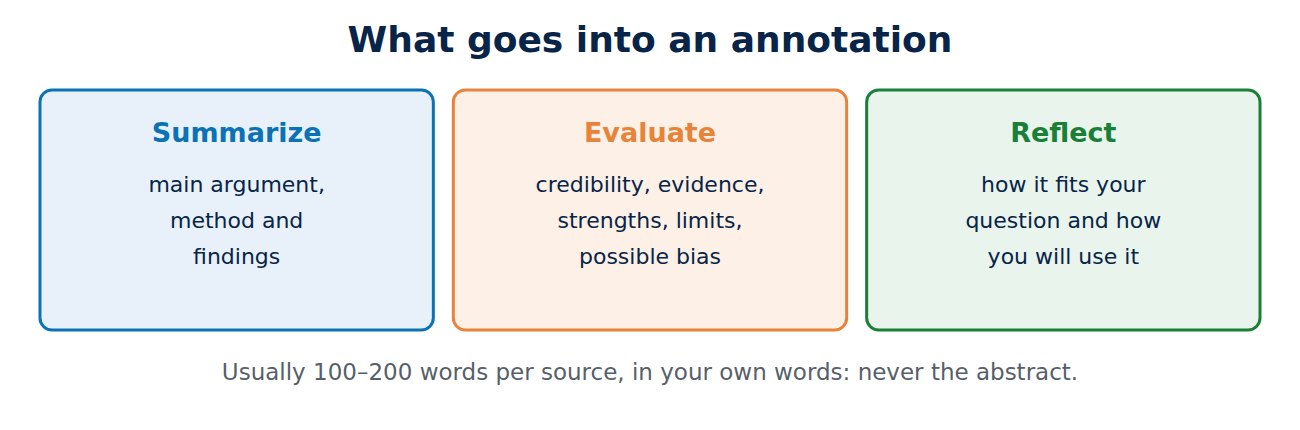
An annotation is usually 100 to 200 words long (check your assignment) and does one or more of three things:
- Summarizes the source: its main argument, method and findings.
- Evaluates it: the author’s expertise, the quality of the evidence, the source’s strengths, limits and possible bias.
- Reflects on its use: how it fits your research question and how you will use it in your paper.
An annotation is different from an abstract: an abstract only describes, while an annotation also judges and connects the source to your own work.
Types of annotated bibliographies
- Descriptive (or informative): summarizes the content without judging it.
- Evaluative (or critical): summarizes and assesses the source’s quality and usefulness. This is what most college assignments want.
- Combined: summary, evaluation and reflection on how you will use the source.
If your assignment does not say, ask; or write a combined annotation, which covers everything.
How to write an annotated bibliography step by step
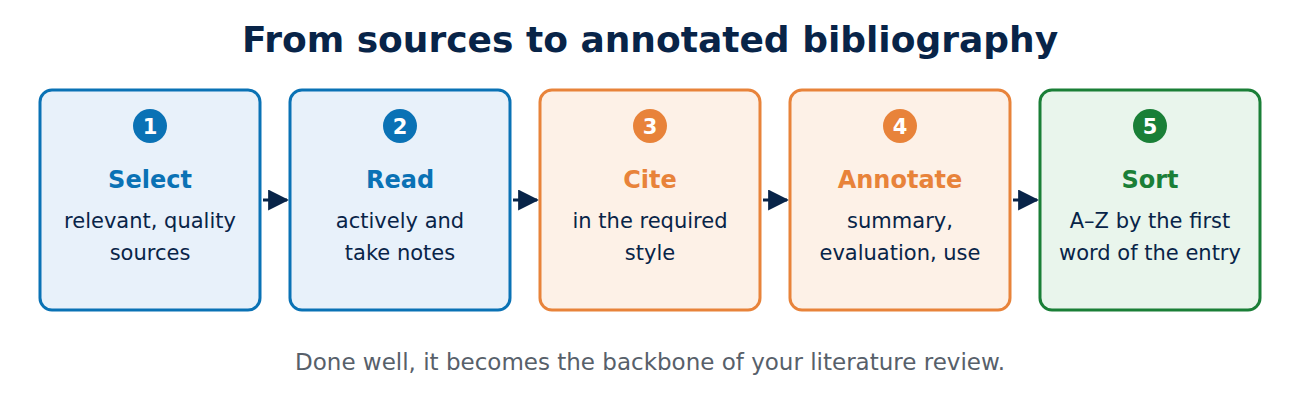
- Find and select sources relevant to your research question: peer-reviewed articles, books and reputable reports. Choose quality over quantity.
- Read each source actively and take notes on the argument, method, evidence and conclusions. For long sources, focus on the introduction, conclusion and the sections most relevant to you.
- Write the citation in the required style (MLA, APA or Chicago).
- Write the annotation below it: start with the summary, then the evaluation, then how you will use it.
- Order the entries alphabetically by the first word of the citation, usually the author’s last name, unless your instructor asks you to group them by theme.
Questions to answer in each annotation
- What is the main argument or research question?
- What method or evidence does the author use?
- What are the key findings or conclusions?
- Who is the author, and why are they credible?
- What are the strengths and limitations (sample size, date, scope, bias)?
- How does it compare with your other sources?
- How will you use it: background, evidence for a point, a counterargument, a method to follow?
Formatting in MLA
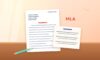
- Title the page Annotated Bibliography (centered).
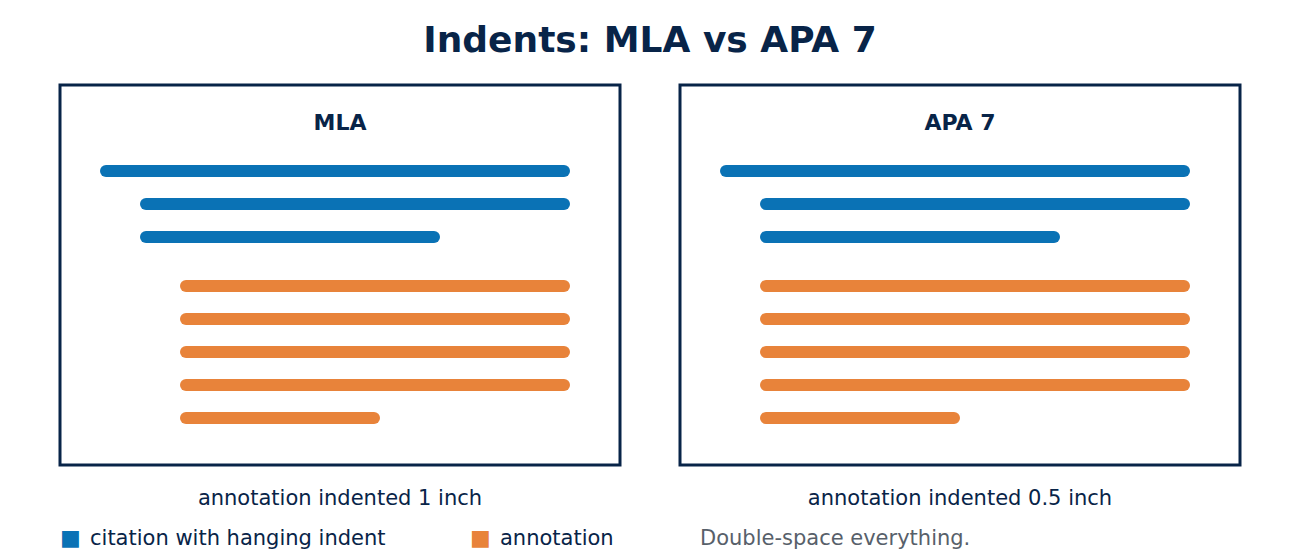
- Write the citation as in a Works Cited list, with a hanging indent of half an inch.
- Start the annotation on the next line, indented one inch from the left margin.
- Double-space everything.
See our MLA citation guide for the citation format.
Formatting in APA 7
- Title the page Annotated Bibliography (centered, bold), or as your instructor specifies.
- Format the reference as in a reference list, with a hanging indent.
- Start the annotation on a new line, indented half an inch (so it lines up with the hanging indent).
- Double-space everything.
See our APA 7th edition guide. In Chicago style, the annotation usually follows the bibliography entry as an indented paragraph; see our Chicago style guide.
Example (APA 7)
Dunlosky, J., Rawson, K. A., Marsh, E. J., Nathan, M. J., & Willingham, D. T. (2013). Improving students’ learning with effective learning techniques: Promising directions from cognitive and educational psychology. Psychological Science in the Public Interest, 14(1), 4–58. https://doi.org/10.1177/1529100612453266
This review by five cognitive and educational psychologists evaluates ten popular learning techniques, from highlighting and rereading to practice testing and distributed practice. For each technique, the authors examine experimental studies across different learners, materials and tasks, and rate its overall usefulness. Practice testing and distributed practice receive the highest rating, while highlighting, rereading and summarization are rated as having low utility. The article’s strengths are its broad evidence base and clear criteria; a limitation is that many studies were conducted in laboratory settings rather than real courses. I will use the review as the main source for the section of my paper on evidence-based study strategies and compare its ratings with newer classroom studies.
Common mistakes
- Only summarizing when the assignment asks for evaluation.
- Copying the abstract. This is not your own work and can count as plagiarism; see how to avoid plagiarism.
- Writing annotations that are much too long or too short for the assignment.
- Including sources you have not actually read.
- Inconsistent citation formatting.
Conclusion
An annotated bibliography lists your sources with a citation and a short paragraph for each: summarize the main argument and evidence, evaluate the source’s credibility, strengths and limits, and explain how you will use it. Follow the required citation style, indent the annotations below each entry, sort alphabetically, and write in your own words. Done carefully, it becomes the foundation of your research paper or literature review.
Sources and further reading
- Annotated Bibliographies (Purdue Online Writing Lab)
- Annotated bibliographies (APA Style)















Recent Comments