
A research paper is more than a long essay. You have to find a question worth answering, gather and evaluate sources, build an argument from evidence and cite everything correctly. It feels overwhelming when you look at it as one huge task, but it becomes manageable when you break it into clear steps.
This guide walks you through writing a research paper from the first idea to the final proofread, with a timeline, a standard structure and tips for each stage.
Step 1: understand the assignment
Read the assignment twice and note: the required length, the citation style (MLA, APA, Chicago), the number and type of sources, the deadline and how it will be graded. Check whether you are expected to write an argumentative paper (you take a position and defend it) or an analytical one (you examine a question from several angles). If anything is unclear, ask your instructor in the first week, not the night before.
Step 2: choose a focused topic
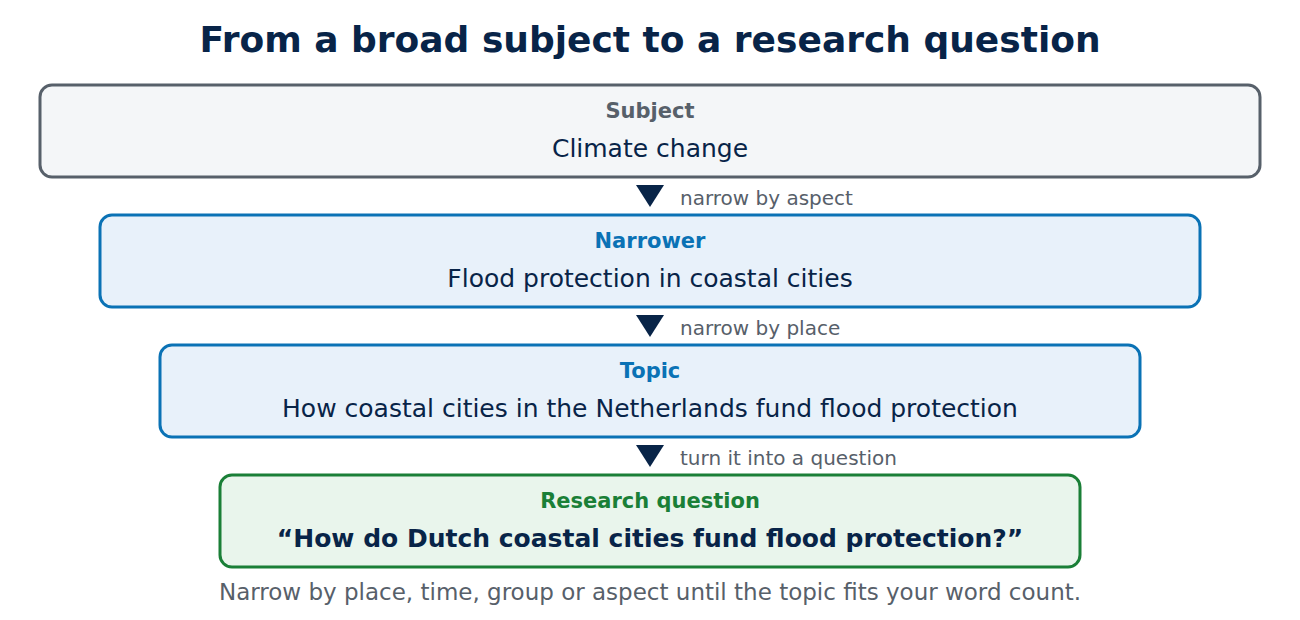
A good topic is interesting to you, has enough reliable sources, and is narrow enough to cover properly in the length you have. “Climate change” is a subject; “how coastal cities in the Netherlands fund flood protection” is a topic. Start broad, do some background reading, then narrow it down by place, time, group or aspect.
Turn the topic into a research question: what exactly do you want to find out? The question guides every later step.
Step 3: find and evaluate sources
- Start with your library: university library databases give you access to peer-reviewed journals, e-books and newspapers that are not free on the web.
- Use Google Scholar to find academic articles and to see who cited a key paper later.
- Use encyclopedias and Wikipedia for orientation only: follow their references to the original sources instead of citing them directly.
- Evaluate each source: who wrote it, is it peer-reviewed or from a reputable publisher, how current is it, and what evidence does it give?
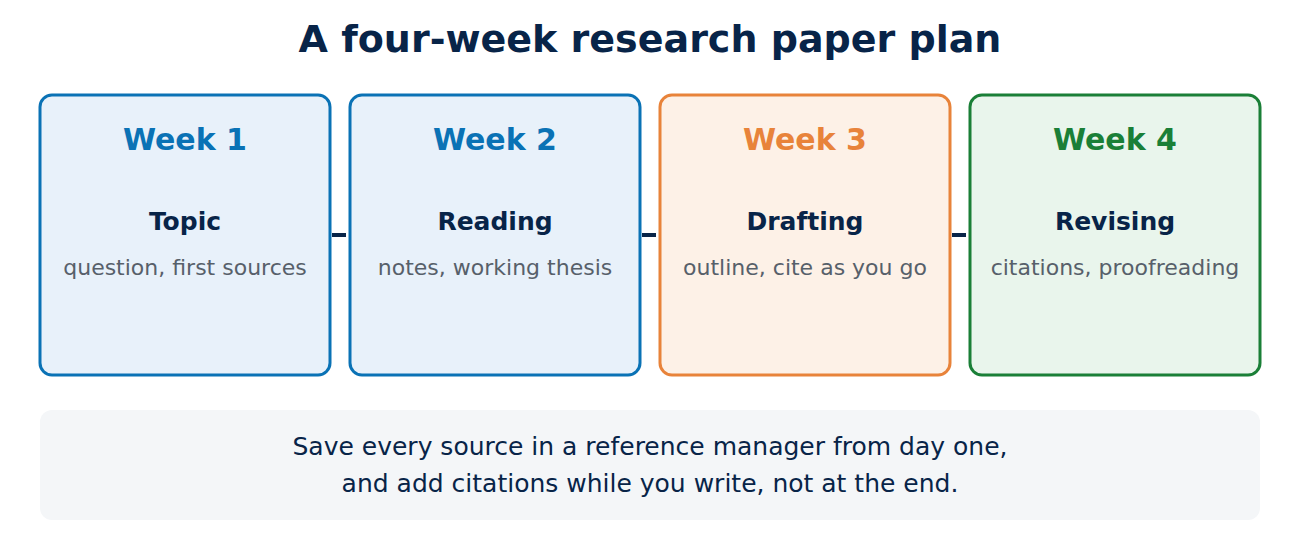
Save every source in a reference manager such as Zotero from the start. It stores the PDF, your notes and the citation details, and creates the bibliography for you later.
Step 4: take notes and develop a thesis
Read actively. For each source, note the main argument, the evidence and page numbers for quotes and key facts, and mark what is your own idea and what comes from the source. Clear notes are the best protection against accidental plagiarism. The Cornell note-taking method works well for readings too.
Once you see patterns in your sources, write a working thesis statement: one or two sentences that answer your research question and that the rest of the paper will support. Our guide on how to write a strong thesis statement shows how.
Step 5: make an outline
Most research papers follow a standard structure:
- Introduction: context, the research question and your thesis.
- Background or literature review: what is already known and where the gap or debate is.
- Body sections: one main point per section, each with evidence from your sources and your analysis of it.
- Counterarguments: address the strongest objections and explain why your thesis still holds.
- Conclusion: answer the research question, summarize the argument and say what it means or what further research could show.
- References: Works Cited (MLA) or References (APA).
Empirical papers in the sciences and social sciences often use the IMRaD structure instead: Introduction, Methods, Results and Discussion.
Step 6: write the first draft
- Start with the body, not the introduction. It is easier to introduce an argument once you have written it.
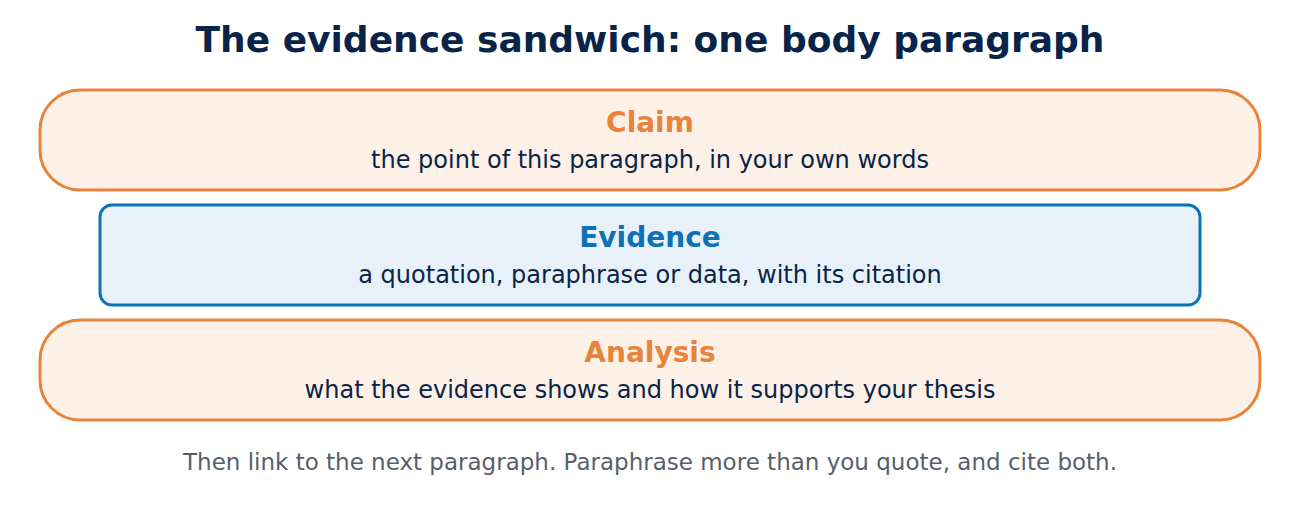
- Use the evidence sandwich: make a claim, present the evidence (quote, paraphrase or data with a citation), then explain what it shows and how it supports your thesis.
- Paraphrase more than you quote, and cite paraphrases too.
- Do not aim for perfection. The goal of a first draft is to get everything down; you will fix the wording later.
Step 7: cite as you write
Add citations while drafting, not at the end, or you will spend hours searching for where a quote came from. Follow the required style exactly. See our guides to MLA format and APA 7th edition. If you use AI tools at any stage, check your course policy first and document how you used them.
Step 8: revise, edit and proofread
- Revise the argument: does every section support the thesis? Is anything missing or repeated? Reorder or cut where needed.
- Edit paragraphs and sentences: clear topic sentences, smooth transitions, no filler.
- Check the citations against your reference list: every in-text citation needs an entry, and every entry must be cited.
- Proofread a day later, reading aloud or on paper, and use your university’s writing center if it has one. Our list of common essay writing mistakes helps you know what to look for.
A realistic timeline
For a paper due in four weeks: week 1 topic, question and first sources; week 2 reading, notes and working thesis; week 3 outline and first draft; week 4 revision, citations and proofreading. Break each week into small daily tasks and protect the time in your calendar.
Conclusion
To write a research paper, understand the assignment, narrow your topic to a clear research question, gather and evaluate reliable sources, take careful notes, develop a thesis, outline, draft, cite as you go and revise in several rounds. Starting early and working in small steps is the single most effective way to write a better paper with less stress.
Sources and further reading
- Research Papers (Purdue Online Writing Lab)
- Google Scholar


















Recent Comments