
Lab reports are a standard part of every science course, from introductory chemistry to engineering labs. They follow a fixed structure, which is good news: once you know what goes into each section, writing them becomes routine. A clear lab report also teaches you how scientific papers are written, a skill you will need in upper-level courses and research.
This guide explains each section of a lab report, what to include and what to avoid, with tips on figures, tables and writing style.
The standard structure
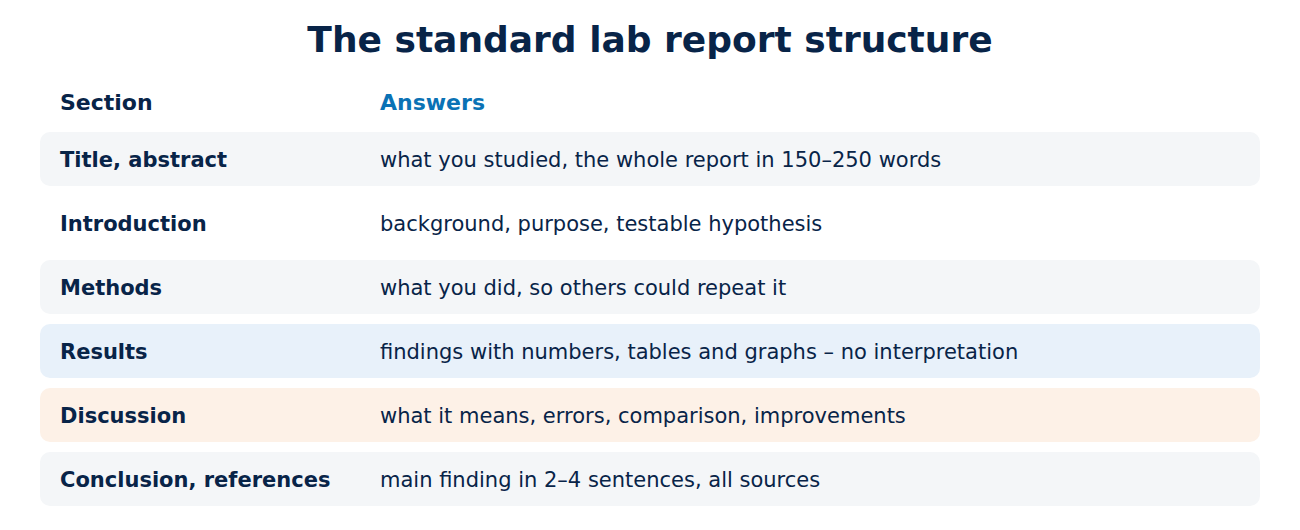
Most lab reports follow the IMRaD format used in scientific journals, with a few additions:
- Title
- Abstract (for longer reports)
- Introduction
- Methods (Materials and Methods)
- Results
- Discussion
- Conclusion (sometimes part of the discussion)
- References
- Appendices (raw data, calculations), if required
Always check your instructor’s or lab manual’s requirements first; they may differ.
Title and abstract
The title says precisely what you studied: “Effect of Temperature on the Rate of Catalase Activity”, not “Lab 4”. The abstract summarizes the whole report in about 150–250 words: purpose, method, key results with numbers and the main conclusion. Write it last.
Introduction
- Explain the scientific background and the concepts the experiment is based on.
- State the purpose or research question.
- State your hypothesis, ideally as a testable prediction: “If temperature increases from 20 °C to 37 °C, catalase activity will increase.”
- Cite sources for background information.
Methods
Describe what you did in enough detail that someone else could repeat the experiment: materials, equipment, quantities, conditions, procedure and how you measured and analyzed the data.
- Write in paragraphs, in the past tense, usually in the passive voice or “we” if your instructor allows it.
- Do not copy the lab manual’s step-by-step list; summarize it and note any changes you made.
Results
Present your findings without interpreting them:
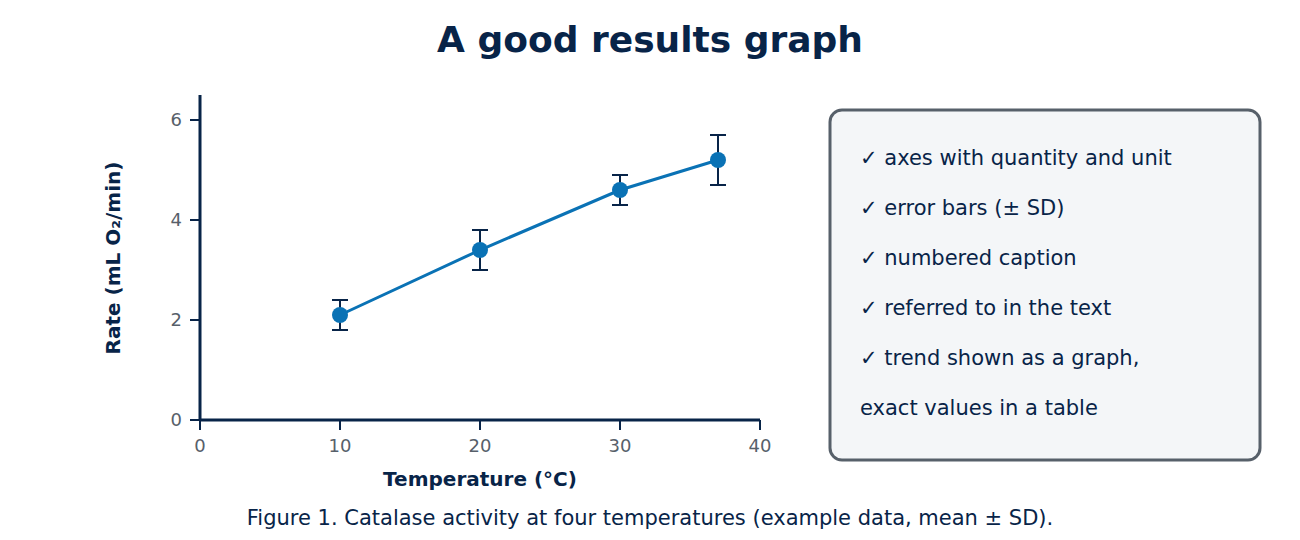
- Summarize the main results in text, with key numbers and units.
- Use tables for precise values and graphs for trends.
- Number every table and figure, give it a descriptive caption, label axes with quantities and units, and refer to it in the text (“As shown in Figure 1…”).
- Include statistics where relevant, for example means, standard deviations and error bars.
Discussion
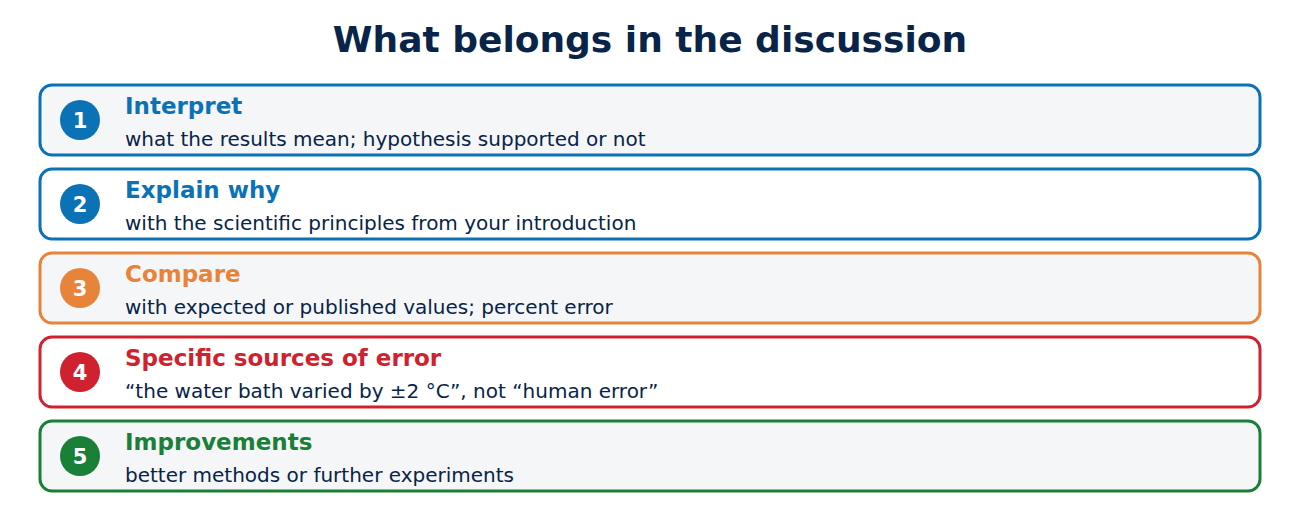
This is the most important section, where you show understanding:
- Interpret the results: what do they mean? Do they support or contradict your hypothesis?
- Explain why, using scientific principles from your introduction.
- Compare with expected or published values, and calculate percent error if appropriate.
- Discuss sources of error specifically: not “human error”, but, for example, “the water bath temperature varied by ±2 °C”.
- Suggest improvements or further experiments.
Conclusion and references
In two to four sentences, restate the main finding and whether the hypothesis was supported. List all sources in the required citation style, often APA or the style of a scientific society such as the ACS for chemistry. See our APA guide.
Writing style tips
- Be precise and concise; avoid filler.
- Use the past tense for what you did and found, the present tense for established facts.
- Report numbers with units and sensible significant figures.
- Write your own report even if you worked in a group; copying a partner’s text is plagiarism. See how to avoid plagiarism.
- Keep your raw data and lab notebook; you may need them for the discussion.
Common mistakes
- Interpreting results in the Results section.
- Graphs without units, labels or captions.
- Vague error analysis (“human error”).
- Claiming the experiment “proved” something; data support or do not support a hypothesis.
- Leaving the report until the night before the deadline, when you no longer remember the details.
Frequently asked questions
Should a lab report be written in past or present tense?
Use the past tense for what you did and found, and the present tense for established scientific facts and for referring to figures (“Figure 2 shows”).
How long should a lab report be?
It depends on the course: from two or three pages for a short report to ten or more for a formal report with an abstract and full discussion.
Can I use “we” in a lab report?
Many instructors and journals now accept “we”, while others prefer the passive voice. Check your lab manual.
Conclusion
A lab report follows a clear structure: a precise title, an abstract, an introduction with background and hypothesis, methods that allow repetition, results presented in tables and labeled graphs, a discussion that interprets the data and analyzes errors, a short conclusion and references. Write while the experiment is fresh, keep results and interpretation separate, and be specific about sources of error. For larger projects, see how to write a research paper.
Sources and further reading
- Scientific Reports (The Writing Center, University of North Carolina at Chapel Hill)
- Writing in Psychology: Experimental Report Writing (Purdue Online Writing Lab)



















Recent Comments