
Vocabulary, anatomy terms, formulas, dates, drug names, definitions: every course has material you simply have to remember. Most students try to memorize by rereading and highlighting, which feels productive but is one of the least effective methods. Memory research offers better tools, and they are not complicated. This guide explains the techniques with the strongest evidence and when to use memory tricks such as mnemonics and the memory palace.
How memory works, in one paragraph
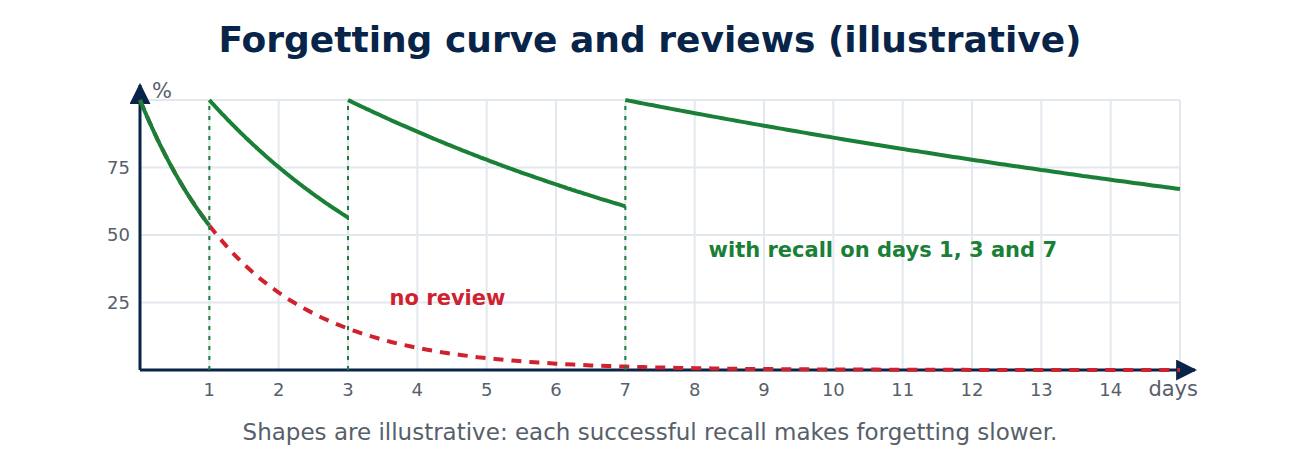
To remember something, you have to encode it (pay attention and connect it to what you know), store it (sleep helps consolidate memories), and retrieve it (bring it back to mind). Every successful retrieval makes the memory stronger and easier to find next time. Forgetting is normal: without review, much new material fades within days, a pattern first described by Hermann Ebbinghaus as the “forgetting curve”. The techniques below fight that curve.
1. Test yourself (active recall)
Instead of rereading, close the book and try to recall. Use flashcards, answer practice questions, write down everything you remember about a topic, or explain it aloud. In a classic study, Roediger and Karpicke (2006) found that students who practiced recalling a text remembered substantially more a week later than students who reread it, even though the rereaders felt more confident. More in why active recall beats rereading.
2. Space it out (spaced repetition)
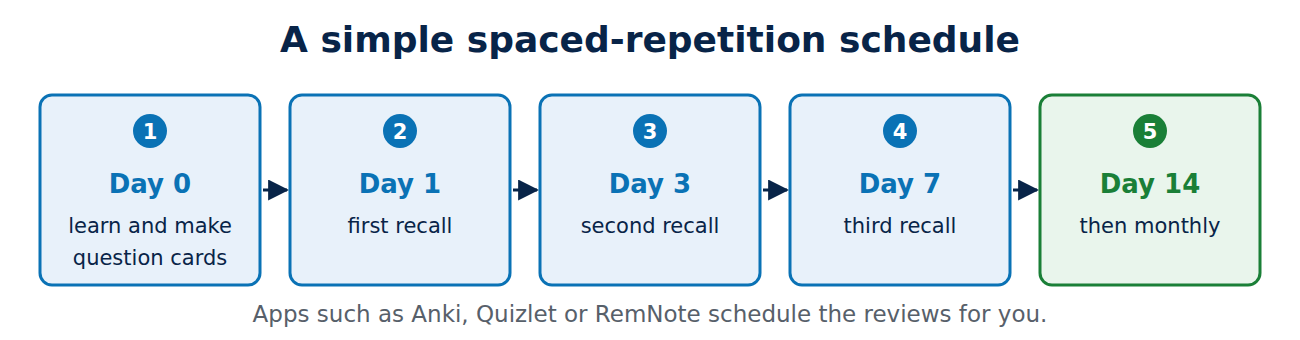
Review material several times with growing gaps: for example after one day, three days, a week and two weeks. Spacing feels harder than cramming, but it produces much longer-lasting memory. Flashcard apps such as Anki (free on most platforms), Quizlet or RemNote schedule reviews automatically. See spaced repetition.
3. Make it meaningful (elaboration)
Facts with connections stick better than isolated facts. Ask “why?” and “how does this relate to what I already know?” Link a new biology term to an everyday example, put dates into a story, and explain concepts in your own words. The Feynman technique is a structured way to do this.
4. Mix and connect (interleaving and dual coding)
- Interleaving: mix related topics or problem types in one session instead of doing one type at a time. It helps you tell similar items apart, for instance different drug classes or integration methods.
- Dual coding: combine words with visuals: draw a diagram, a timeline or a concept map next to your notes.
5. Mnemonics for lists and sequences
Mnemonics are memory tricks for material that has little natural meaning:
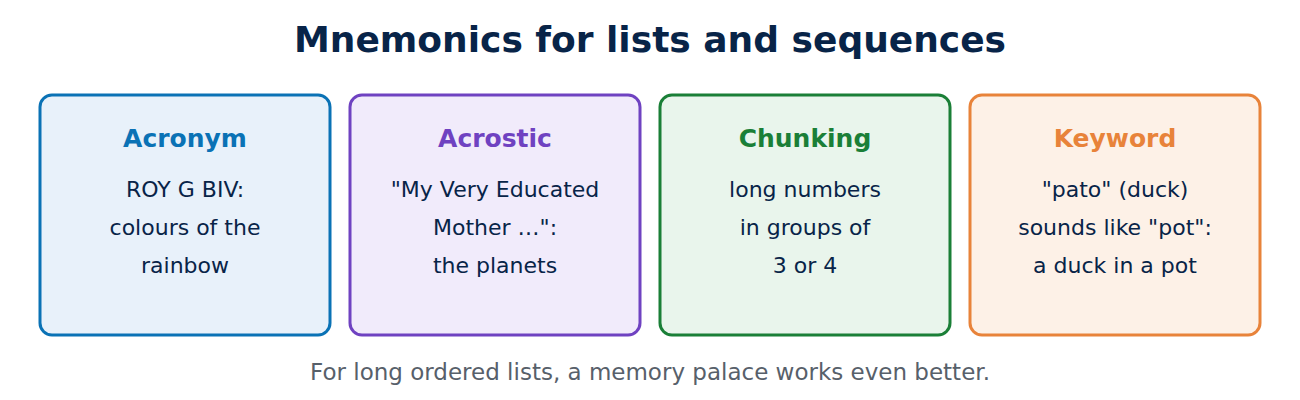
- Acronyms: ROY G BIV for the colors of the rainbow.
- Acrostic sentences: “My Very Educated Mother Just Served Us Noodles” for the planets in order.
- Chunking: group long numbers or lists into chunks of three or four, as with phone numbers.
- Keyword method for vocabulary: link a foreign word to a similar-sounding word in your language and form a vivid image. Spanish “pato” (duck) sounds like “pot”: picture a duck sitting in a pot.
- Rhymes and songs: “In 1492, Columbus sailed the ocean blue.”
6. The memory palace (method of loci)
Memory champions use this ancient technique for long lists. Picture a place you know well, such as your home, and a route through it. Place vivid, exaggerated images of the items at points along the route: the first cranial nerve as a giant nose on your doormat, the second as an eye in the hallway mirror. To recall, walk the route in your mind. It takes practice, but works well for ordered lists, speeches and sequences.
7. Protect your memory: sleep and breaks
Sleep is when the brain consolidates new memories; an all-nighter undoes much of the work. Short breaks during study sessions (for example the Pomodoro technique) keep attention high. Exercise and limiting multitasking help too. See sleep tips for students.
What works less well
- Rereading and highlighting: feels familiar, but familiarity is not recall.
- Cramming: can get you through tomorrow’s quiz, but you will forget most of it within days, and cumulative finals require it again.
- “Learning styles”: research has not found that matching teaching to a preferred style (visual, auditory and so on) improves learning. Use the techniques that suit the material instead.
A sample weekly routine
- After each lecture, make 10–20 flashcards with questions, not just terms.
- Review due cards daily for 15–20 minutes in a spaced-repetition app.
- Once a week, do a blank-page recall of each topic and fill the gaps from your notes.
- Use mnemonics or a memory palace for lists that resist understanding.
Conclusion
The fastest way to memorize is to test yourself, spread reviews over days, connect new facts to what you know and use mnemonics or a memory palace for arbitrary lists. Sleep makes it stick. Replace rereading and cramming with short daily recall sessions and you will remember more in less time. Exams coming up? How to prepare for final exams.
Sources and further reading
- Roediger and Karpicke (2006): Test-enhanced learning (Psychological Science)
- Dunlosky et al. (2013): Improving students’ learning with effective learning techniques (Psychological Science in the Public Interest)
- Six strategies for effective learning (The Learning Scientists)


















Recent Comments