
For many students, college is the first time sharing a room with someone who is not family, often a complete stranger. A good roommate can become a lifelong friend; a bad roommate situation can make a semester miserable. Most conflicts are not about big issues but about everyday habits: noise, cleanliness, guests and sleep. This guide shows how to start on the right foot, set agreements, talk about problems and know when to ask for help.
Before you move in
Once you know who your roommate is, send a friendly message or arrange a video call. Talk about where you are from, your majors and interests, and practical things: who brings the mini-fridge, the microwave (if allowed), a rug or a printer. You do not need to become best friends before you meet; the goal is a good start.
Set up a roommate agreement
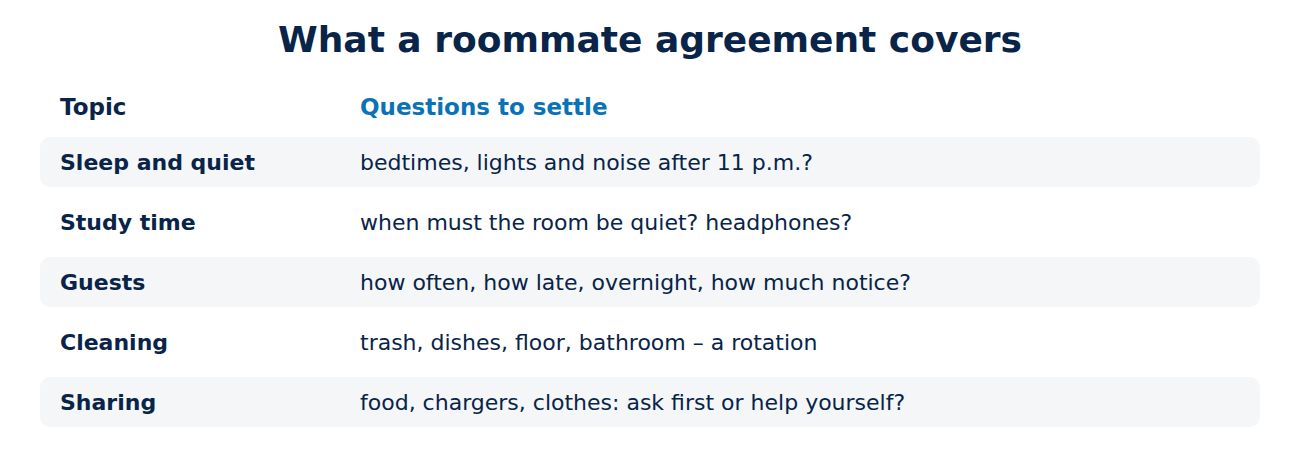
Many residence halls ask roommates to fill out a roommate agreement in the first weeks, often with the RA (resident assistant). Even if yours does not, have the conversation early, before problems appear. Topics to cover:
- Sleep and quiet hours: when do you go to bed and get up? Lights and noise after 11 p.m.?
- Study time: when does the room need to be quiet? Music with headphones?
- Guests: how often, how late, overnight guests and how much notice.
- Cleaning: trash, dishes, floor, bathroom if you share one; a simple rotation helps.
- Sharing: food, clothes, chargers and other things: ask first, or “help yourself”?
- Temperature, lights and windows.
- Alcohol and other substances: in line with campus rules.
- How to bring up problems: agree that you will tell each other directly and early.
Write the agreement down and revisit it after a month; habits change once the semester gets busy.
Everyday habits that keep the peace
- Communicate before acting: “Is it OK if two friends study here tonight?” prevents most guest conflicts.
- Respect sleep: use a small desk lamp and headphones late at night; set your alarm so it does not ring for 20 minutes.
- Clean up after yourself the same day, especially food.
- Respect privacy: give each other alone time in the room, and do not read each other’s things or screens.
- Be friendly, not forced: you can be good roommates without doing everything together. Have your own friends and activities.
How to bring up a problem
Small irritations grow when you keep quiet. Address issues early, in private and calmly:
- Choose the right moment: not when you are angry or when they are about to leave for class.
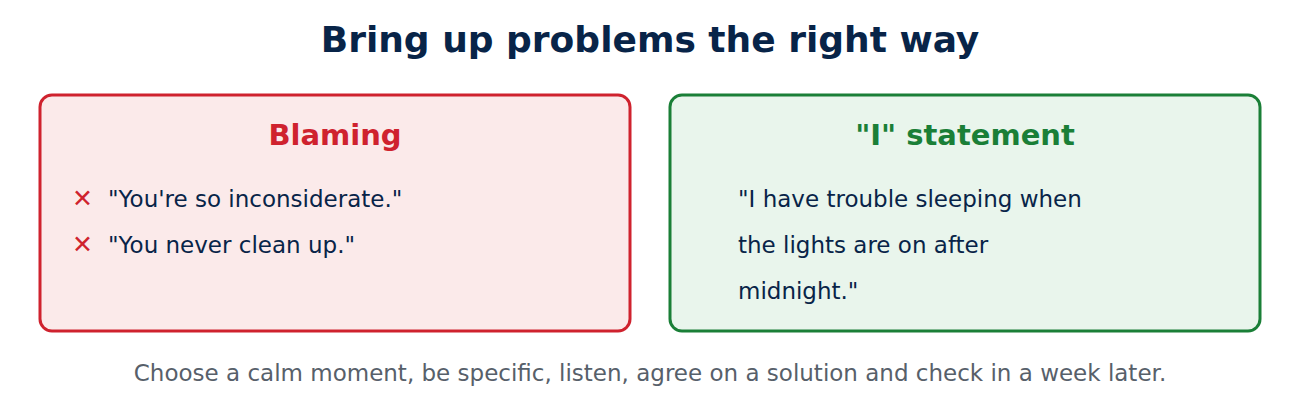
- Use “I” statements: “I have trouble sleeping when the lights are on after midnight” instead of “You’re so inconsiderate.”
- Be specific: describe the behavior, not their character.
- Listen: they may have a complaint too, or reasons you did not know about, such as a night job.
- Agree on a concrete solution and check in a week later.
Avoid passive-aggressive notes, group-chat complaints and talking about them behind their back; these usually make things worse.
Different backgrounds
Your roommate may come from a different country, culture, religion, political view or income level. That can be one of the most valuable parts of college. Ask with curiosity, be open about your own habits, and agree on practical things such as cooking smells, prayer times or visitors in a respectful way.
When to involve your RA
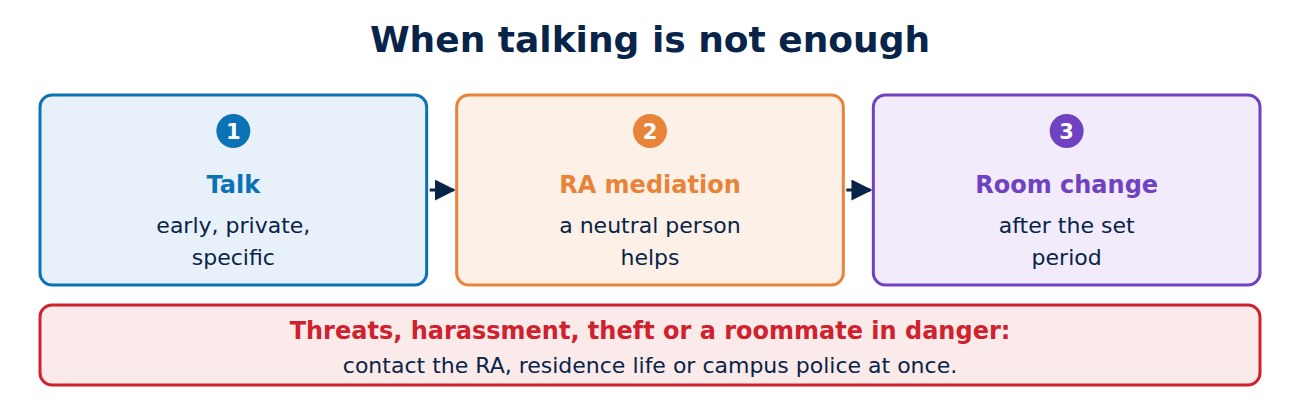
If conversations do not help, ask your RA to mediate. RAs are trained to help roommates find solutions, and a neutral third person often makes a big difference. Housing offices usually allow room changes after a set period, often a few weeks into the semester, once mediation has been tried.
Seek help right away, without trying to solve it alone, if a situation involves:
- threats, harassment, violence or discrimination;
- theft or damage to your property;
- signs that your roommate is in danger, for example from substance use, an eating disorder or talk of self-harm.
Contact the RA, residence life staff or campus police. If a roommate seems to be in crisis, the campus counseling center can advise you; in the US, 988 is available 24/7.
Living off campus
In shared apartments, the same rules apply plus money: agree in writing on rent, utilities, internet and shared groceries, and whose name is on each bill and the lease. Use an app to split expenses. Financial disagreements are a common reason roommate friendships break down.
Related: surviving the shared bathroom, how to deal with homesickness and how to make friends in college.
Conclusion
Contact your roommate before move-in, write a roommate agreement in the first weeks covering sleep, study, guests, cleaning and sharing, and revisit it after a month. Address problems early and privately with “I” statements, ask your RA to mediate when talking does not help, and get help immediately for safety issues.
Sources and further reading
- Conflict resolution (American Psychological Association)
- Mental health resource center (The Jed Foundation)
- 988 Suicide & Crisis Lifeline



















Recent Comments