
College reading lists are long, and many students read every assigned chapter word by word, highlight half of it and still remember little a week later. Reading a textbook is different from reading a novel: the goal is not to get to the end, but to understand and remember the key ideas. A structured method helps you do that in less time.
This guide explains the SQ3R method step by step, how to adapt your reading to the subject, and how to turn reading into lasting knowledge.
Why rereading and highlighting do not work well
Highlighting and rereading feel productive because the text becomes familiar, but familiarity is not the same as being able to recall or explain it. A major review of learning techniques by Dunlosky and colleagues (2013) rated both as low-utility methods, while practice testing and spaced review rated highest. The SQ3R method builds that self-testing into your reading.
The SQ3R method
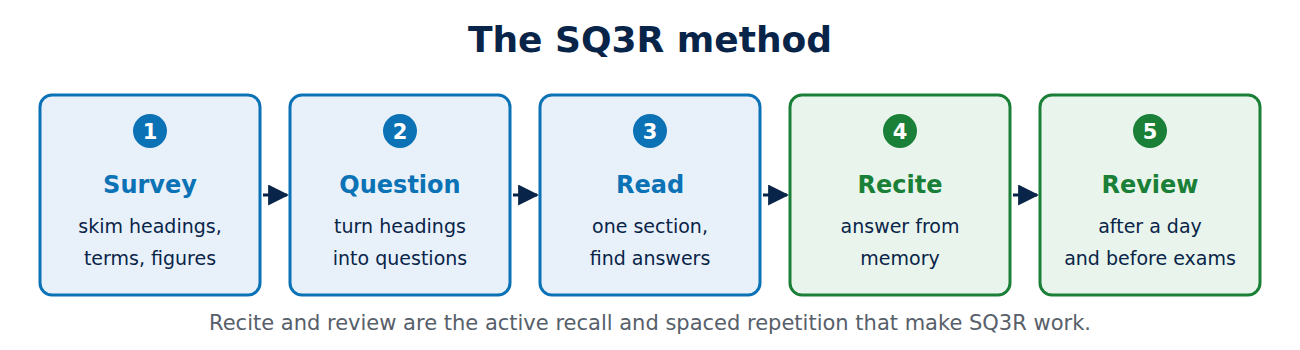
SQ3R stands for Survey, Question, Read, Recite and Review. It was described by psychologist Francis P. Robinson in the 1940s and is still taught by university learning centers today.
1. Survey (5 minutes)
Before reading, skim the chapter: title, introduction, headings, bold terms, figures, summaries and end-of-chapter questions. You build a mental map of what is coming, which makes the details easier to place.
2. Question
Turn each heading into a question. “Causes of the Great Depression” becomes “What caused the Great Depression?” Write the questions down or keep them in mind. Questions give your reading a purpose.
3. Read
Read one section at a time, actively looking for the answers to your questions. Pay attention to examples, graphs and anything the author emphasizes. Slow down on difficult passages; speed up on parts you already know.
4. Recite
After each section, look away and answer your question in your own words, out loud or in brief notes. If you cannot, reread that part. This step is the active recall that makes the method work; see why active recall beats rereading.
5. Review
At the end of the chapter, go through all your questions and answer them from memory. Review again after a day or two and before the exam; this spaced repetition keeps the material in long-term memory.
Taking notes while reading
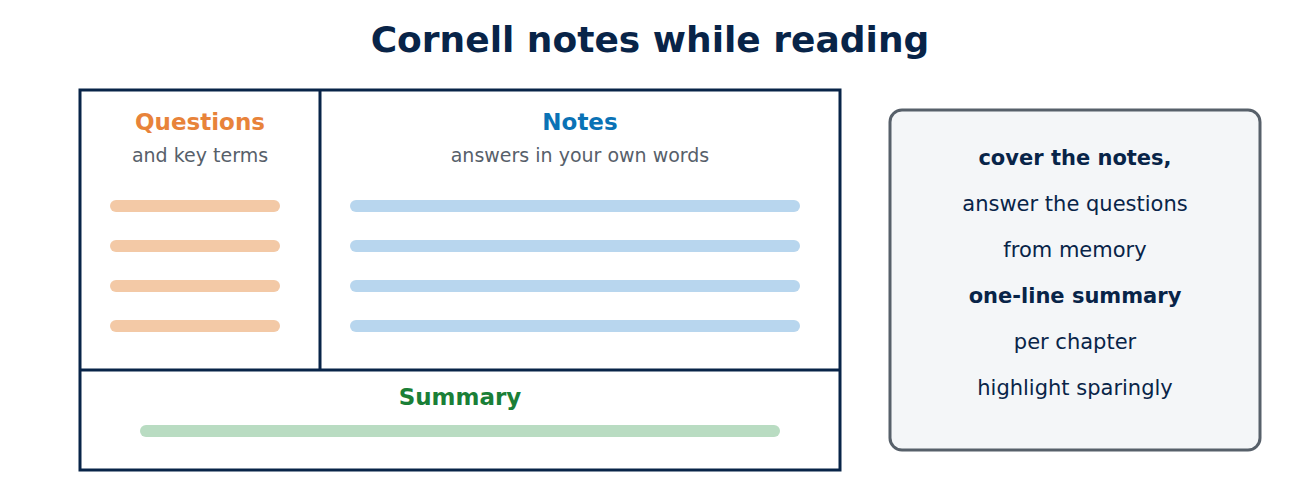
- Write notes in your own words, not copied sentences.
- Use the Cornell format: questions in the left column, answers on the right, a summary at the bottom.
- Highlight sparingly, only after you have read a section, and only key terms or one sentence per paragraph.
- Write a short summary of each chapter from memory.
Adapt to the subject
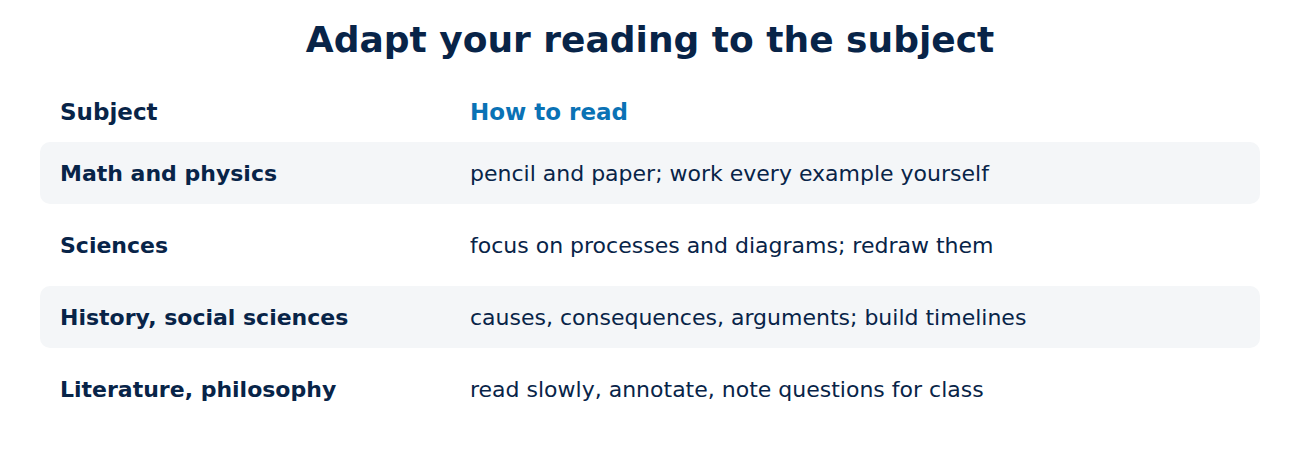
- Math and physics: read with pencil and paper; work through every example yourself before looking at the solution, then try the practice problems. See how to study for a math exam.
- Sciences: focus on processes and diagrams; redraw them from memory.
- History and social sciences: look for causes, consequences, arguments and evidence; build timelines.
- Literature and philosophy: read more slowly, annotate key passages and note your questions for class.
Managing a heavy reading load
- Check what is required: ask which readings are essential for exams and discussions.
- Read before the lecture, at least the survey step, so the lecture fills in the details.
- Schedule reading in focused blocks of 25 to 50 minutes, for example with the Pomodoro technique.
- Remove distractions: phone in another room, one tab open.
- Use digital textbooks wisely: search, adjustable fonts and text-to-speech can help, but avoid switching to other apps.
Frequently asked questions
Is SQ3R still useful today?
Yes. Its core steps, previewing, questioning and recalling from memory, match what learning research shows about active recall and spaced review.
How long does SQ3R take per chapter?
Longer than a single read-through at first, but less than reading twice and rereading before the exam, because you remember more the first time.
Should I highlight while reading?
Sparingly, after reading a section, and only key terms. Recalling and summarizing in your own words is far more effective.
Conclusion
Reading a textbook effectively means reading actively. With SQ3R you survey the chapter, turn headings into questions, read to answer them, recite the answers from memory and review over time. Take notes in your own words, highlight sparingly and adapt the method to the subject. It takes a little longer per chapter at first, but saves hours of rereading before exams.
Sources and further reading
- Studying for and Taking Exams (Cornell University Learning Strategies Center)
- Improving Students’ Learning with Effective Learning Techniques (Dunlosky et al., 2013, Psychological Science in the Public Interest)
- Reading Textbooks Effectively (Learning Center, University of North Carolina at Chapel Hill)

















Recent Comments