
Websites are among the most common sources in student papers, and among the trickiest to cite. Who is the author when there is none? Which date do you use? Do you need the full URL? The answers depend on the citation style, but the logic is the same: give readers enough information to find exactly the page you used.
This guide shows how to cite a website in APA 7, MLA 9 and Chicago 18 with examples, what to do when information is missing, and how to judge whether a website is a good source at all.
The information you need
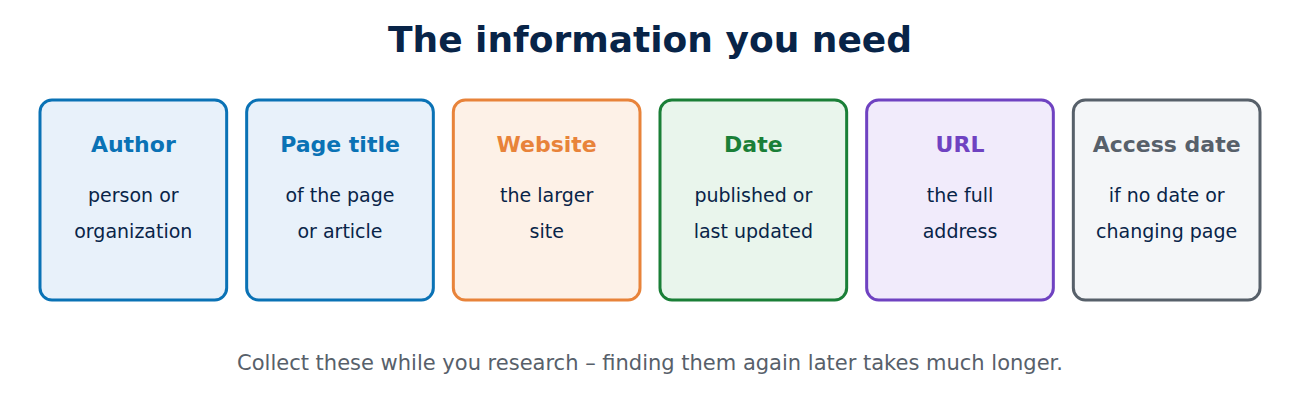
Before you cite, collect these details from the page:
- Author: a person, or an organization if no person is named.
- Title of the page (or article).
- Name of the website (the larger site the page belongs to).
- Publication or last-updated date.
- URL.
- Access date for pages without a date or that change often.
APA 7th edition
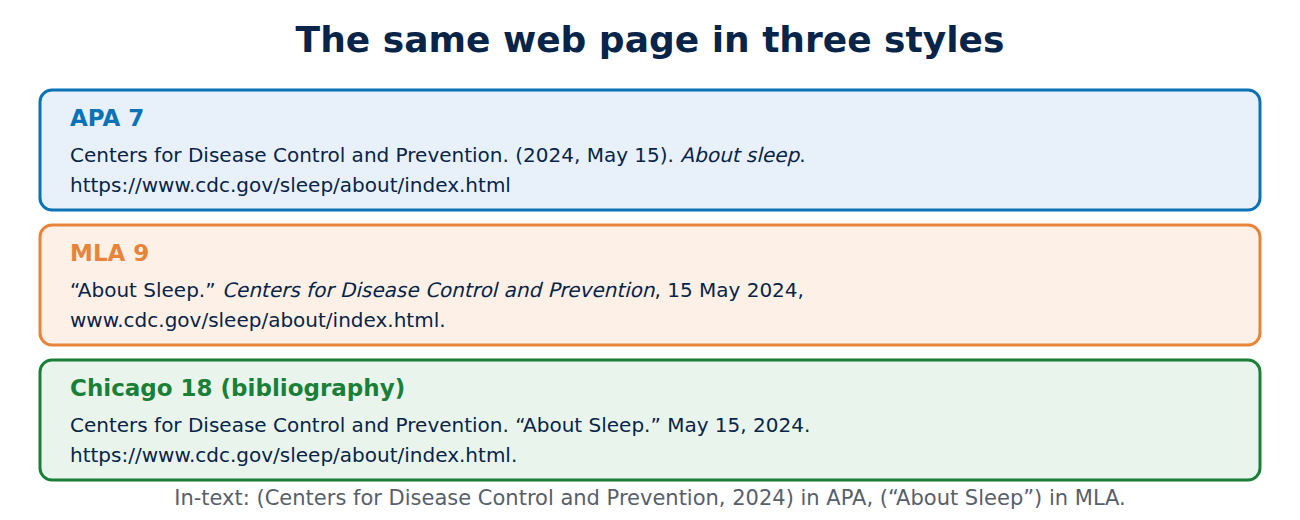
Format: Author, A. A. (Year, Month Day). Title of page. Site Name. URL
Example: Centers for Disease Control and Prevention. (2024, May 15). About sleep. https://www.cdc.gov/sleep/about/index.html
- If the author and the site name are the same, leave out the site name, as in the example.
- No date: use (n.d.) and add a retrieval date for pages that change: “Retrieved October 21, 2026, from https://…”
- In-text: (Centers for Disease Control and Prevention, 2024).
More in our APA 7th edition guide.
MLA 9th edition
Format: Author Last Name, First Name. “Title of Page.” Name of Website, Publisher (if different), Day Month Year, URL. Accessed Day Month Year.
Example: “About Sleep.” Centers for Disease Control and Prevention, 15 May 2024, www.cdc.gov/sleep/about/index.html.
- When an organization is both author and publisher, start with the title.
- MLA recommends dropping “https://” from URLs.
- Add an access date if there is no publication date.
- In-text: a shortened title or author, usually without a page number: (“About Sleep”).
More in our MLA citation guide.
Chicago 18th edition (notes and bibliography)
Note: 1. “About Sleep,” Centers for Disease Control and Prevention, May 15, 2024, https://www.cdc.gov/sleep/about/index.html.
Bibliography: Centers for Disease Control and Prevention. “About Sleep.” May 15, 2024. https://www.cdc.gov/sleep/about/index.html.
Use an access date only if no publication or revision date is available. More in our Chicago style guide.
When information is missing
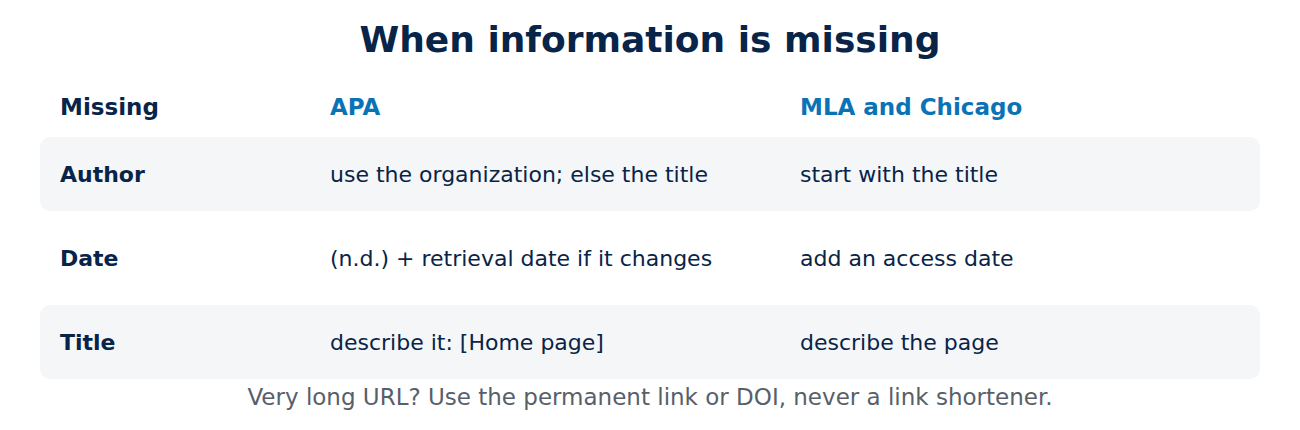
- No author: use the organization; if there is none, start with the title.
- No date: APA uses (n.d.); MLA and Chicago add an access date.
- No title: describe the page in brackets in APA, for example [Home page].
- Very long URL: use the page’s permanent link or DOI if one exists; do not shorten it with link shorteners.
Special cases
- Online news articles: cite like a newspaper article, with the newspaper’s name in italics.
- Online journal articles: cite as a journal article, with the DOI.
- Wikipedia: usually not accepted as a source; follow its references to the original sources.
- Social media and YouTube: each style has its own format with the account name and post date.
- AI chatbots: follow your style’s guidance on generative AI and your course policy; see how to avoid plagiarism.
Is the website a good source?
Check before you cite:
- Authority: who wrote it, and what are their qualifications? Is the organization reputable?
- Accuracy: are claims supported with evidence and sources?
- Purpose: does the site inform, sell or persuade? Watch for bias and advertising.
- Currency: is it up to date for your topic?
Government agencies, universities, established news outlets and professional organizations are usually strong sources; anonymous blogs and content farms are not.
Frequently asked questions
Do I need the URL in a citation?
Yes in APA, MLA and Chicago for web pages. MLA recommends leaving out “https://”, while APA and Chicago keep the full URL.
What is an access date and when do I need one?
The date you viewed the page. Add it when a page has no publication date or is likely to change, following your style guide.
Can I cite Wikipedia?
Most instructors do not accept it as a source. Use it for orientation and cite the original sources it references.
Conclusion
To cite a website, collect the author, page title, site name, date and URL, then follow your style: APA puts the year after the author, MLA ends with the URL and an optional access date, Chicago uses notes and a bibliography. Use the organization as the author when no person is named, handle missing dates correctly, and choose credible sites. A reference manager can store all these details as you research.
Sources and further reading
- Webpage on a website references (APA Style)
- MLA Style Center (Modern Language Association)
- Chicago Style Citation Quick Guide (The Chicago Manual of Style Online)
















Recent Comments