
A literature review is a structured overview of what researchers have already published on a topic. It can be a section of a research paper or thesis, or a stand-alone assignment. Many students write it as a long list of summaries, one source after another, but that is not what instructors are looking for. A good literature review compares and connects sources, shows patterns and debates, and points to the gap your own work addresses.
This guide explains the purpose of a literature review and walks you through searching, reading, organizing and writing it, step by step.
What a literature review does
- Shows what is known: the main theories, findings and methods in the field.
- Shows how sources relate: where researchers agree, disagree or have moved on.
- Evaluates the research: strengths, weaknesses and limitations of studies.
- Identifies a gap: a question that has not been answered well, which justifies your own research question.
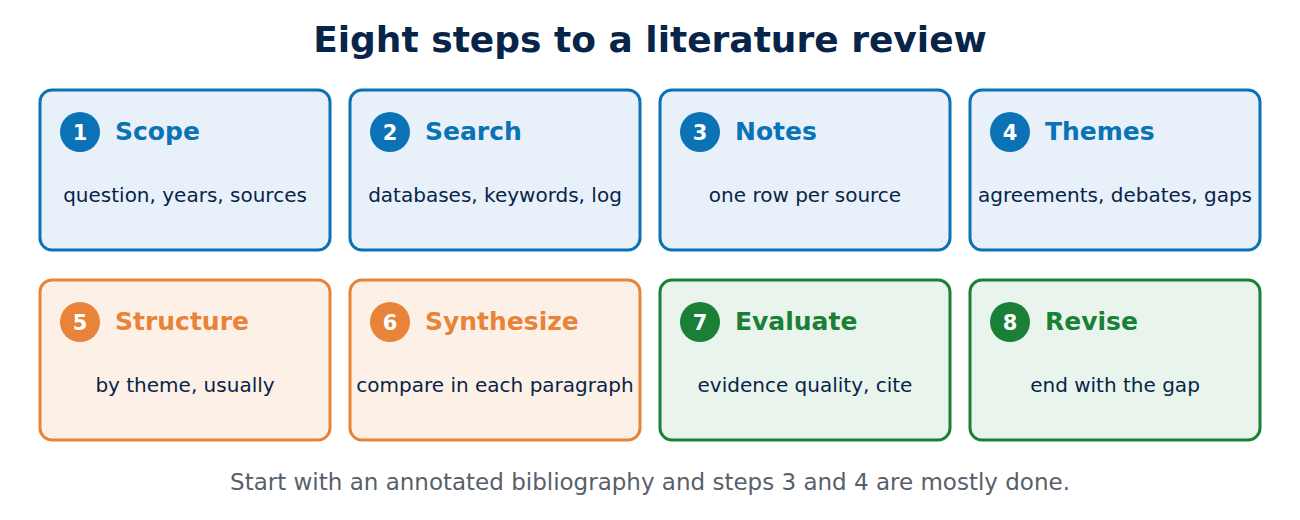
Step 1: define your scope
Start with a focused research question, and decide on boundaries: the time period (for example studies from the last ten years plus classic works), the populations, the regions, the types of sources (peer-reviewed articles, books, reports) and the disciplines. A clear scope stops the search from growing endlessly. See how to narrow a topic in our guide on how to write a research paper.
Step 2: search systematically
- List keywords and synonyms for each part of your question (“online learning” OR “distance education” OR “e-learning”).
- Search your library databases for your field (for example PsycINFO, ERIC, JSTOR, PubMed, Web of Science) and Google Scholar.
- Use filters for date, peer review and document type.
- Follow the citations: check the reference lists of key articles (backward) and who cited them later (forward, with “Cited by” in Google Scholar).
- Look for recent reviews and meta-analyses, which summarize many studies at once.
- Keep a search log of databases, keywords and dates, so you can repeat or explain your search.
Step 3: read and take structured notes
For each source, note the research question, method, sample, key findings, limitations and how it relates to other sources. A spreadsheet or reference manager such as Zotero works well, with one row per source and columns for these points. If you wrote an annotated bibliography first, you already have most of this work done.
Step 4: find themes and patterns
Look at your notes across all sources and ask:
- Which topics, findings or arguments come up again and again?
- Where do studies contradict each other, and why (different methods, samples, contexts)?
- How has thinking changed over time?
- What has hardly been studied?
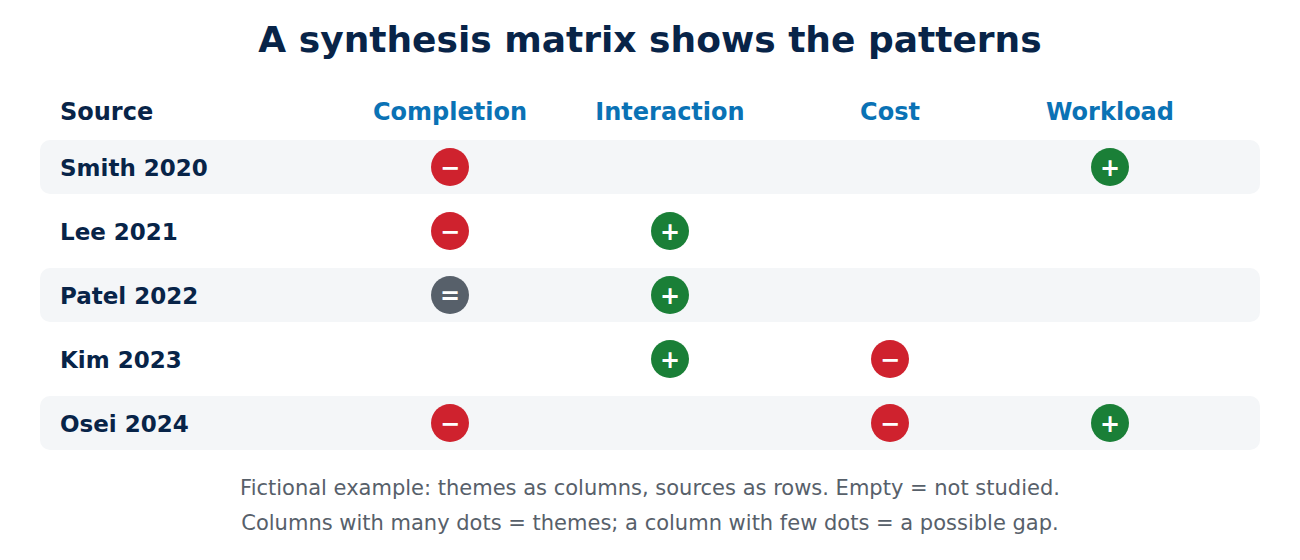
A simple synthesis matrix, with themes as columns and sources as rows, makes these patterns visible.
Step 5: choose a structure
- Thematic: one section per theme or debate. The most common and usually the best structure.
- Chronological: how the research developed over time. Useful when the history of the debate matters.
- Methodological: grouping studies by method (surveys, experiments, case studies) to compare their results.
- Theoretical: comparing the theories or frameworks used in the field.
Whatever structure you choose, the review needs an introduction (topic, scope and why it matters), a body organized by your structure, and a conclusion (main insights, the gap and how your research addresses it).
Step 6: write to synthesize, not summarize
Each paragraph should be about an idea, not a single author. Compare and connect sources within the paragraph:
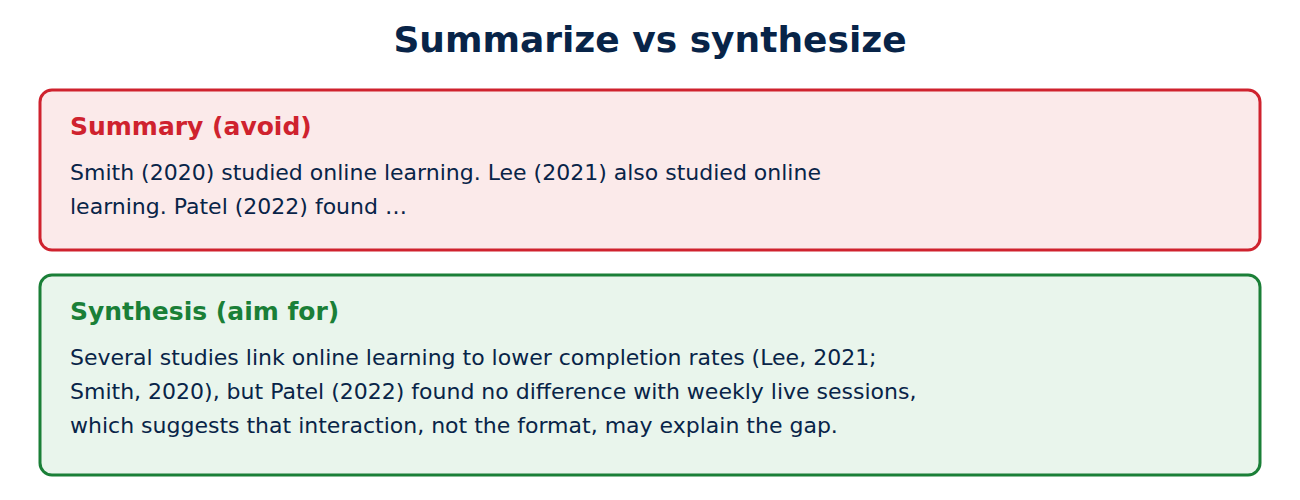
- Summary style (avoid): “Smith (2020) studied online learning. Lee (2021) also studied online learning. Patel (2022) found…”
- Synthesis style (aim for): “Several studies link online learning to lower completion rates (Lee, 2021; Smith, 2020), but Patel (2022) found no difference when courses included weekly live sessions, which suggests that interaction, not the format itself, may explain the gap.”
Use signal phrases that show relationships: “similarly”, “in contrast”, “building on”, “however”, “a limitation of these studies is”.
Step 7: evaluate and cite carefully
Do not only report findings; comment on the quality of the evidence, such as small samples, short time frames or a focus on one country. Cite every source in the required style: APA in most social sciences, MLA or Chicago in the humanities. Paraphrase in your own words and keep track of sources to avoid plagiarism.
Step 8: revise
- Check that every section links back to your research question.
- Make sure the review ends by identifying a clear gap or open question.
- Remove sources that do not add anything.
- Check that recent work is included and that key classic studies are not missing.
- Read the topic sentences only: together they should outline your argument.
Conclusion
A literature review shows what is known about a topic, how studies relate and where the gaps are. Define a clear scope, search databases systematically and log your search, take structured notes, find themes, organize the review by theme rather than by source, synthesize and evaluate in every paragraph, and end with the gap your research will address. Start with an annotated bibliography, and the review will be much easier to write.
Sources and further reading
- Literature Reviews (The Writing Center, University of North Carolina at Chapel Hill)
- Writing a Literature Review (Purdue Online Writing Lab)
- Google Scholar


















Recent Comments