
This article was published in 2021 and updated in October 2026.
Slopes are considered to be an important topic in mathematics, especially in geometry. The slope represents a change of y with regards to x on a straight line. It is the same at every point of a line. But, certainly, this is not the case with a curve line.
So, how do you find the slope of a curve line? It is found by calculating the slope of the secant line passing through two points of the curve.
Above is a graph of the function of x². We drew a secant line to find the slope between point (1,1) and point (2,4).
But what if we wanted to find the slope of a point at the exact point (1,1), the instantaneous rate of change?
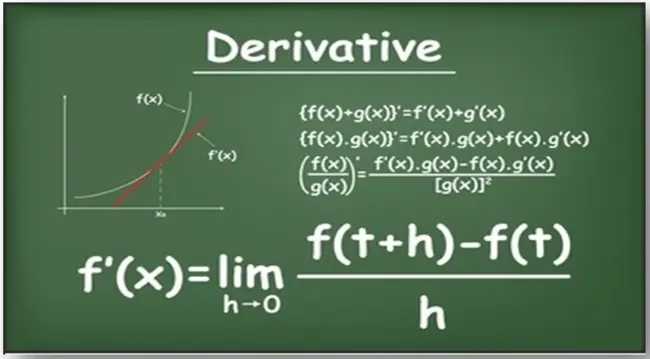
Derivatives – Definition
Derivatives are used to find the slope of a curve line at an exact point. Derivatives can be defined as:
The derivative of a function can be interpreted as the slope of the graph of the function or, more precisely, as the slope of the tangent line at a point.
To calculate a derivative, we start with the slope between two points on the curve — the change in y divided by the change in x.
These points are placed so closely together that the difference between them is almost zero and the secant line between them becomes the tangent line.
Derivatives are notated in three different ways. The most common are Leibniz’s notation (dy/dx), Lagrange’s notation (f′(x)) and Newton’s dot notation, used mainly in physics.
How to solve derivatives?
Hopefully, now your confusion about derivatives and why we use them is clear. Let’s move on to the calculation of derivatives.
There are two main ways by which derivatives are solved. One is formal and the other is an alternate form. We will learn both with general examples. Once you know the method, you can check your answers with a graphing tool such as Desmos, but work through the steps by hand first: that is what exams test.
Differentiation – The Formal One
It will be easy to derive a formula for derivatives while looking at a graph.
Consider any smooth curve y = f(x). We want to calculate the slope between two points on this curve. The first point is at x. As we know y=f(x), we can write the point as (x,f(x)).
We will take the second point at a distance of h from x. The point here will be (x+h,f(x+h)), where h is an arbitrary value. It could be any number.
Slope at this point is:
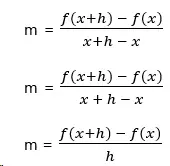
As we want to calculate the slope of the exact point, we will bring the two points so close together that they almost become one point and the difference between them approaches zero.
For this purpose, we will apply a limit on this function. The equation becomes like this:
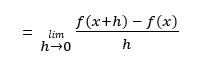
This is what we will call derivative or d over dx (d/dx). Now, we can substitute any value at the place of x.
So this was one way to calculate the derivative or find the slope at a pinpoint. Let’s move on to the second and alternative formula of differentiation.
Usually in calculus, delta x replaces h. Delta (Δ) stands for “change in”; Δx is the change in x, which we let shrink towards zero. The slope formula with delta x is:
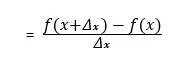
This is quite similar to the first formula. But here instead of adding a distance to x, we will take a whole different point (a,f(a)).
On applying the slope formula, the equation will be:
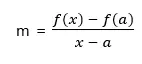
On applying limit:
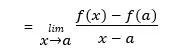
This is the same thing as the formal way. Here, instead of taking a distance h, we took a direct point a. So when x approaches a the distance will be almost zero. And this is exactly what we want to calculate.
Example:
Find the derivative of f(x) = x².
Solution:
Step 1: Add a small distance Δx (written dx here) to x and expand f(x + dx) = (x + dx)².
= (x + dx)²
f(x + dx) = x² + 2x·dx + (dx)²
Step 2: Applying slope formula is:
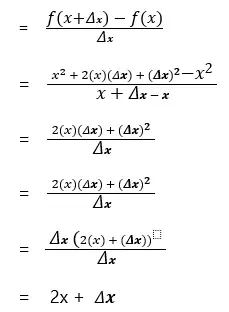
Step 3: Apply limit dx approaches to zero.
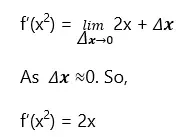
Hence, the derivative of x² is 2x — at any point x, the slope of the tangent to the curve y = x² is 2x.
Differentiation rules: the shortcuts
Working from the limit definition every time would be slow. These rules, all derived from the definition above, let you differentiate most functions in a few lines:
| Rule | Formula | Example |
|---|---|---|
| Constant | \(\frac{d}{dx}\,c = 0\) | \(\frac{d}{dx}\,7 = 0\) |
| Power | \(\frac{d}{dx}\,x^n = n\,x^{n-1}\) | \(\frac{d}{dx}\,x^3 = 3x^2\) |
| Constant multiple | \((c\,f)’ = c\,f’\) | \((5x^3)’ = 15x^2\) |
| Sum and difference | \((f \pm g)’ = f’ \pm g’\) | \((x^2 + x)’ = 2x + 1\) |
| Product | \((uv)’ = u’v + uv’\) | \((x^2 \sin x)’ = 2x \sin x + x^2 \cos x\) |
| Quotient | \(\left(\frac{u}{v}\right)’ = \frac{u’v – uv’}{v^2}\) | \(\left(\frac{x^2+1}{x}\right)’ = \frac{x^2-1}{x^2}\) |
| Chain | \(\big(f(g(x))\big)’ = f'(g(x))\,g'(x)\) | \(\big((3x+1)^5\big)’ = 15(3x+1)^4\) |
You also need the derivatives of a few standard functions: \((\sin x)’ = \cos x\), \((\cos x)’ = -\sin x\), \((e^x)’ = e^x\) and \((\ln x)’ = \frac{1}{x}\).
Example: a polynomial
Find the derivative of \(f(x) = 3x^4 – 5x^2 + 7\).
Differentiate term by term with the power, constant multiple and constant rules: \(f'(x) = 12x^3 – 10x\).
Example: the chain rule
Find the derivative of \(\sin(x^2)\). The outer function is \(\sin\), the inner function is \(x^2\). Differentiate the outer function and keep the inside, then multiply by the derivative of the inside: \(\cos(x^2) \cdot 2x = 2x\cos(x^2)\). For more examples, see the chain rule explained step by step.
How to approach any derivative
- Identify the structure: a sum of terms, a product, a quotient, or a function inside another function.
- Apply the matching rule from the outside in.
- Use the power rule and the standard derivatives for the individual pieces.
- Simplify, and check the result: at a point where the graph rises, the derivative should be positive.
Insight – Implicit Differentiation
Now that you can find derivatives, let us look at implicit differentiation, which uses the chain rule from the section above.
An implicit equation is one that is not written in the form y = f(x) — for example, x² + y² = z² describes a circle, and y is not isolated on one side.
Implicit differentiation is simple differentiation except that it is performed on both sides of the equation.
Example
Differentiate this implicit equation:
x² + y² = z²
Where z is constant.
Solution:
Step 1: Apply derivative.
d/dx (x²) + d/dx(y²) = d/dx(z²)
Step 2: Solve left hand side.
= d/dx (x²) + d/dx(y²)
= 2x + 2y(dy/dx) … applying chain rule.
Step 3: Solve right hand side.
The derivative of constant numbers is 0.
= d/dx (z²)
= 0
Step 4: put the values in the equation.
2x + 2y(dy/dx) = 0
2y(dy/dx) = -2x
y(dy/dx) = -x
dy/dx = -x/y
So, on performing differentiation on equation x² + y² = z², we got dy/dx = -x/y (valid wherever y ≠ 0).
Common mistakes
- Forgetting the chain rule: \((3x+1)^5\) is not \(5(3x+1)^4\); the inner derivative 3 is missing.
- Multiplying derivatives in a product: \((uv)’\) is not \(u’v’\). Use the product rule.
- Dropping constants incorrectly: a constant added to a function disappears (its derivative is 0), but a constant multiplying a function stays.
- Sign errors in the quotient rule: the numerator is \(u’v – uv’\), in that order.
Where derivatives are used
Derivatives describe how fast something changes. The derivative of position with respect to time is velocity, and the derivative of velocity is acceleration. Economists use derivatives to find the output with maximum profit, engineers to optimize shapes and loads, and biologists to model population growth. Whenever you need the highest or lowest point of a curve, you set the derivative equal to zero.
Conclusion
A derivative is the slope of a curve at a single point, defined as the limit of the slope between two points that move closer and closer together. With the limit definition you understand where the rules come from; with the power, product, quotient and chain rules you can solve most exercises quickly. Practice each rule on its own first, then mix problem types. For related topics, see the quadratic formula, derived step by step.
Sources and further reading
- Derivative (Wikipedia)
- Differentiation rules (Wikipedia)
- Calculus Volume 1, Chapter 3: Derivatives (OpenStax)


















Recent Comments